Santiago's Commitment Against Transnational Organized Crime: Opportunities and Limitations
This article was translated automatically and may contain differences from the original. For reference, read the original.
- por Diego Sazo
- Análisis
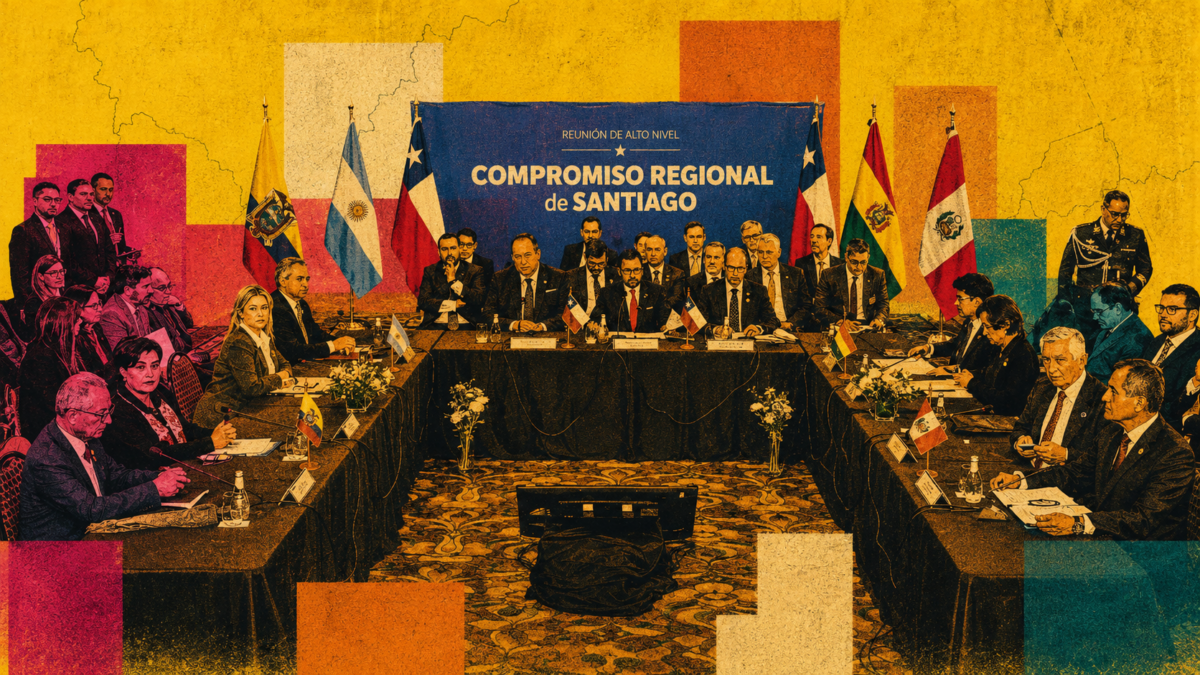
On May 28, 2026, Santiago hosted a regional summit against transnational organized crime. The meeting, led by the Chilean Ministry of Foreign Affairs, brought together foreign ministers and interior and security ministers from Argentina, Bolivia, Ecuador, and Peru.
For the government of José Antonio Kast, the event demonstrated that the security agenda serves not only as a priority domestically but also as a means of international positioning. This comes at a time when criminal violence, illicit economies, and pressure on borders have become among the main concerns of citizens in the region.1.
The significance attributed to the meeting came from the Chilean government itself. In his opening speech, President Kast described the event as “historic”2, suggesting it could mark a “turning point” in the fight against transnational crime. Regardless of whether this was a metaphor or hyperbole, the fundamental question is whether the summit (called the Santiago Regional Commitment) will succeed in transforming that ambition into effective coordination among countries, with verifiable results and a timeline extending beyond current administrations.
2. Overview of Transnational Organized Crime and Insecurity in South America
The summit in Santiago had precedents that justified its convening. The most critical is the increase in criminal violence and the use of firearms in the region over the past decade3. Although national trajectories have been different, homicide violence has ceased to be a problem concentrated in a few countries and has begun to spread, with varying intensity, to societies that until recently were considered relatively safe, such as Ecuador, Peru, Uruguay, and Chile4. This has heightened pressure on governments and favored urgent responses, often more reactive than evidence-based.

Source: Own elaboration based on Insight Crime (2025)
A second precedent is the expansion, fragmentation, and diversification of illicit markets. Drug trafficking remains the most visible axis in South America, particularly due to the regional weight of cocaine. However, organized crime can no longer be understood solely as a dispute among large cartels over routes, shipments, and territories. Its current operation combines smaller, more flexible structures, operating through a wide range of activities, such as financial crimes, money laundering, smuggling, human trafficking, arms trafficking, cybercrime, and logistical networks that connect local actors with transnational organizations5. Today, therefore, the threat does not solely reside in the existence of gangs but in the capacity they have developed to adapt, buy influence, outsource functions, and exploit control gaps between countries.
The third precedent is institutional fragility in the face of networks that exploit control gaps. In Latin America, organized crime not only challenges the state from the outside. It also infiltrates institutions, regulates territories, imposes informal rules, and disputes basic functions of authority, which erodes the rule of law6. For Chile, this vulnerability has a concrete territorial expression: it shares 5,308 kilometers of land border with Argentina, 26 border crossings, and various unregulated crossings7. In this context, regional cooperation ceases to be a diplomatic gesture and becomes a minimum condition to contain criminal advancement.
3. The Santiago Regional Commitment 2026: main agreements
The summit in Santiago concluded without major developments. The five participating countries agreed to classify transnational organized crime as a central threat to stability and democratic governance in the region. They also shared the premise that in the face of a challenge that does not respect borders, isolated efforts are insufficient and require a regional response that is “articulated, coordinated, sustained, and effective”8. The final declaration confirms that the main agreement of the meeting was the establishment of a Working Group composed of the five countries, which will be responsible for developing a Joint Action Plan against transnational crime.

Source: Own elaboration.
Four main areas were defined for discussion: security, financial and tax intelligence, migration control, and border control. Although the details of each area are as broad as they are generic, the goal—reiterated insistently by the host authorities—is for the plan to translate into concrete, measurable, and verifiable measures. The declaration instructs that the first working meeting must take place within the next three months, while the review of progress will have a six-month deadline. The final plan will be submitted for approval by the foreign and security ministers of the signing countries, although the declaration does not establish a minimum number of working meetings or a specific timeline for that approval.
4. Opportunities
The evaluation of a security summit cannot be limited to recording what was declared. The relevant question is whether the mechanism created opens real conditions for effective coordination, verifiable results, and institutional projection beyond the initial impetus. From this perspective, the Santiago Regional Commitment offers three concrete opportunities.
The first is the formal creation of a multilateral Working Group. Although its scope will depend on how it operates in practice, its existence can begin to address a recurring structural problem in regional cooperation: the absence of a stable technical space where national agencies can coordinate. Comparative evidence shows that sustained police and judicial cooperation does not arise from declarations but from intermediate structures that allow for the accumulation of trust, standardization of procedures, and construction of shared intelligence. The Working Group created in Santiago is not comparable in resources or institutional capacity to experiences like Europol, SIENA, or European Joint Investigation Teams. However, it establishes a formal space that, if it manages to meet regularly, can become more than just a diagnostic forum.
The second opportunity is the inclusion of financial and tax intelligence as a priority line in the Joint Action Plan. This inclusion is not trivial. Various studies9 recognize that combating organized crime cannot rely solely on punishing individuals, as these organizations can easily replace operators. Criminal policy must also target the capital that finances new operations, infiltrates legal economies, and corrupts institutions. Instruments such as the Palermo Convention and the standards of the Financial Action Task Force (FATF) have shifted part of the focus toward assets and financial flows precisely because weakening the material base of crime is as decisive as pursuing its operators. The challenge will be to translate that priority into concrete mechanisms for information exchange, financial traceability, and asset recovery among the five countries.
The third opportunity is that periodic meetings among technical counterparts can open space to incorporate dimensions that are still absent, such as economic development and social cohesion. Criminal prosecution and border control are necessary but insufficient when criminal economies are anchored in the territories. In countries with fragile states and accelerated economic development10, drug trafficking has persisted for decades as part of a political economy of the border, where poverty, institutional absence, and illicit markets reinforce each other. A similar situation occurs with criminal enclaves11, which arise where exclusion and low state presence allow crime to provide protection and control territories. The Santiago Commitment does not currently contemplate this approach. However, if the Working Group manages to consolidate and build trust among its members, there is a possibility of expanding the agenda to include these factors.
5. Limitations
This summit also poses challenges for the Kast government. Like the promises made in the security realm during the presidential campaign, the Santiago Commitment is born with high ambitions in the fight against crime. However, as shown in the first two months of governance, turning a political aspiration into concrete results requires planning that connects objectives, means, and institutional capacities. Regional experience shows that security initiatives can easily multiply, but only a few manage to produce added value. This will be the central test for the new mechanism. From the declaration, three limitations are identified.
The first limitation is that the Santiago Commitment is framed as a selective international cooperation space. The exclusion of key countries, such as Colombia, Brazil, and Mexico, limits the strategic density of the initiative from the outset, as three of the main nodes where criminal logistics operate in the region (cocaine production, transit and laundering, and distribution, respectively) are left outside the mechanism. Thus, what happened in Santiago replicates the recent experience of the Shield of the Americas in March 202612, where a security coalition was established only among ideologically aligned governments. When cooperation is organized by political proximity rather than criminal relevance, regional coordination becomes biased and fragmented. While the declaration leaves the invitation open to future participants, it does not eliminate the initial signal of selectivity or the distrust it may generate among excluded actors. A mechanism against transnational markets cannot consolidate as a partial block. Rather, it must broaden its base, add critical capacities, and avoid allowing regional security to become trapped in the logic of ideological cycles.
The second limitation of the summit is the omission of causal factors in the expansion of organized crime. The lines of work of the Commitment do not center on two decisive issues, such as drug trafficking and arms control, and leave corruption at a more declarative than operational level. These are not peripheral matters. Drugs generate extraordinary profits, arms elevate the coercive capacity of these groups, and corruption opens institutional doors to move shipments, launder assets, or capture authorities. In the recent trajectory of Ecuador13, the dispute over cocaine routes, ports, and prisons accelerated a crisis of violence that the state failed to contain in time. Thus, an intelligent strategy against crime must pursue and punish gangs, but also intervene in the conditions that make them profitable, with access to weapons and political protection.
The third limitation is the duplication of efforts with existing instances. The region does not start from scratch in anti-crime efforts. The Commitment itself recognizes the accumulated experience in Mercosur and the Resolutive Action Plan of the Andean Community (in which Chile does not fully participate), and warns of the need to articulate initiatives to avoid duplications. This is compounded by spaces such as CLASI-UE, EL PAcCTO, AMERIPOL, and initiatives from the Inter-American Development Bank. The problem, so far, is not the lack of forums but the difficulty in converting them into sustained coordination with concrete results. If the new Working Group replicates diagnostics, agendas, and meetings already available, its added value will be low.
6. Conclusions
In Latin America, previous experiences of joint work against organized crime suggest approaching the Santiago Regional Commitment with caution. In matters of security and criminal violence, a summit can organize an agenda, but only effective implementation turns that agenda into state capacity. The summit had political value because it established a multilateral platform in the face of a common threat in the region. For Chile, it also implied an additional rapprochement in political dialogue with Bolivia. However, its true test will begin after the official photograph, when countries must share sensitive information, prioritize issues, maintain commitments beyond the initial impetus, and withstand changes in administration.
This is a central challenge for President Kast’s government. The recent departure of Trinidad Steinert from the Ministry of Security showed the cost of raising expectations without articulating discourse, planning, and execution. Martín Arrau, newly appointed to the position, must face this task domestically, but the Santiago Commitment adds a greater difficulty. As a multilateral initiative, its results will not depend solely on the will of the Chilean government but also on the trust, capacities, and incentives of the other countries. If the new minister Arrau can lead and organize these factors, he may open a useful agenda for the region and politically beneficial for the government. If he fails, he risks not only incurring popularity costs but also confirming a well-known lesson: in security, promising coordination is often easier than building it.
- AthenaLab, “ESTUDIO | 6ta Encuesta de Percepciones sobre Política Exterior y Seguridad (AthenaLab-IPSOS),” Libros y estudios, 7 de mayo de 2025, consultado el 28 de mayo de 2026, https://www.athenalab.org/publicaciones/2025/05/07/estudio-6ta-encuesta-de-percepciones-sobre-politica-exterior-y-seguridad-athenalab-ipsos/ ↩︎
- T13, “‘Puede ser un antes y después’: Kast califica como ‘histórica’ a la cumbre transnacional contra crimen organizado,” 28 de mayo de 2026, consultado el 28 de mayo de 2026, https://www.t13.cl/amp/noticia/politica/puede-ser-antes-despues-kast-califica-historica-cumbre-transnacional-contra-cri-28-5-2026 ↩︎
- InSight Crime, “Balance de InSight Crime de los homicidios en 2025,” InSight Crime, 11 de marzo de 2026, consultado el 29 de mayo de 2026, https://insightcrime.org/es/noticias/balance-insight-crime-homicidios-2025/ ↩︎
- Lucía Dammert, Gonzalo Croci y Antonio Frey, “¿Por qué tanta violencia homicida en América Latina? Caracterizando el fenómeno y expandiendo su marco de interpretación,” Documentos de Trabajo, no. 94, Fundación Carolina, febrero de 2024, consultado el 28 de mayo de 2026, https://www.fundacioncarolina.es/wp-content/uploads/2024/02/DT_FC_94-1.pdf ↩︎
- Global Initiative Against Transnational Organized Crime, “Índice global de crimen organizado 2025” [informe], Global Organized Crime Index, 2025, consultado el 29 de mayo de 2026, https://globalinitiative.net/wp-content/uploads/2025/11/GI-TOC-I%CC%81ndice-global-de-crimen-organizado-2025.pdf ↩︎
- Andreas E. Feldmann y Juan Pablo Luna, “Gobernanza criminal y la crisis de los Estados latinoamericanos contemporáneos,” Annual Review of Sociology 48, 2022, 1-23. https://papers.ssrn.com/sol3/papers.cfm?abstract_id=4180164 ↩︎
- Ángel Valencia Vásquez, “Crimen Organizado en Latinoamérica. La importancia de la cooperación regional”, Fiscalía Nacional, Ministerio Público de Chile, 28 de mayo de 2026. ↩︎
- Ministerio de Relaciones Exteriores de Chile, “Compromiso Regional de Santiago Contra la Delincuencia Organizada Transnacional,” 28 de mayo de 2026, consultado el 29 de mayo de 2026, https://www.minrel.gob.cl/sala-de-prensa/compromiso-regional-de-santiago-contra-la-delincuencia-organizada ↩︎
- Michael Kilchling, “Finance-Oriented Strategies of Organized Crime Control,” en Letizia Paoli, ed., The Oxford Handbook of Organized Crime (Oxford: Oxford University Press, 2014), 655-674. ↩︎
- Roderic Broadhurst y Nicholas Farrelly, “Organized Crime ‘Control’ in Asia: Experiences from India, China, and the Golden Triangle,” en Letizia Paoli, ed., The Oxford Handbook of Organized Crime (Oxford: Oxford University Press, 2014), 634-654. ↩︎
- Diego Sazo, “Cómo nacen y mueren los enclaves criminales,” Tercera Dosis, 31 de marzo de 2024, consultado el 30 de mayo de 2026, https://terceradosis.cl/2024/03/31/como-nacen-y-mueren-los-enclaves-criminales/ ↩︎
- BBC News Mundo, “Qué es el Escudo de las Américas, la iniciativa impulsada por Trump en la que nace la nueva coalición militar regional contra los carteles de la droga,” 6 de marzo de 2026, consultado el 29 de mayo de 2026, https://www.bbc.com/mundo/articles/cjrq9j55wnwo ↩︎
- Jorge Mantilla, Carolina Andrade y Maria Fe Vallejo, “Why Cities Fail: The Urban Security Crisis in Ecuador,” Journal of Strategic Security 16, no. 3, 2023, 141-153. ↩︎
por Diego Sazo
Jefe de investigación en Relaciones Internacionales en AthenaLab