The Ceuta Crisis and the Return of the Border as an Instrument: Key Aspects of the Migration Episode in Spain on July 30 and 31, 2026
This article was translated automatically and may contain differences from the original. For reference, read the original.
SUMMARY
On July 30 and 31, approximately 70,000 people entered Ceuta (a Spanish territory in Africa) irregularly from Morocco. This document explains where and why it occurred, and examines two debates that this situation raises: the interstate instrumentalization of migration and the controversy over whether Spanish intelligence failed or if it was a political decision.
WHAT HAPPENED
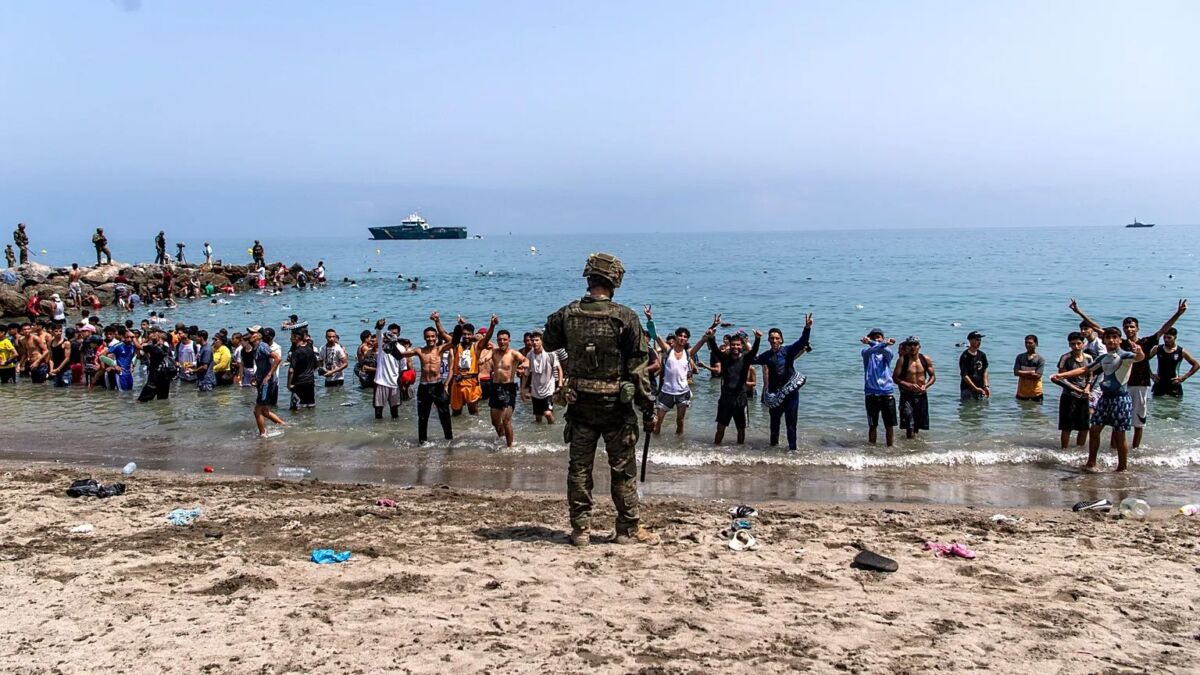
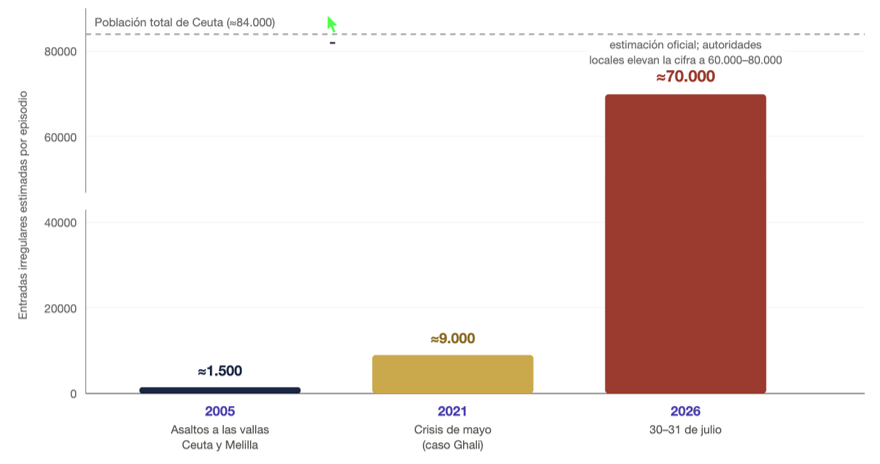
In the early hours of July 30, thousands of people crossed from Morocco to Ceuta, mostly by swimming, skirting the border breakwaters of El Tarajal and Benzú. The Spanish Ministry of the Interior estimated around 50,000-70,000 entries within 24 hours, in a city of just 84,000 inhabitants. The Government Delegation reported at least 88 fatalities, most due to drowning.[i].
President Pedro Sánchez described the events as a violation of territorial integrity and ordered the deployment of the Armed Forces in support of the Civil Guard. In the following days, most of those who entered returned to Morocco through coordinated measures between both governments. However, the impact exceeded the bilateral context. Italy and Denmark led a stern letter signed by 22 European Union countries demanding a tightening of migration policy and the fortification of the bloc’s external borders.[ii].
Figure 1. Essential Timeline of the Crisis (July-August 2026)

Source. Own elaboration based on press reports and official statements.
WHY THERE. GEOGRAPHY AND HISTORY OF AN ENCLAVE
Ceuta occupies 19 km² on the African shore of the Strait of Gibraltar, 14 kilometers from the Peninsula. Under Spanish sovereignty since the 17th century, it, along with Melilla, constitutes the only land border of the European Union in Africa. Morocco claims both cities and has never formally recognized that border, making each migration flow there acquire a dual condition, humanitarian and geopolitical.
Recent history confirms this pattern. In 2021, nearly 10,000 people entered in two days after Moroccan police relaxed controls, in retaliation for Spain’s hosting of the leader of the Polisario Front, Brahim Ghali.[iii]. The European Parliament then condemned the use of border control as a mechanism of political pressure.[iv]. This is compounded by a structural dependency. The EU has outsourced much of its migration containment to Morocco, making border cooperation a permanent lever for the Moroccan monarchy against Madrid and Brussels.[v].
Figure 2. Ceuta, an autonomous Spanish city on the northern African coast.
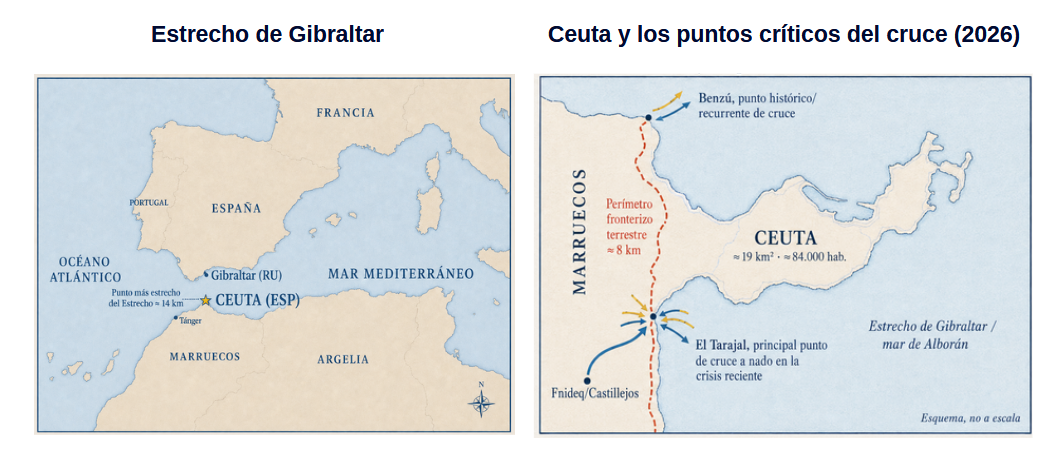
Source. Own elaboration. Schematic representation, not to scale.
THE IMMEDIATE TRIGGERS
The episode had both a legal and a symbolic trigger. On July 8, the Spanish Supreme Court established that the special rejection regime at the border only applies to those attempting to overcome physical containment elements, such as fences, and that individuals intercepted at sea must undergo the ordinary immigration procedure. A simplified reading of that ruling, asserting that anyone arriving by swimming to Spanish territory would not be returned, circulated widely on social media throughout July.
Between July 20 and 29, about 1,500 people had already entered, and the Spanish police warned of saturation. On July 30, coinciding with the Moroccan Throne Day[vi], the trickle turned into an avalanche. The Moroccan government denied having promoted or tolerated the entry, attributing it to human trafficking networks and the spread of rumors.
Figure 3. An unprecedented scale jump at the Hispano-Moroccan border.
Source. Own elaboration based on press reports.
MIGRATION AS AN INSTRUMENT OF INTERSTATE PRESSURE
Political science refers to coercive engineered migration as the deliberate use of migration flows (through their generation, tolerance, or threat) to obtain concessions from another state[vii]. This instrument exploits a basic asymmetry: facilitating or allowing the departure of people incurs a relatively low cost for the “sending” state, while receiving them can impose high material and political costs on the “receiving” state. Furthermore, recent evidence suggests that migration coercion is more likely to succeed when the target country is experiencing internal instability and simultaneously facing environmental disasters[viii]. Turkey in 2015 and 2020, Belarus in 2021, and Morocco itself that same year provide precedents[ix], to the extent that the EU incorporated the category of instrumentalization into its crisis migration regulations[x].
The case of Ceuta in 2026 illustrates the central difficulty of this phenomenon: verifying the will of the “sending” country. A state engaging in this practice does not need to open its border; it merely needs to refrain from closing it at the opportune moment. This selective passivity is almost indistinguishable from simple incapacity. In the recent case of Ceuta, there are signs that fuel suspicion, such as the coincidence with a date of maximum symbolic weight for the monarchy, reports of prior bus movements toward the border, and the initial inaction of Moroccan forces. There are also counter-signals, including the formal denial by the Moroccan government, its subsequent cooperation in returns, and the reputational cost of a crisis for the country itself. In perspective, the most useful test will be to observe what Morocco obtains from Spain and the EU in the coming months.
INTELLIGENCE FAILURE OR POLITICAL DECISION FAILURE?
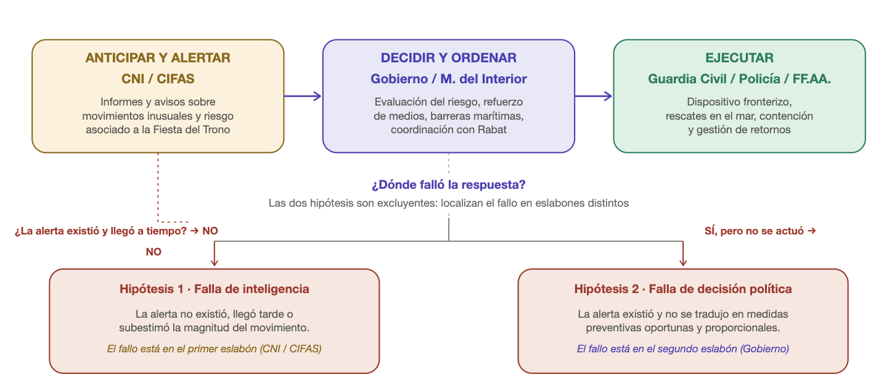
The Ceuta crisis also sparked domestic controversy. Spanish media reported that the National Intelligence Center (CNI) and the Armed Forces Intelligence Center (CIFAS) issued prior warnings about unusual movements in northern Morocco and the associated risks of the Throne Day. The Sánchez government responded that no report alerted to the magnitude of what occurred.
Three key points organize the debate without resolving it. First, the literature on strategic surprises distinguishes between alertness and response, showing that many so-called intelligence failures correspond to failures in the decision-maker’s receptivity[xi]. Second, the argument regarding magnitude is weak. Intelligence almost never predicts exact numbers. Its job is to warn that a risk exists and is growing. If the government only acts when given the precise number, the failure shifts from the one who alerts to the one who decides. Third, open data from the Ministry of the Interior itself showed a doubling of land entries to Ceuta until July 15, which weakens the thesis of absolute surprise. At the same time, neither the CNI nor the CIFAS directs police operations or closes borders; that decision was governmental. The issue can only be resolved with documentary traceability, that is, dates, contents, and recipients of each warning. Until that evidence is known, both hypotheses remain open.
Figure 4. The alert-decision-execution chain and the two hypotheses in dispute.
Source. Own elaboration
KEYS TO OBSERVE
Three indicators will help interpret what is to come. First, the gestures and concessions that appear in the Hispano-Moroccan relationship will be a retrospective test of the instrumentalization hypothesis. Second, whether Spain reforms its immigration legislation to close the operational gap opened by the ruling. Third, the effect on the Schengen agreement and European migration policy. For Latin American audiences, the case offers a cross-cutting lesson. The management of borders under mixed pressure can no longer be separated from intelligence analysis or foreign policy.
DIEGO SAZO
Head of Research in International Relations
[i] Euronews, “The Tragedy of Ceuta Leaves 88 Dead as the National Court Opens an Investigation,” August 3, 2026, https://es.euronews.com/my-europe/2026/08/03/espana-cifra-en-72-los-muertos-tras-el-cruce-a-ceuta-mientras-aumentan-desaparecidos
[ii] El Mundo, “22 Countries Led by Italy and Denmark Question Spain’s Migration Policy and Demand the EU Take the Helm,” August 1, 2026, https://www.elmundo.es/internacional/2026/08/01/6a6dcbd7e9cf4a5d338b4585.html
[iii] Western Sahara, a former Spanish colony, remains for the UN as a non-self-governing territory pending decolonization. Morocco claims sovereignty over it, while the Polisario Front, led by Ghali, advocates for Sahrawi self-determination and independence.
[iv] European Parliament, “Resolution of the European Parliament of June 10, 2021, on the Violation of the United Nations Convention on the Rights of the Child and the Use of Minors by Moroccan Authorities in the Ceuta Migration Crisis (2021/2747(RSP)),” June 10, 2021, https://www.europarl.europa.eu/doceo/document/TA-9-2021-0289_EN.html.
[v] Xavier Ferrer-Gallardo and Lorenzo Gabrielli, “Three Decades of Fences in Ceuta and Melilla: Crisis, Outsourcing, and Intensification of Migration Control at the EU’s External Borders,” Documents d’Anàlisi Geogràfica 71, no. 1 (2025): 65-92.
[vi] The Throne Day, celebrated every July 30, commemorates the enthronement of Mohamed VI in 1999 and constitutes the main political ceremony of the Moroccan monarchy, marked by the royal speech and public acts of loyalty to the sovereign.
[vii] Kelly M. Greenhill, Weapons of Mass Migration: Forced Displacement, Coercion, and Foreign Policy (Cornell University Press, 2010).
[viii] Tobias Böhmelt, “Coercive Engineered Migrations and Environmental Stress,” Journal of Peace Research 62, no. 7 (2025): 2435-2444.
[ix] Styliani Gerani, “Technologies of Coercion: Strategic Engineered Migration and the Weaponization of Mobility in Turkey’s Foreign Policy,” Comparative Strategy 45, no. 4 (2026): 556 and Nina Miholjcic, Migration as an Instrument of Modern Political Warfare: Cases of Turkey, Morocco and Belarus, Jean Monnet Network on EU Law Enforcement Working Paper Series no. 12/22 (2022), https://jmn-eulen.nl/wp-content/uploads/sites/575/2022/05/WP-Series-No.-12-22-Migration-as-an-Instrument-of-Modern-Political-Warfare-Cases-of-Turkey-Morocco-and-Belarus-Miholjcic.pdf
[x] European Commission and High Representative of the Union for Foreign Affairs and Security Policy, “Response to State-Sponsored Migrant Instrumentalization at the Union’s External Border,” JOIN(2021) 32 final, November 23, 2021, https://eur-lex.europa.eu/legal-content/EN/TXT/HTML/?uri=CELEX:52021JC0032
[xi] Richard K. Betts, Surprise Attack: Lessons for Defense Planning (Brookings Institution, 1982).