The Limits of Just War: Between Cause, Timing, and Legitimacy
This article was translated automatically and may contain differences from the original. For reference, read the original.
One of the most difficult decisions a state faces is determining when it is legitimate to use force against another state actor. The challenge is compounded in a strategic environment where threats materialize rapidly and adversaries develop capabilities that could produce devastating effects in very short timeframes. Waiting for the first strike can compromise effective defense when there are solid indications of an imminent attack, while acting too early turns any adversarial capability into a sufficient argument for initiating war.
The normative tradition of just war offers a useful framework for addressing this dilemma, as it recognizes the existence of morally justified wars while simultaneously establishing demanding limits on the use of force. Prominent in this tradition is political philosopher Michael Walzer, who argues that an attacked state retains the right to defend its existence, adding that war remains an exceptional alternative subject to legitimate authority, as a last resort, proportionality, and a reasonable probability of success.[i]. In this regard, aggression constitutes the paradigmatic case, as it violates a state actor’s right to exist and govern itself, as occurred with Ukraine following the Russian invasion in February 2022. This article argues that only a concrete threat, supported by observable preparations and evidence of intent, justifies the anticipatory use of force, while uncertainty regarding an adversary’s future military capabilities does not meet this justifying condition. To support this argument, the article first examines the limits that just cause imposes for initiating and conducting war; then, the temporal limit of its initiation, which distinguishes between anticipation and prevention; and subsequently, the gap between the threshold for the use of force recognized by positive international law and that accepted by moral tradition. Finally, certain implications for Chile’s national security are identified.
The Limits of Just Cause
A just cause is insufficient to justify a war and its conduct, as the justice of resorting to force and the justice of its conduct respond to different questions. The ius ad bellum determines whether there is a sufficient reason to fight, while the ius in bello imposes obligations on the behavior of belligerents during hostilities[ii]. This separation prevents the legitimacy of a cause from operating as authorization to use any available means, so that those fighting under a defensive argument remain subject to restrictions regarding the civilian population[iii].
An example of this is the proportionality that must operate at both levels. Proportionality ad bellum compares the total foreseeable damage of the war with the good that would be obtained by achieving the just cause, while proportionality in bello compares the incidental civilian damage of each attack with the concrete and direct military advantage anticipated[iv]. The reciprocal campaign of deep attacks during 2026, within the context of the war between Ukraine and Russia, demonstrates the necessity of this second examination even for the party making a defensive argument[v]. Since the beginning of the year, Ukraine has attacked Russian refineries, as well as airfields, railway hubs, and ports located more than a thousand kilometers from the front, while Russia has launched waves of missiles and drones against the Ukrainian power grid, leaving millions without supply during the winters[vi]. These facts remind us of the obligation to assess the military character of the target alongside the foreseeable effects on those remaining outside the hostilities. These two formulations of proportionality show that just cause limits the means of war once it has begun. Thus, the question that remains open is at what moment there is even that cause; that is, when a threat authorizes the use of force before suffering the first blow.
Anticipation and Prevention
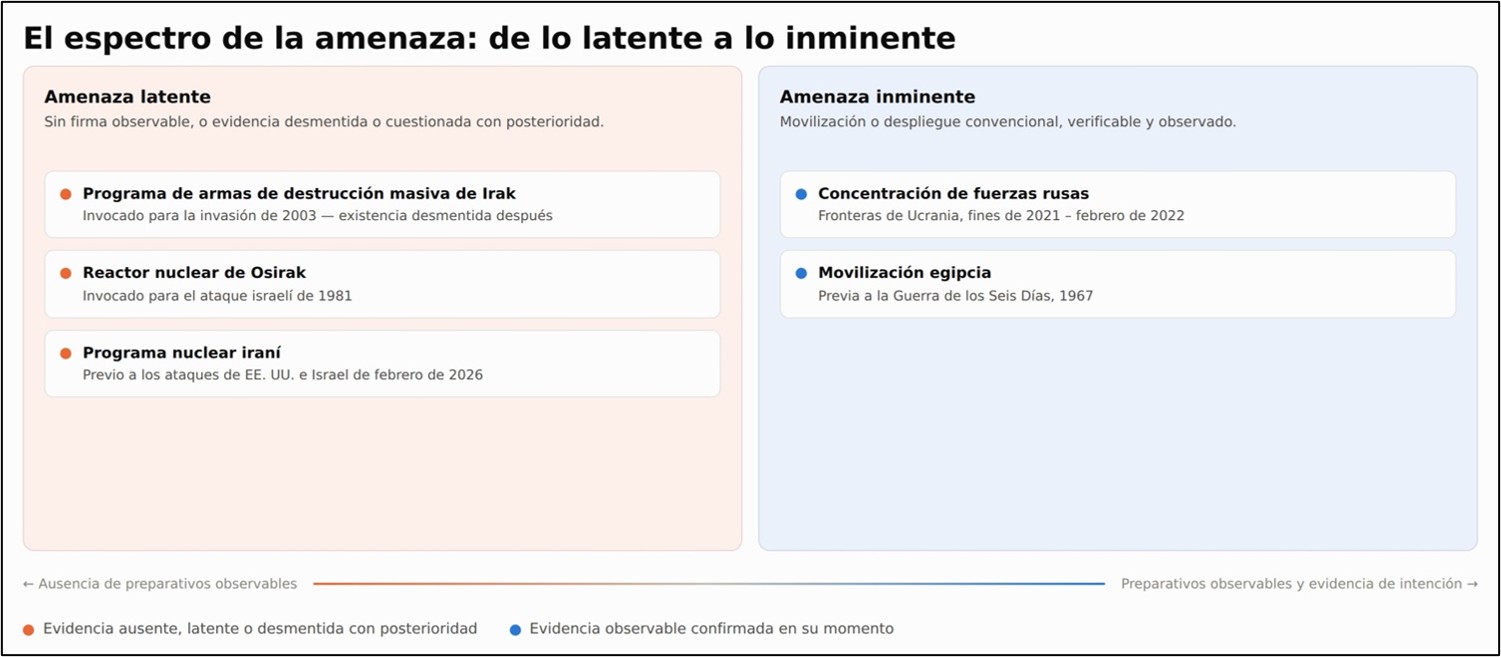
The question that concludes the previous section defines the second limit imposed by just cause. The difference between anticipatory war and preventive war requires establishing when a latent threat acquires the necessary concreteness to enable the legitimate use of force. Anticipatory action responds to an actual danger, where waiting would compromise the very possibility of effective defense. On the other hand, preventive action seeks to neutralize a capability whose intent to use remains indeterminate over time. In this regard, Walzer departs from the classical formula that demands an immediate and overwhelming threat; instead, he proposes the criterion of imminent threat. This framework includes the following three elements: a manifest intention to cause harm; active preparations that transform that intention into a positive danger, and a situation in which waiting materially increases the risk assumed[vii]. The comparison between the Six-Day War of 1967[viii] and the invasion of Iraq in 2003[ix] allows us to observe the difference. In the first case, there were verifiable mobilizations and deployments of Egyptian forces at the border with Israel, while in the second, it relied on intelligence reports about a capability for weapons of mass destruction whose existence was later disproven.
Current technological advancements modify the type of evidence available before an attack, as decisive preparations today occur in industrial facilities and networks rather than in border deployments. A conventional mobilization produces the evidence that the imminent threat criterion requires, as occurred with the concentration of Russian forces at the borders of Ukraine between late 2021 and February 2022[x]. A developing technological program lacks that observable signature, so the discussion shifts from the imminence of the attack to the moment when the possibility of preventing it expires. This shift allows preventive action to be presented with the vocabulary of anticipation, as the argument of a closing window can be invoked against any ongoing program. Therefore, the absence of observable preparations keeps the threat in the latent category, regardless of the speed at which the adversarial development occurs.
However, non-state armed actors subject the imminent threat criterion to equivalent pressure, as their preparations lack the evidence produced by a state’s mobilization. A state actor preparing an offensive concentrates forces, mobilizes reserves, and deploys logistical means; while a non-state armed organization can achieve a comparable level of damage without emitting any of those signals. The dispersion of their capabilities in urban environments and civil infrastructure further reduces the available evidence to substantiate that an attack is imminent. The Israeli campaign against Hezbollah’s command structure in Lebanon during 2024, for example, illustrates this difficulty in demonstrating the causes of an attack. Israel invoked intelligence about preparations for a large-scale attack, but the dispersion of Hezbollah’s arsenal in urban areas of southern Lebanon made it difficult to publicly substantiate the level of concreteness required by the imminent threat criterion, and the response was executed in Lebanese territory, a state formally unrelated to that planning[xi]. This case demonstrates that the evidentiary difficulty is compounded by an additional issue, as the response against a non-state actor is often executed in the territory of a third state unrelated to the attack.
Finally, it is necessary to indicate that strategic uncertainty alone lacks the solidity to justify the use of force preventively, as every decision in the realm of defense is made with partial information about others’ intentions. The military capabilities of an adversary provide limited insight into the purposes of those who possess them. This level of uncertainty produces more severe consequences when the decision made consists of a preventive attack, as the military action itself may generate the threat it intended to suppress. The joint attacks by the United States and Israel against Iran on February 28, 2026, illustrate this sequence particularly clearly[xii]. The declared justification combined the destruction of the Iranian nuclear program with a supposed objective of regime change in that state.
FIGURE 1.
Legality and Legitimacy
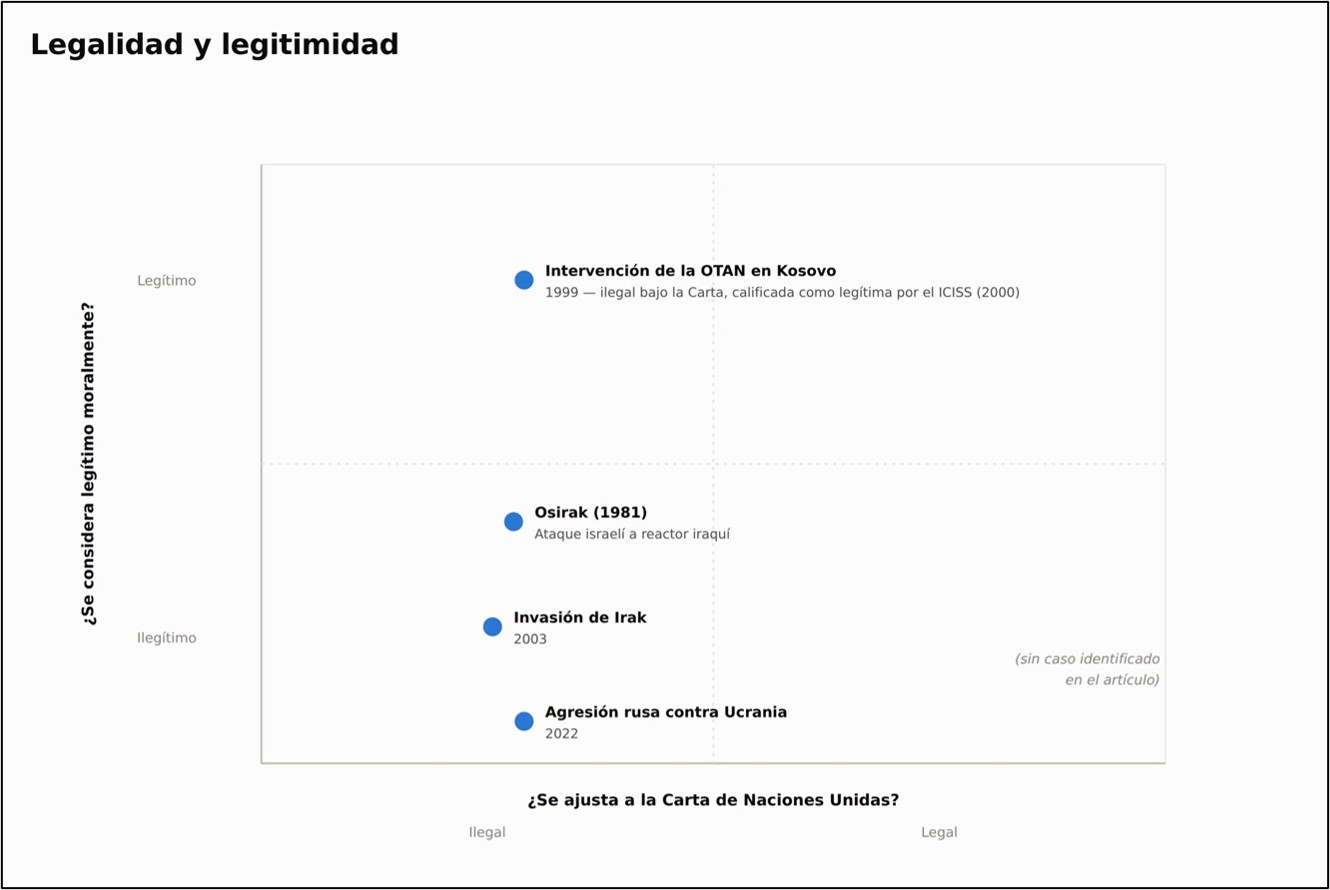
The criterion of imminent threat that distinguishes anticipatory war from preventive war belongs to the moral plane of the just war tradition. It is certainly important to ask whether positive international law recognizes that same threshold. The United Nations Charter and the just war tradition share three elements while establishing different criteria for evaluating the use of force. Both frameworks presume that any use of force requires justification, identify the response to aggression as the case that grants it, and require that the decision comes from an authority entitled to make it. The Charter translates this core into positive law by generally prohibiting the threat and use of force in its Article 2.4 and recognizing the inherent right of self-defense against an armed attack in its Article 51[xiii]. The just war tradition operates as a broader moral framework that encompasses situations that positive law addresses with difficulty; among them, humanitarian interventions and the anticipatory use of force against a sufficiently concrete danger. Certainly, NATO’s intervention in Kosovo in 1999 expressed the tension between both frameworks. In this regard, the Independent International Commission on Kosovo classified it in its 2000 report as illegal under the Charter, but legitimate according to moral criteria associated with the interruption of ethnic cleansing[xiv].
The distance between both frameworks becomes more visible when evaluating the anticipatory use of force, as each sets its own threshold for admitting it. Article 51 links self-defense to the occurrence of an armed attack, while subsequent practice has allowed readings that incorporate responses to imminent attacks. In fact, the 2004 report of the United Nations High-Level Panel[xv] and the document presented by the Secretary-General in 2005[xvi] precisely delineated that space by accepting anticipatory defense against an imminent threat and reserving responses to latent threats for authorization by the Security Council. The Israeli attack on the Osirak reactor in 1981 remains the precedent that set the terms of this discussion, and the Security Council unanimously condemned it through Resolution 487[xvii].
Figure 2.
Chile at the Threshold of the Use of Force
The tension between the legal and moral thresholds is not resolved in the abstract, as its resolution determines how much protection the international order offers a state based on its relative power position. Considering that Chile faces a strategic scenario different from that of great powers and the states involved in the wars of Europe and the Middle East, the main implication of the distinction between anticipation and prevention lies in the strategic value of the threshold. The security and territorial integrity of our state rests, to some extent, on the validity of the prohibition on the use of force, as this principle prevents the mere possession of a capability from enabling another state to attack preventively. The broadening of the concept of self-defense to include latent threats does not expose Chile to neighbors with superior military power, but rather to our strategic capabilities being reinterpreted as a latent threat that would authorize preventive action against us.
The challenge for Chile, then, is to maintain deterrence with a relevant development of strategic capabilities, associated with a political will to use force if necessary, while preserving a clear separation between the preparation and the use of force. For example, intelligence, surveillance, and reconnaissance capabilities, border protection, and the safeguarding of critical infrastructure, along with the necessary readiness of the force, operate continuously without any of these activities constituting a use of force.
In this context, the National Defense Policy of 2020 orders the preparation of defense through objectives, mission areas, and strategic capabilities, and the discussion on thresholds for the use of force corresponds to the strategic concept of employment[xviii]. The process of developing the National Defense Policy 2026, whose draft will be presented in November[xix], is an opportunity to consider that the use of force should be conditioned on the presence of a manifest adversarial intent, observable preparations that turn it into a concrete danger, and such urgency that waiting materially compromises our capacity to respond.
Conclusions
The just war tradition remains relevant because it imposes limits on the military power of states in an international scenario characterized by uncertainty. The distinction between anticipating an imminent aggression and preventing a latent threat currently concentrates the discussion and determines the solidity of the threshold that must separate both categories. For Chile, defending that threshold requires a strong position in the realm of international security, as its validity depends significantly on the protection that the international order offers to states like ours against the threat of the use of force by military powers.
ALEJANDRO AMIGO
Senior Researcher, AthenaLab
[i] Walzer, Michael. Just and Unjust Wars: A Moral Argument with Historical Illustrations. New York: Basic Books, 1977.
[ii] Ibid..
[iii] International Committee of the Red Cross. Additional Protocol I to the Geneva Conventions of August 12, 1949, relating to the Protection of Victims of International Armed Conflicts, June 8, 1977, Articles 51 and 57. Available at https://ihl-databases.icrc.org/en/ihl-treaties/api-1977
[iv] Orend, Brian. The Morality of War. 2nd edition. Peterborough: Broadview Press, 2013.
[v] Atlantic Council. “Ukrainian Drones Reportedly Knock Out 10 Percent of Russian Refining Capacity”. UkraineAlert. Washington D.C. Available at https://www.atlanticcouncil.org/blogs/ukrainealert/ukrainian-drones-reportedly-knock-out-10-percent-of-russian-refining-capacity/
[vi] Jensen, Benjamin and Yasir Atalan. “A Tale of Two Strategic Attacks: The Race to End the War in Ukraine”. Center for Strategic and International Studies, July 15, 2026. Available at https://www.csis.org/analysis/tale-two-strategic-attacks-race-end-war-ukraine; Belfer Center for Science and International Affairs. “The Russia-Ukraine War Report Card”. Russia Matters, August 5, 2026. Available at https://www.russiamatters.org/news/russia-ukraine-war-report-card/russia-ukraine-war-report-card-aug-5-2026
[vii] Walzer, Michael. Just and Unjust Wars: A Moral Argument with Historical Illustrations. New York: Basic Books, 1977.
[viii] Oren, Michael B. Six Days of War: June 1967 and the Making of the Modern Middle East. Oxford: Oxford University Press, 2002.
[ix] Iraq Survey Group. Comprehensive Report of the Special Advisor to the Director of Central Intelligence on Iraq’s Weapons of Mass Destruction (Duelfer Report). Washington D.C., September 30, 2004. Available at https://www.govinfo.gov/content/pkg/GPO-DUELFERREPORT/pdf/GPO-DUELFERREPORT-3.pdf; United Kingdom. The Report of the Iraq Inquiry (Chilcot Report), Executive Summary. London, July 6, 2016. Available at https://assets.publishing.service.gov.uk/government/uploads/system/uploads/attachment_data/file/535407/The_Report_of_the_Iraq_Inquiry_-_Executive_Summary.pdf
[x] Center for Strategic and International Studies. “Unpacking the Russian Troop Buildup along Ukraine’s Border”. Washington D.C. Available at https://www.csis.org/analysis/unpacking-russian-troop-buildup-along-ukraines-border
[xi] Jones, S. G., Byman, D., Palmer, A., & McCabe, R. “The Coming Conflict with Hezbollah”. CSIS. March 21, 2024. Available at https://www.csis.org/analysis/coming-conflict-hezbollah
[xii] Chatham House. “US and Israel Attack Iran, Killing Khamenei. Tehran Launches Counterstrikes: Early Analysis from Chatham House Experts”. London, February 2026. Available at https://www.chathamhouse.org/2026/02/us-and-israel-attack-iran-early-analysis-chatham-house-experts; International Institute for Strategic Studies. “The US–Israel Campaign in Iran: Further Assessments”. London, February 2026. Available at https://www.iiss.org/online-analysis/online-analysis/2026/02/the-usisrael-campaign-in-iran–further-assessments/
[xiii] United Nations. United Nations Charter, San Francisco, June 26, 1945, Articles 2.4 and 51. Available at https://www.un.org/en/about-us/un-charter/full-text
[xiv] Independent International Commission on Kosovo. The Kosovo Report: Conflict, International Response, Lessons Learned. Oxford: Oxford University Press, 2000. Available at https://reliefweb.int/attachments/784047f3-501d-3af1-a1a9-31498003d4a5/6D26FF88119644CFC1256989005CD392-thekosovoreport.pdf
[xv] United Nations. A Safer World: The Responsibility We Share. Report of the High-Level Panel on Threats, Challenges and Change, document A/59/565, December 2, 2004, paragraphs 188 to 193. Available at https://www.un.org/peacebuilding/sites/www.un.org.peacebuilding/files/documents/hlp_more_secure_world.pdf
[xvi] Annan, Kofi. A Broader Concept of Freedom: Development, Security, and Human Rights for All. Report of the Secretary-General, document A/59/2005. New York: United Nations, March 21, 2005. Available at https://digitallibrary.un.org/record/543857
[xvii] United Nations Security Council. Resolution 487 (1981), adopted unanimously on June 19, 1981. Available at https://digitallibrary.un.org/record/280155
[xviii] Ministry of National Defense. National Defense Policy of Chile 2020. Santiago, 2020. Available at https://www.defensa.cl/wp-content/uploads/2023/06/POL%C3%8DTICA-DE-DEFENSA-NACIONAL-DE-CHILE-2020.pdf
[xix] García, Nicolás (July 28, 2026). “Chile Will Present the Draft of the Defense Policy in November 2026”. Infodefensa. Available at https://www.infodefensa.com/texto-diario/mostrar/5967652/chile-presentara-borrador-politica-defensa-noviembre-2026