A History of Service to Chile: People, Events, and Figures
This article was translated automatically and may contain differences from the original. For reference, read the original.
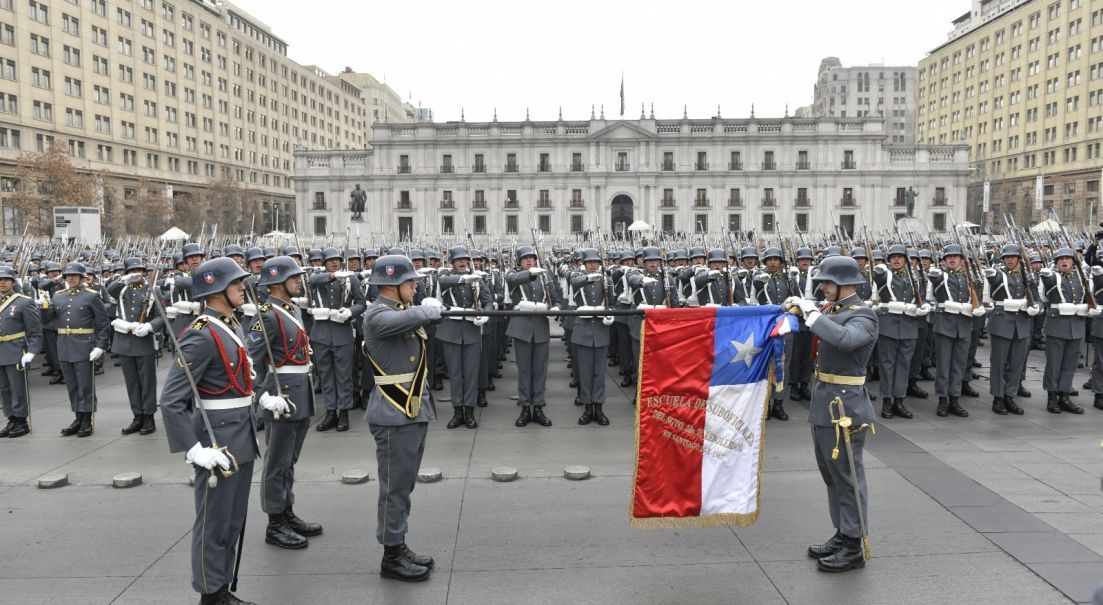
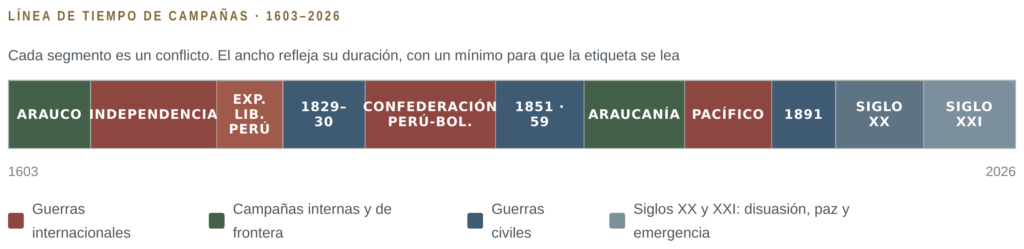
The Chilean Army is one of the founding institutions of the Republic and has remained a fundamental piece throughout its history, being the oldest armed organization in Hispanic America. Society and soldiers have been a single entity for over 200 years, and it is the only institution that has accompanied the Chilean nation in each of its conflicts, from the Royal Decree of 1603 to the peace operations of the 21st century.
This is its record:

ORIGIN AND FOUNDATIONAL UNITS
The first permanent army in Hispanic America
The losses suffered in the Arauco War forced the Crown to undertake something unprecedented in Spanish America: to finance a professional and permanent army, with fixed salaries and its own supply.
At the suggestion of Governor Alonso de Ribera, King Philip III created by Royal Decree in January 1603 the Army of the Kingdom of Chile, the first organized in Hispanic America. Ribera enhanced the professional capacity of the troops, established a salary scale, and even founded basic industries to supply military personnel. This armed body, which improved through successive ordinances over two centuries, served as the foundation for the Chilean Army that would emerge alongside the Republic.
In 1810, the First Government Junta legally established the three units that founded the republican institution. The three remain active as part of the Army, a rare case of continuity in America.
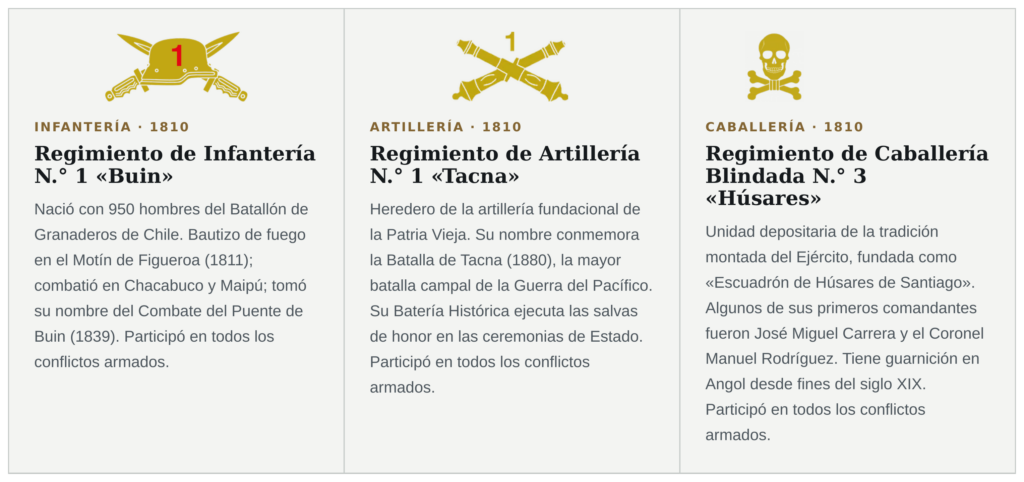
Continuity fact. On December 2, 2010, the Army officially commemorated the creation of these three units in the honor courtyard of the Military School, with 21 gun salutes from the Historical Battery of the “Tacna” and a parade before the historical Battle Standards of the three regiments.
WARS AND CAMPAIGNS
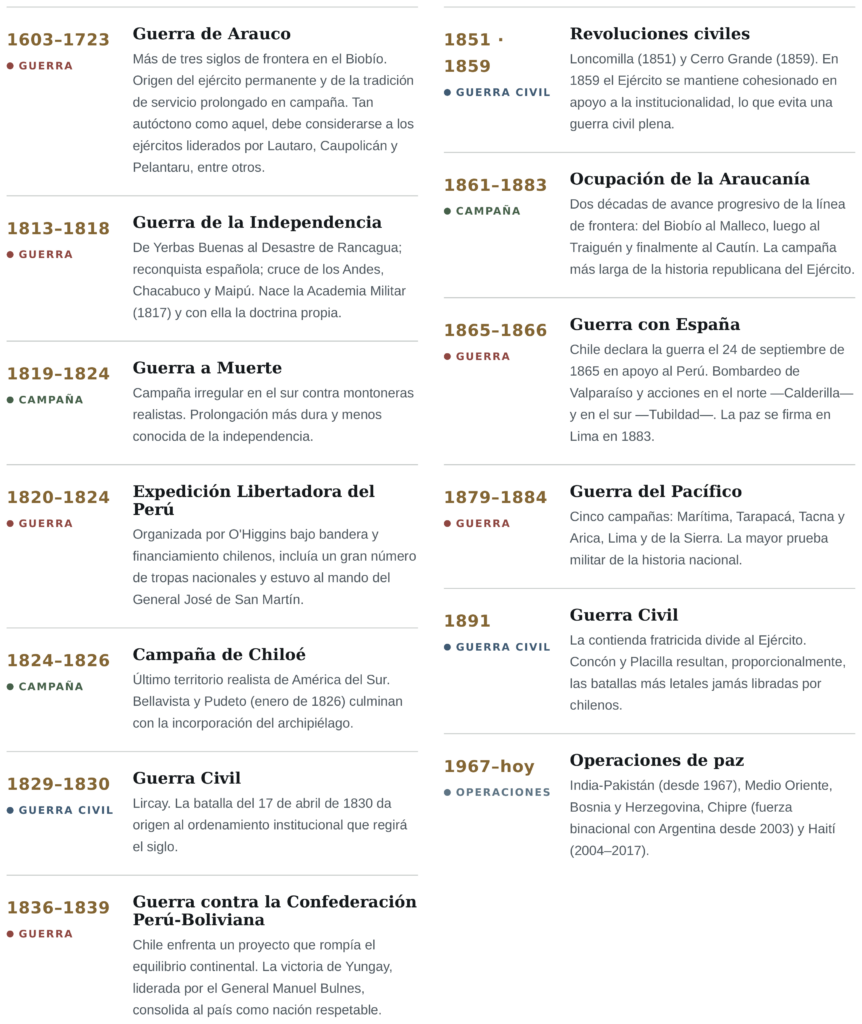
Thirteen conflicts in four centuries
The Chilean Army has not lost an international war. Its record includes three successful invasions—1820, 1838, and 1879—and more than a century without external conflict since 1884.
GEOGRAPHY OF ACTIONS
Where each battle occurred
The shape of the marker indicates the type of conflict and the color indicates the campaign. The number refers to the list accompanying each map.

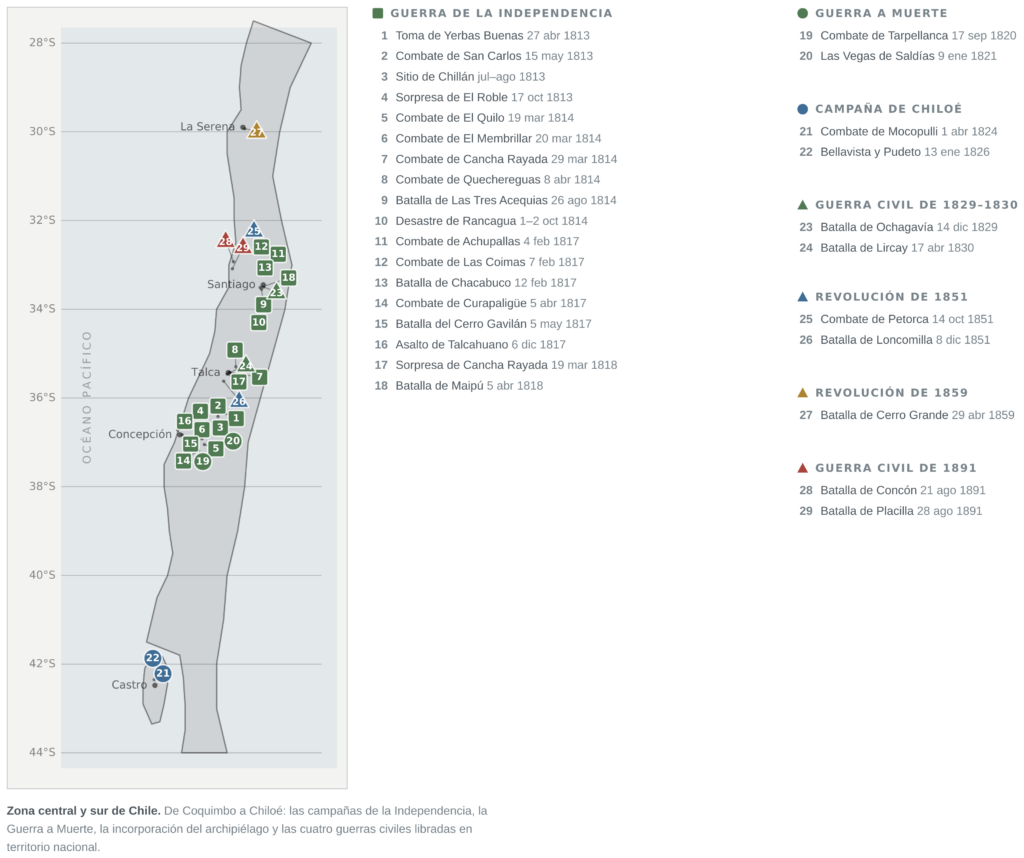
Central and southern Chile. From Coquimbo to Chiloé: the campaigns of Independence, the War to the Death, the incorporation of the archipelago, and the four civil wars fought on national territory.
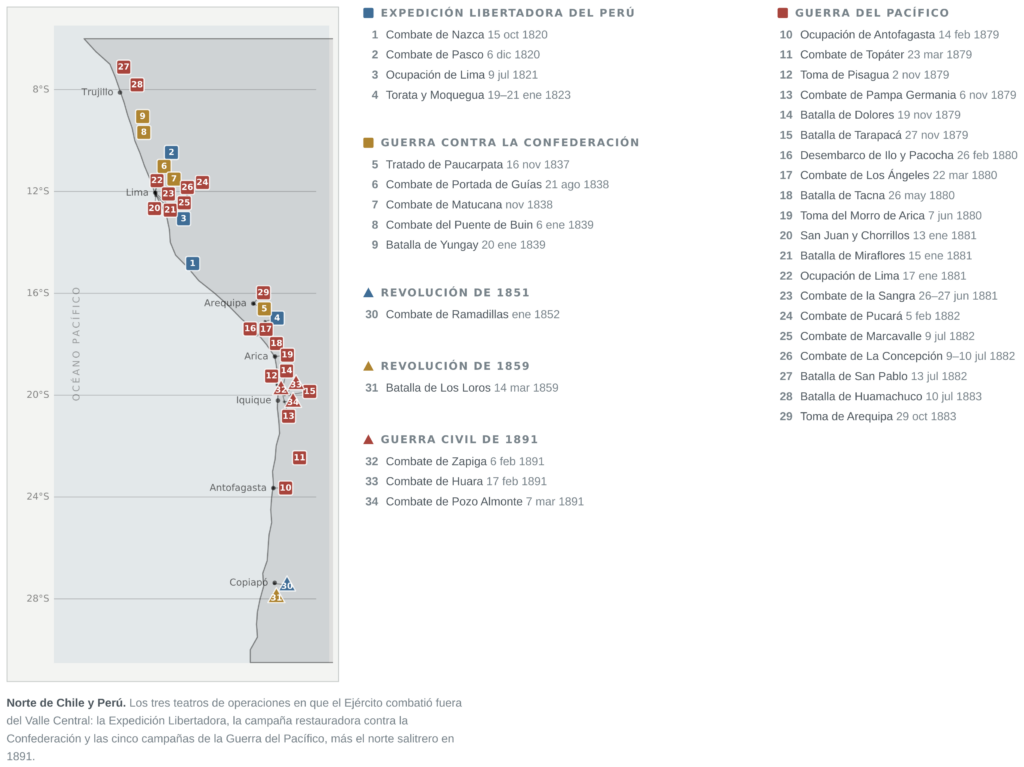
Northern Chile and Peru. The three theaters of operations where the Army fought outside the Central Valley: the Liberating Expedition, the restoration campaign against the Confederation, and the five campaigns of the Pacific War, plus the nitrate region in 1891.
About the maps. They are schematics, not cartography, so the coastline and the border are simplified; the layout corresponds to current territory, and the positions are approximate, sufficient to locate each action but not to measure distances. Where actions coincide almost at the same point—Lima, Tacna, and Arica, the Junín highlands—the markers are separated for readability, with a fine line connecting them to their actual location.
About Araucanía. The occupation of the territory south of the Biobío (1861–1883) was not resolved in pitched battles but through two decades of fortification and sustained advancement of the border line. Key milestones include the foundations of Mulchén and Angol (1862), the general uprising of 1881 with the simultaneous siege of several forts, and the refounding of Villarrica on January 1, 1883, which concluded the longest campaign in the republican history of the Army.
MOBILIZATION AND CASUALTIES
The price of glory
Chile is a country that has gone to war with improvised armies based on a very small professional foundation. The following figure explains why the Pacific War marked an entire generation.

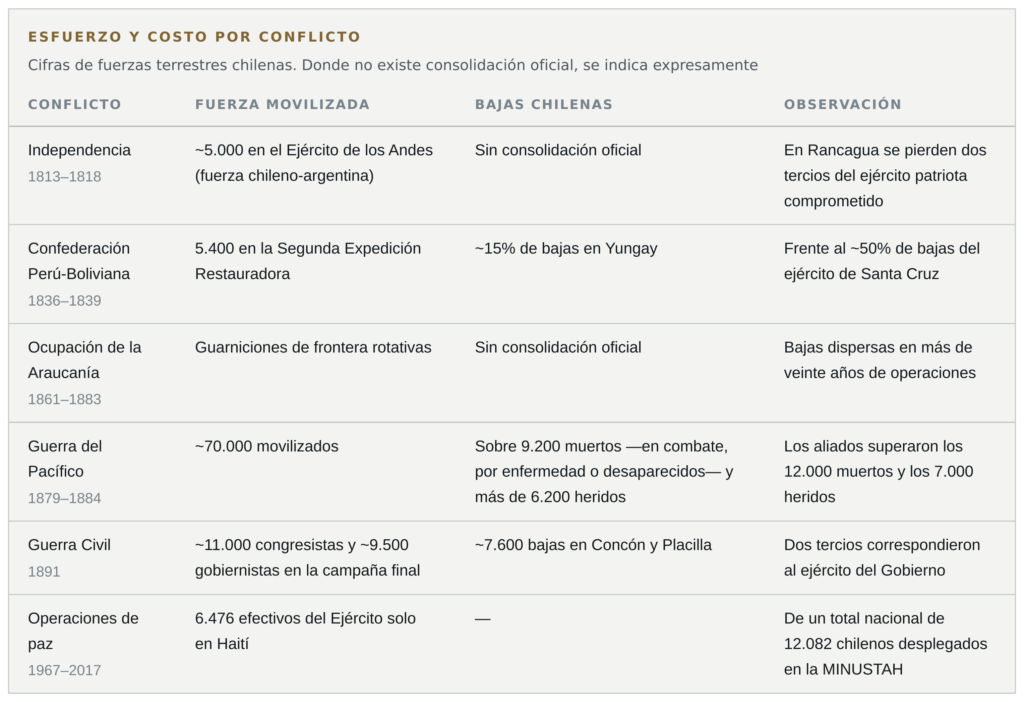
THE BLOODIEST
Three actions that were the costliest
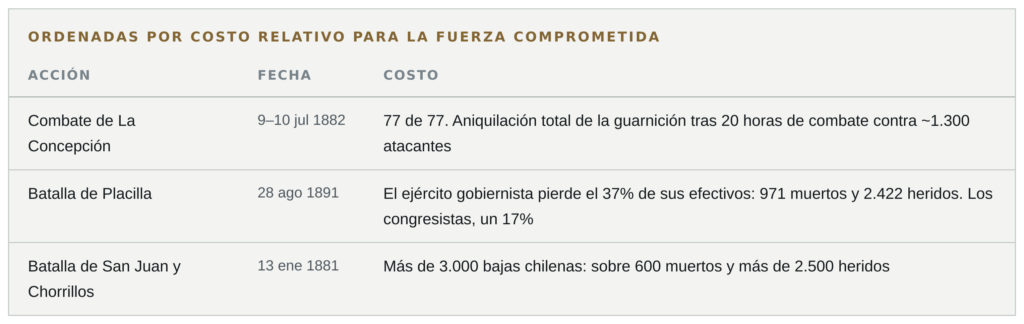
MILITARY ACTIONS
The feats that founded a tradition
It is not only the greatest victories that the Army solemnly commemorates, but also those in which the fulfillment of duty was taken to its utmost limit. Some examples are:
The Disaster of Rancagua, October 1 and 2, 1814
Fewer than 1,200 defenders under the command of Bernardo O’Higgins and Juan José Carrera held out for almost two days against a siege of about 5,000 royalists led by Mariano Osorio in the square of Rancagua, without receiving the reinforcements they expected. On the second day, O’Higgins broke the siege on horseback with what remained of the garrison. Two-thirds of the patriot army were lost, along with the Old Homeland.
Two days of siege · fewer than 1,200 against about 5,000
The Battle of Chacabuco, February 12, 1817
Twenty-five days after the crossing of the Andes began, the divisions of the Army of the Andes—under the command of General San Martín—converged on the slope of Chacabuco. O’Higgins charged at the head of his division before the agreed hour and resolved the action with the bayonet, while Soler’s enveloping maneuver completed the royalist defeat. The victory opened the way to Santiago and recovered the capital lost in Rancagua two and a half years earlier; days later, O’Higgins was appointed Supreme Director.
Twenty-five days in the mountains · the capital recovered
The Battle of Maipú, April 5, 1818
Seventeen days after the disaster at Cancha Rayada, when the cause of the patriots was considered lost in Santiago, the United Army faced Mariano Osorio’s forces in the plains of Maipú. San Martín led the battle; O’Higgins, wounded in the arm, arrived at the field with a garrison that included cadets from the new Military Academy, and the encounter between them became known as the embrace of Maipú. The victory definitively secured the Independence declared on February 12.
Seventeen days after Cancha Rayada · Independence secured
The Battle of Yungay, January 20, 1839
The Restorative Army of Manuel Bulnes, with about 5,000 men, attacked the entrenched positions of Andrés de Santa Cruz, who had 6,000. The action was decided in the assault on the Pan de Azúcar hill. Confederate casualties approached 50%; Chilean casualties were around 15%. Yungay dissolved the Peru-Bolivian Confederation, consolidated Chile as a power in the southern Pacific, and led Bulnes to the presidency.
~5,000 against 6,000 entrenched · the Confederation dissolves
The Battle of Tacna or Alto de la Alianza, May 26, 1880
In the plains of Alto de la Alianza, north of Tacna, the Northern Operations Army advanced in the open field and without cover against the entrenched positions of the Peruvian-Bolivian allied army. It was the largest pitched battle of the Pacific War: the allied line broke after several hours of combat, and the alliance ceased to exist as an organized force. Bolivia did not field an army again, and the way to the Morro de Arica was opened.
The largest pitched battle of the war · Bolivia exits the conflict
The assault and capture of the Morro de Arica, June 7, 1880
Colonel Pedro Lagos assaulted a fortified and mined position considered impregnable with a bayonet. The capture of the Morro closed the campaign of Tacna and Arica and became ingrained in national memory as the archetype of the Chilean infantry assault. Sergeant 2nd Class Daniel Rebolledo would repeat the act of planting the flag on the Morro Solar during the Battle of Chorrillos.
Fifty-five minutes of assault · the campaign of Tacna and Arica closed
The 77 of La Concepción, July 9 and 10, 1882
The 4th Company of the Chacabuco Regiment, 6th Line, garrisoned the town of La Concepción in the Peruvian highlands: 77 men under the command of the recently promoted Captain Ignacio Carrera Pinto, with three sections led by Second Lieutenants Julio Montt Salamanca, Luis Cruz Martínez, and Arturo Pérez Canto. From two-thirty in the afternoon on July 9 until nine in the morning the next day, they held off an attack from a force of about 1,300 men. No Chilean survived.
Twenty hours of combat · 77 fallen · no surrender
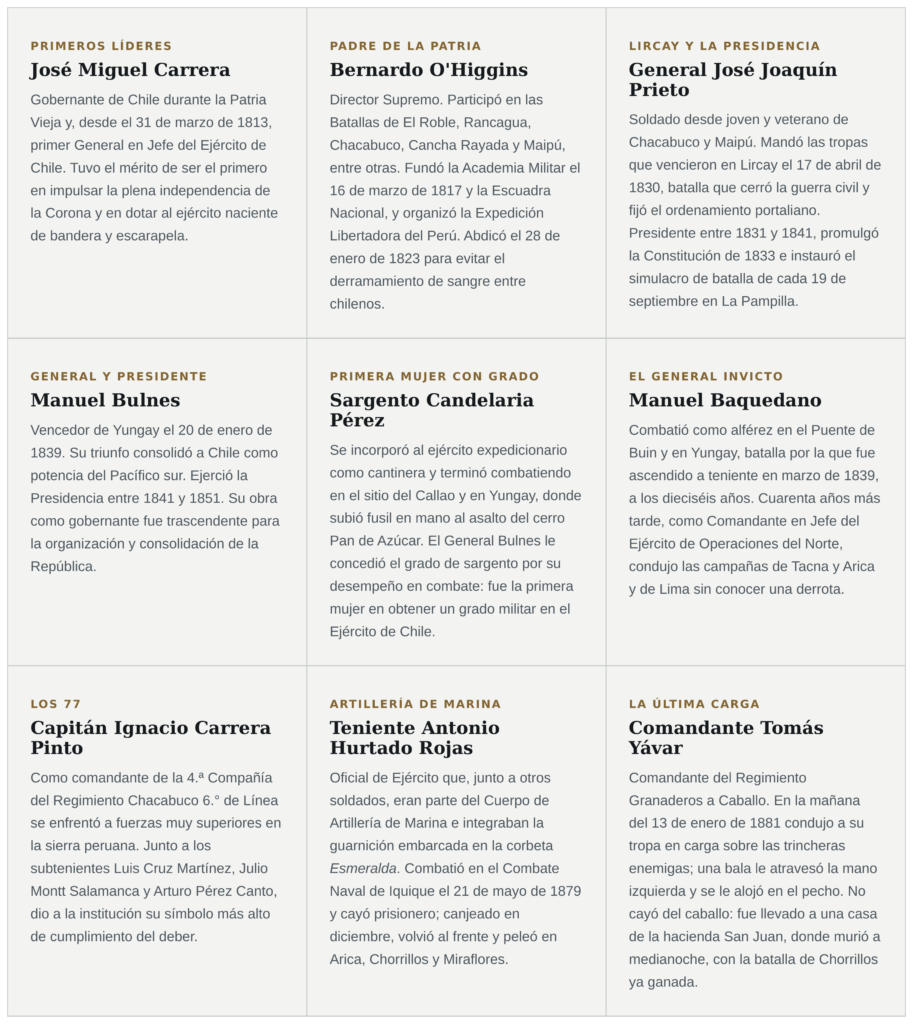
COMMANDERS AND HEROES
Soldiers of the Homeland
From the first leaders of the Old Homeland to the commanders of the Pacific War: generals who ordered the Republic and officers who upheld their duty until the end.
THE DATE AND THE CEREMONY
September 19 and the Great Military Parade
On September 19, 1810, shortly after the establishment of the First National Government Junta, the first military ceremony of the Homeland took place in the Plaza de Armas of Santiago. The Prince’s Cavalry Regiment, a Veteran Company of the Queen’s Dragoons, and a Veteran Company of the Frontier Dragoons paraded.
Nine years later, on September 28, 1819, Supreme Director Bernardo O’Higgins ordered a Military Review to enhance the patriotic solemnities: the units created under his management paraded alongside the troops of the Army of the Andes. Since 1831, at the initiative of President Joaquín Prieto, a battle simulation was held every September 19 in La Pampilla—now Parque O’Higgins—a tradition that continued uninterrupted until 1895.
Until 1915, the date lacked legal recognition, despite being the day the Army chose year after year to crown the national festivities.
On January 28, 1915, Supreme Decree No. 2977 declared September 19 a legal holiday in honor of all the Glories of the Army..
Signed by President Ramón Barros Luco and his Interior Minister, Pedro N. Montenegro. The decree expressly encompasses the National Independence Process, the War against the Peru-Bolivian Confederation, and the Pacific War, among others.
Ongoing tradition. Before the start of the parade, a cueca dance is performed, and a toast with chicha in a horn is made. The ceremony takes place in the ellipse of Parque O’Higgins, where the Army, Navy, Air Force, and Carabineros de Chile parade.
INSTITUTIONAL LEGACY
What the Army has given to the country
A significant part of the technical and security apparatus of the Chilean state was born within the Army and later became independent. This is probably its least visible and most enduring influence.
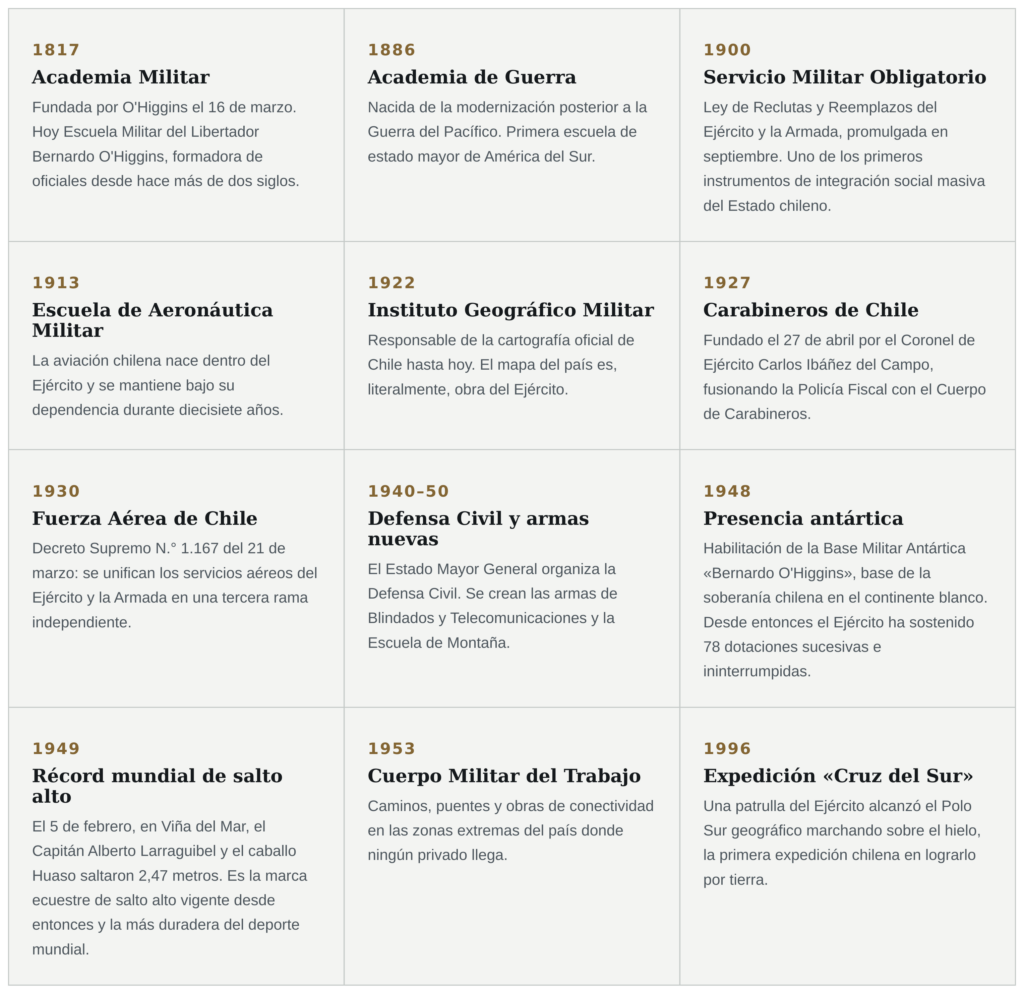
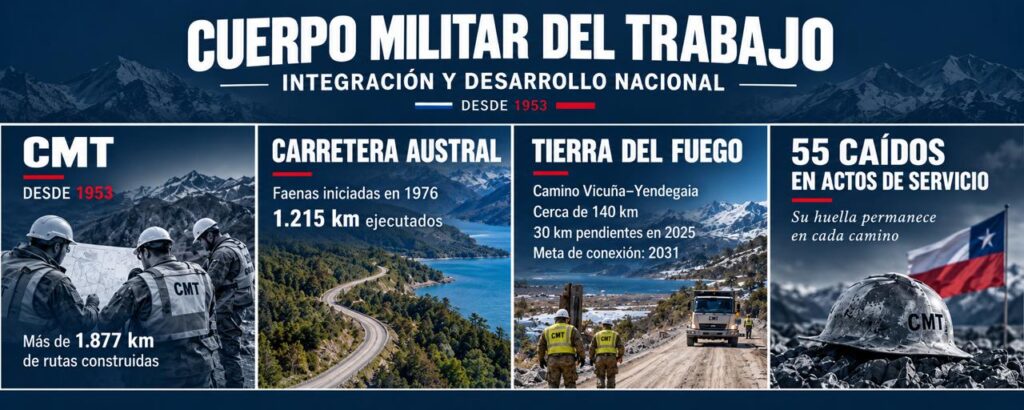
Military Labor Corps. Roads, bridges, and connectivity in extreme areas: the civil works that the Army executes where no private entity reaches.
EXTERNAL INFLUENCE
The Chilean model exported
The prestige gained after the Pacific War and the Prussian reorganization turned Chile into a reference in South America. Several states hired Chilean military missions to modernize their armies according to the Chilean “Prussian” model: Ecuador, Colombia, El Salvador, Venezuela, Nicaragua, and Paraguay. Chilean officers focused their work on training officers and non-commissioned officers, through the modernization of their respective schools or the creation of staff courses—reproducing the method with which German instructors had worked in Chile.
After World War II, a new cycle of modernization began under U.S. influence: specialization studies for Chilean officers in North American academies, transfer of military material, and instructors in Chile.
21ST CENTURY
The Army of today
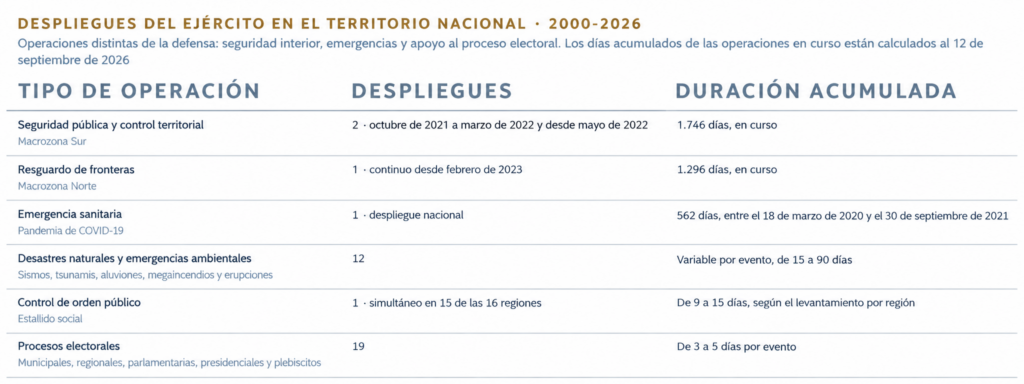
Since 1884, the Chilean Army has not fought an international war. In the crises of 1974 and 1978, it acted alongside other armed institutions, maintaining a tradition of peace that now exceeds a century and a half. Its current employment is divided between defense, peace operations, Antarctic presence, support to the population, and deployments in response to emergencies or disasters.
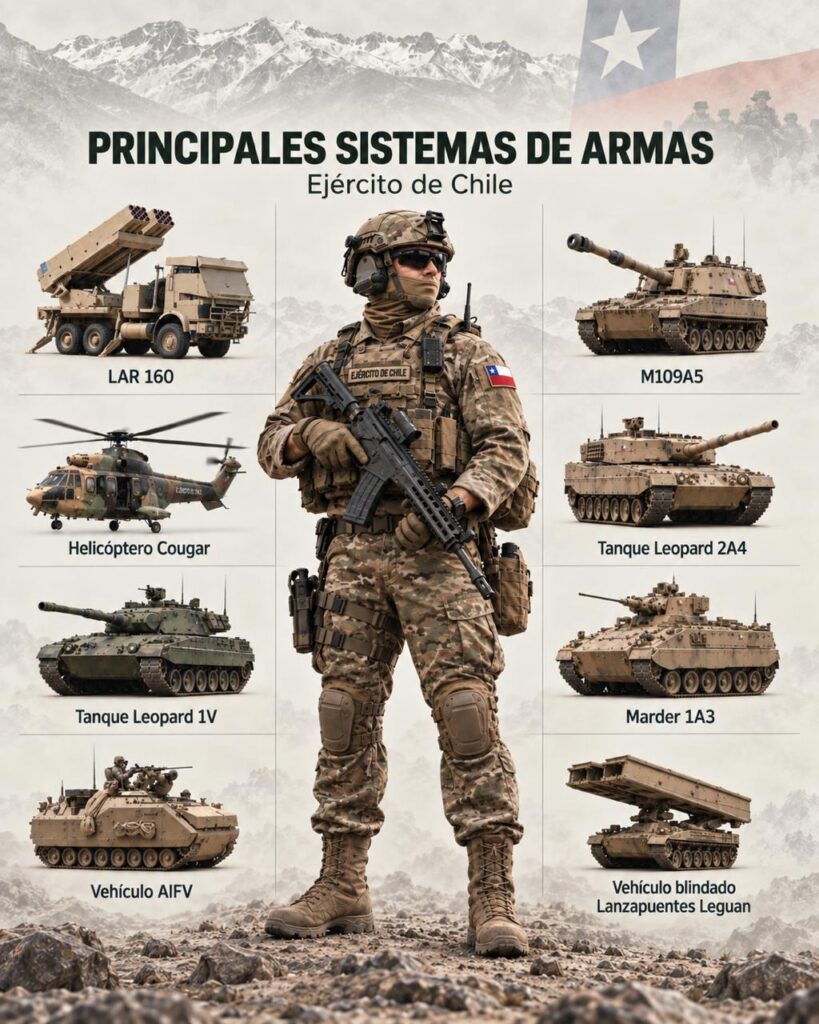
Main weapon systems. Rocket and self-propelled artillery, transport aviation, combat armored vehicles, and combat support vehicles.
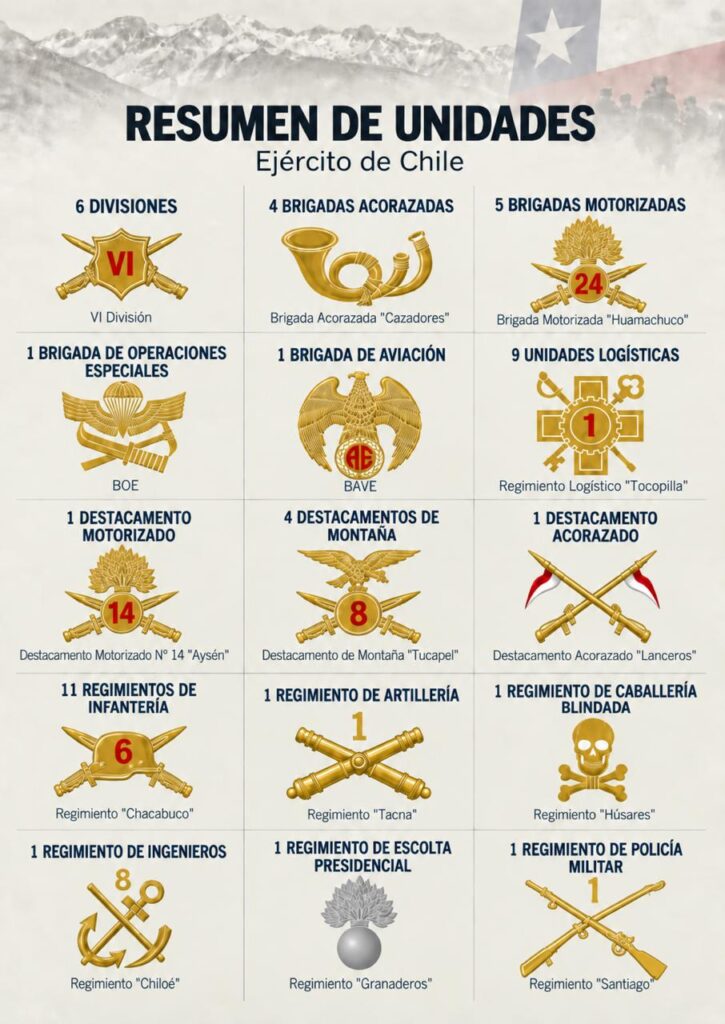
Summary of units. From six divisions to historical regiments. The Army is permanently present in all regions of the country.
The previous two illustrations are computer-generated images prepared for this document based on the material and organization that the Chilean Army publicly declares. They are not photographs or official plates of the institution.
REFERENCES
Chilean Army — History of the Army
Chilean Army — Regiment No. 1 “Buin”
Military History Academy — Battle of Chorrillos
Military History Academy — Battle of Placilla
Chilean Memory — Formation and development of the Army (1810–1890)
Chilean Memory — Sergeant Candelaria Pérez
Military History Academy — General Manuel Baquedano González
BCN — Biographical review of José Velásquez Bórquez
Pablo Rodríguez Márquez — “The Artillery Regiment of the Navy: Soldiers at Sea or Soldiers of the Sea?”, Military History Academy, Perspectives of Military History, June 2018
Chilean Memory — War against the Confederation
Chilean Army — History of the commemoration of the Glories
Chilean Army — First military units
Military History Academy — The Military Parade
Military History Academy — Combat of La Concepción
Military History Academy — History of the Chilean Army, Volume I
Chilean Memory — Professionalization and modernization (1885–1974)
Chilean Army — Verdugo career, first Chief General
BCN — Biographical review of José Joaquín Prieto Vial
Military History Academy — Antonio Hurtado and the Naval Combat of Iquique
Chilean Memory — Concón and Placilla
Roberto Arancibia Clavel — The influence of the Chilean Army in Latin America
The figures for mobilization and casualties follow those published by the Chilean Army and the Military History Academy. Where there is no official consolidation—Araucanía, civil wars of the period 1829–1859—it is expressly indicated instead of estimating. The dates of military actions follow the institutional periodization of the Army and the historiography of Gonzalo Bulnes, Diego Barros Arana, and Francisco A. Machuca.
Document prepared for the commemoration of the Day of the Glories of the Army, September 19.
MARCELO MASALLERAS
Director of Studies, AthenaLab