Extradition and Sovereignty
This article was translated automatically and may contain differences from the original. For reference, read the original.
- by María Trinidad Steinert
- Analysis

In the early hours of February 21, 2024, a group of individuals dressed in clothing resembling the uniforms of the Chilean Investigative Police broke into the apartment occupied by Ronald Ojeda Moreno, a retired Venezuelan Army lieutenant and political refugee in Chile, in the municipality of Independencia. Ojeda, 32 years old, was forcibly removed from his home in his underwear, in front of his wife and young child.[1]. Days later, his body was found inside a suitcase, buried under concrete in an illegal settlement in the municipality of Maipú, showing evident signs of torture. The coldness of the act, the absence of a ransom demand, and the profile of the victim—an active opponent of Nicolás Maduro’s regime—led the Chilean Prosecutor’s Office to support a hypothesis that now constitutes the core of the indictment: it was a politically motivated crime, organized from Venezuela and executed by “Los Piratas de Aragua,” a cell of the Tren de Aragua.
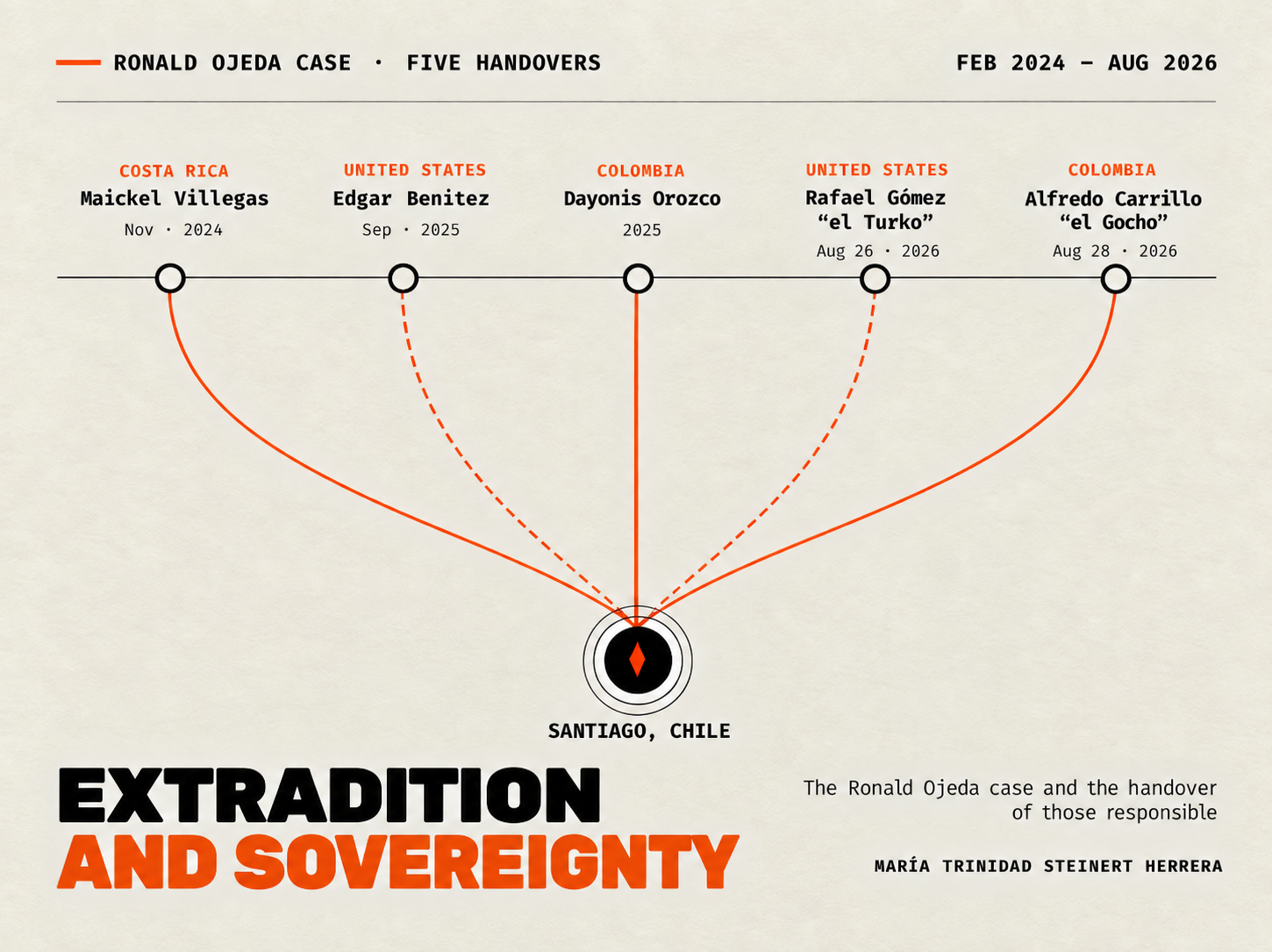
More than two and a half years later, the case has entered its decisive phase. On August 28, 2026, two key individuals arrived in Santiago, extradited: Rafael Enrique Gámez Salas, alias “El Turko,” delivered by the United States following the approval of his extradition on July 2, and Alfredo Carrillo Ortiz, alias “Gocho,” delivered by Colombia. According to the prosecution’s accusation, the former coordinated the operation through a WhatsApp group he created and named after a pirate flag. The latter allegedly participated in the excavation of the grave where the body was buried. They are joined by previous extraditions—Maickel Villegas, delivered by Costa Rica in November 2024; Edgar Benítez, deported from the United States in September 2025; and Dayonis Orozco, extradited by Colombia.
This text aims to explain the significance of these events. To do so, it will first examine the legal framework that made the extraditions possible; second, the reasons that grant this case an importance that exceeds that of a common homicide; third, the motivations—legal and political—that led the United States and Colombia to grant the extradition of the requested individuals; and finally, the challenges that the process still faces, which will test the institutional strength of the country.
I. THE LEGAL FRAMEWORK: HOW CHILE OBTAINS THE DELIVERY OF THE ACCUSED
Extradition is, in essence, the delivery of a requested person that one state makes to another for trial or to serve a sentence. When Chile requests the delivery—as has occurred in this case—we refer to active extradition; when Chile grants it to another state, it is passive extradition. Both modalities are governed in our domestic law by Articles 431 and following of the Criminal Procedure Code[2], as well as bilateral and multilateral treaties based on principles that the international community has consolidated over more than a century: dual criminality—the act must be a crime in both the requesting and requested states—the principle of specialty—the delivered person can only be tried for the crimes that motivated the extradition—reciprocity, and the prohibition of extraditing for purely political crimes.
Active extradition occurs in several stages: the Public Prosecutor’s Office, once the investigation is formalized, requests the court of guarantees to send the information to the respective Court of Appeals, which analyzes its admissibility and, if accepted, orders that the request be processed through diplomatic channels via the Ministry of Foreign Affairs, and that the requested state submit the request to the scrutiny of its own judicial and political authorities. It is a complex process involving the Public Prosecutor’s Office, the judiciary, and the Foreign Ministry. The country’s recent experience—which includes the processing of a new extradition treaty with Brazil, signed in August 2024 to replace the 1935 instrument—demonstrates a willingness to modernize this process, incorporating the digital transmission of documents, the elimination of legalizations, and figures such as temporary delivery, all designed to respond to a criminality that no longer recognizes borders[3].
The Ojeda case also illustrates the concurrence of several requests. When Colombia detained Dayonis Orozco, both Chile and Venezuela requested his extradition. The Colombian Supreme Court resolved the conflict by applying the criterion of temporal primacy: the Chilean request arrived first and was, moreover, from the state in whose territory the crime was committed, which is primarily responsible for criminal jurisdiction according to the principle of territoriality. This decision, reiterated in September 2025 when a new Venezuelan request was rejected, is particularly significant considering that Venezuela is the country of nationality of the requested individuals.
II. WHY IS THIS CASE IMPORTANT?
The first reason is sovereignty. That a transnational criminal organization kidnapped, tortured, and murdered a person in Santiago, under instructions attributed by the investigation to power structures of a foreign state, constitutes a direct aggression against Chilean jurisdiction and the integrity of its public order. A state that fails to bring the perpetrators of such a crime before its courts effectively declares the porosity of its sovereignty. Each extradition granted is, in this sense, a restitution: the affirmation that Chilean territory is not a venue available for settling scores from abroad or for the export of political violence.
The second reason pertains to the international protection of refugees. Ojeda was not an ordinary migrant: he was a political asylee, a person whom Chile formally recognized as being persecuted by his country of origin. The refugee status, enshrined in the 1951 Geneva Convention and in domestic law, imposes on the host state the duty of effective protection. The kidnapping of a refugee by agents serving—directly or indirectly—the regime that persecuted him represents the most extreme denial of that duty and evokes episodes that Latin American history knows all too well: the transnational persecution operations of dissidents that marked the region in the 20th century. Prosecuting those responsible in Chile is also a way to repair that commitment.
The third reason is criminological. The Tren de Aragua, an organization born in the Tocorón prison, has deployed a network in Chile that reaches several regions of the country, dedicated to kidnapping, extortion, contract killing, human trafficking, and sexual exploitation. The Ojeda case has paradoxically been a master key: the investigation of the crime allowed for the dismantling of “Los Piratas de Aragua,” reconstructing the hierarchy of the organization—from territorial leaders to executors and unsuspected collaborators, such as the concierge from Ñuñoa who participated in the burial—and understanding their modus operandi.
Finally, the case projects Chile onto the international human rights law stage. In March 2025, the national prosecutor and the Minister of Foreign Affairs provided relevant information about this case to the International Criminal Court, which must be studied in light of whether we are facing a precedent regarding the international responsibility of states that instrumentalize organized crime as an executing arm of political repression beyond their borders[4].
III. THE MOTIVATIONS THAT DETERMINED THE GRANTING OF THE EXTRADITIONS
The decisions of the United States and Colombia were not acts of diplomatic courtesy, but arose from a consideration of legal and political factors that should be made explicit.
First, the classic requirements operated: the crimes charged—kidnapping, aggravated homicide, organized crime—are punishable in all three involved countries, so dual criminality was indisputable; the Chilean requests formally complied with the applicable treaties; and Chile offered the usual guarantees, including respect for the principle of specialty and the impossibility of applying more severe penalties than those permitted by its legal system, which does not include the death penalty.
Second, the nature of the crime weighed heavily. In July 2026, the United States approved the extradition of Rafael Gámez in a context where that country had been hardening its policy against the Tren de Aragua, which it has designated as a terrorist organization[5]. For Washington, delivering one of the coordinators of the kidnapping to Chile was consistent with its own strategy of dismantling the network.
Third, the political evaluation of the concurrent requests proved decisive, especially in the Colombian case. Granting the extradition to Venezuela would have effectively meant handing over the accused to the state whose government the Chilean investigation identifies as the instigator of the crime, with the evident risk that the accused would never testify or that their statements would be controlled by the regime. The Colombian judiciary, by prioritizing the Chilean request, favored the effectiveness of criminal prosecution over the formalism of the nationality link, and did so by invoking an objective criterion—the temporal precedence of the Chilean request—that legally shields the decision against political challenges.
Underlying all of this is a fourth structural motivation: the shared recognition that transnational organized crime can only be combated through penal cooperation that matches its mobility. The perpetrators of Ojeda’s crime fled Chile and were captured in Costa Rica, Colombia, and the United States, after traversing much of the continent, despite Interpol’s red alerts.
IV. FUTURE CHALLENGES
1. The first challenge is procedural. The oral trial against the members of “Los Piratas de Aragua” is set to begin on October 20, 2026. In this case, there are around twenty defendants, nearly two hundred witnesses, and sentencing requests that reach up to life imprisonment for the authors of the homicide. A trial of this magnitude will require the Public Prosecutor’s Office to present a complex evidentiary construction before the oral court—based on communication records, protected testimonies, and international cooperation—and for the courts, a management that reconciles speed with the guarantees of due process.
2. The second challenge is specific to extradition: the principle of specialty. The extradited individuals can only be tried for the crimes that motivated their delivery, unless the states that delivered them expressly authorize an expansion of the prosecution. Additionally, other leaders remain detained abroad with extraditions still pending or delayed due to particular legal difficulties. For example, Carlos Francisco Gómez Moreno, “Bobby,” is in Colombia, and another group of defendants is in Venezuela, without the authorities of that country ever having executed the existing arrest warrants.
3. The third challenge is of a political-criminal nature: the determination of intellectual authorship. The capture of Nicolás Maduro and his legal situation in the United States have opened an unimaginable scenario until recently—the Chilean Prosecutor’s Office has already formally expressed its interest in interrogating him. Pursuing the instigators poses enormous legal challenges—immunities, proof of the chain of command, the very viability of extradition—and diplomatic consequences that Chile must manage with the calm that the case requires, without succumbing to the temptation to turn the judicial cause into an instrument of contingent politics, but also without renouncing the full truth for reasons of convenience.
4. The fourth challenge is internal. The Ojeda case revealed vulnerabilities that require structural responses: the capacity of organized crime to infiltrate everyday life—counterfeit police uniforms and collaborators embedded in communities—the insufficiency of protection mechanisms for refugees with risk profiles, and the need to strengthen preventive intelligence against organizations that operate on behalf of foreign entities. The lessons from the case should translate into concrete reforms: differentiated protection protocols for individuals under transnational threat, greater interoperability between the PDI, Carabineros, and international alert systems, and an extradition law that continues to modernize at the pace of the crime it seeks to contain.
V. CONCLUSION
The extraditions of Rafael Enrique Gámez Salas and Alfredo Carrillo Ortiz do not close the case of Ronald Ojeda, but rather transfer it to its natural setting, which is the court. What began as a nighttime kidnapping in a building in Independencia has transformed, through persistent investigation and a network of international cooperation that functioned when it needed to, into one of the most significant criminal cases in recent Chilean history: the one that confronts for the first time, with concrete defendants, the transnational political violence exercised against a state-protected individual. The outcome will say much about the truth of this crime, but also about the kind of country Chile wants to be: one where sovereignty, the right to asylum, and the rule of law are not merely declared, but exercised, even—and especially—when exercising them proves difficult.
SOURCES CONSULTED
Sanhueza, A. M. (July 10, 2026), “The Crime of Ronald Ojeda Enters Its Decisive Phase in Chile with the Crackdown on Six Members of Los Piratas de Aragua.” El País. https://elpais.com/chile/2026-07-10/el-crimen-de-ronald-ojeda-entra-en-su-fase-decisiva-en-chile-con-el-cerco-a-seis-miembros-de-los-piratas-de-aragua.html
Errázuriz, M. J. (August 28, 2026), “The U.S. Extradites to Chile One of the Leaders of the Kidnapping and Murder of Venezuelan Lieutenant Ronald Ojeda.” ABC. https://www.abc.es/internacional/eeuu-extradita-chile-cabecillas-secuestro-asesinato-teniente-20260828202856-nt.html?ref=https%3A%2F%2Fwww.abc.es%2Finternacional%2Feeuu-extradita-chile-cabecillas-secuestro-asesinato-teniente-20260828202856-nt.html
Castro, M. (November 20, 2024), “Costa Rica Extradites to Chile the Main Suspect in the Crime of Venezuelan Dissident Ronald Ojeda.” El País. https://elpais.com/chile/2024-11-20/costa-rica-extradita-a-chile-al-principal-sospechoso-del-crimen-del-disidente-venezolano-ronald-ojeda.html
Tele13 (T13), coverage of the Ronald Ojeda case: extraditions, formalizations, and hearings, 2024-2026.
Cifuentes, L. (August 29, 2026). “Two Individuals Indicated in the Murder of Venezuelan Ex-Military Ronald Ojeda Were Extradited to Chile from the U.S. and Colombia,” NTN24. https://www.ntn24.com/noticias-judicial/desde-ee-uu-y-colombia-fueron-extraditados-a-chile-dos-de-los-senalados-por-el-asesinato-del-exmilitar-venezolano-ronald-ojeda-645959
NTN24 (August 31, 2026). “Could Diosdado Cabello Be Extradited for the Murder of Venezuelan Ex-Military Ronald Ojeda?” [Video Archive]. YouTube. https://youtu.be/FCu7W1PCMKQ?si=Biymv-ZL-77wC8NP
Efecto Cocuyo (August 28, 2026). “Ronald Ojeda Case: Two Extradited Individuals Indicated as Material Authors Arrive in Chile,” Efecto Cocuyo. https://efectococuyo.com/internacionales/caso-ronald-ojeda-llegan-a-chile-dos-extraditados-senalados-de-autores-materiales/
Message from H.E. the President of the Republic, Bulletin No. 17.723-10: “Extradition Treaty between the Republic of Chile and the Federative Republic of Brazil.” (July 22, 2025). https://www.camara.cl/verDoc.aspx?prmID=17950&prmTIPO=INICIATIVA
Criminal Procedure Code of Chile, Articles 421 and following (regime of passive and active extradition). https://www.bcn.cl/leychile/navegar?idNorma=176595
MARÍA TRINIDAD STEINERT
Public Security Researcher, AthenaLab
[1] Newspaper El País, March and November 2024.
[2] Article 431 and following of the Criminal Procedure Code.
[3] Message from the President of the Republic No. 076-373, July 22, 2025. Reviewed at https://www.camara.cl/verDoc.aspx?prmID=17950&prmTIPO=INICIATIVA
[4] BioBioChile, March 28, 2025. Reviewed at https://www.biobiochile.cl/noticias/nacional/chile/2025/03/28/valencia-afirma-que-trabajaran-junto-a-la-corte-penal-internacional-en-investigacion-sobre-caso-ojeda.shtml
[5] Federal Register, Vol. 90, No. 34, February 20, 2025, United States Department.