A Global Order that is Realigning: Insights from a month of alignments around the world
SUMMARY
September 2026 concentrated a sequence of agreements, summits and strategic initiatives across different regions of the world, while the two superpowers held a bilateral summit. This report argues that these events are not isolated episodes but the expression of a world order that is realigning in the face of an increasingly uncertain and strained international context. Several states are observed to be accumulating overlapping ties in order to diversify their sources of security and economic access. The cost of that strategy, however, is greater exposure to cross-entrapment when those commitments are activated in opposite directions.
Figure 1. Countries that took part in alignment milestones between 31 August and 25 September 2026.
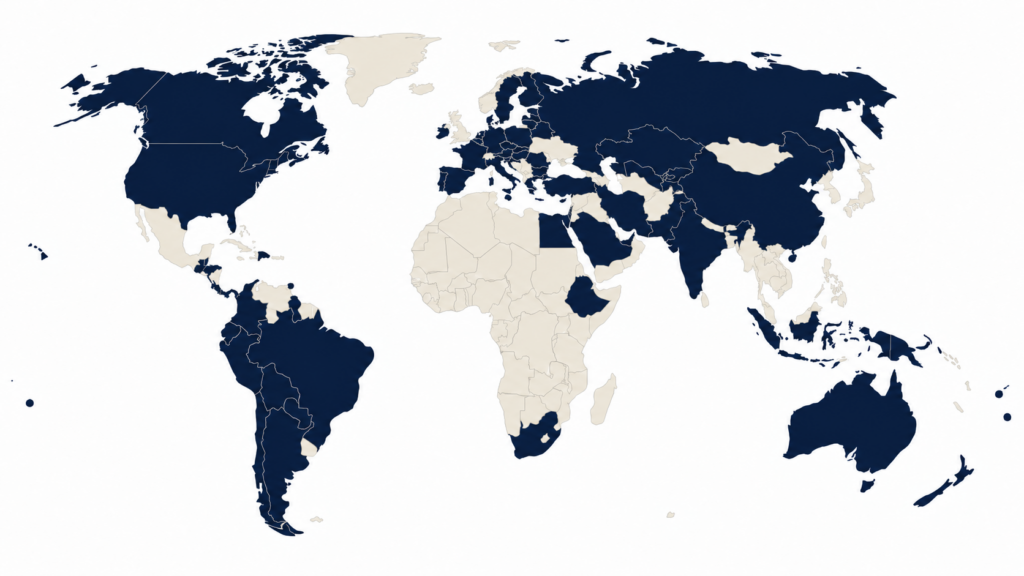
Source: Authors’ elaboration.
WHAT HAPPENED
Seven alignment milestones in 26 days, with different partners, regions and forms. Two are signed pacts or contracts, three are summits or meetings of existing institutions, one is a joint declaration and one is a proposal that still requires approval. Four are original, because they create a commitment that did not exist before 2025, while three are continuity milestones, because a pre-existing institution broadened its scope or deepened its institutionalisation. In the same window, between 23 and 25 September, Xi Jinping made a state visit to Washington, with the official reception led by President Donald Trump.
Figure 2. Seven alignment milestones and one bilateral summit between 31 August and 25 September 2026.
| Milestone | Date | Event | Type | Form |
| Makkah Pact | 31 Aug · 24–25 Sep | First ministerial meeting in Istanbul. Foreign ministers in New York and chiefs of staff in Riyadh in response to Houthi attacks | Original | Mutual defence pact |
| Achilles Shield | 31 Aug 2026 | Israel and Greece sign a multi-layered air defence system worth €3.035 billion | Original | Contract and integration |
| Shanghai Cooperation Organisation (SCO) | 31 Aug – 1 Sep | 26th summit in Bishkek. First amendments to the Charter in two decades | Continuity | Summit of an organisation |
| BRICS | 12 – 13 Sep | 18th summit in New Delhi. 140-paragraph declaration and alternative payments network to the dollar | Continuity | Summit of a forum |
| European Union–Canada | 16 – 17 Sep | Von der Leyen proposes that Canada become the first “associate member”. Trump calls it a “hostile act” | Original | Association proposal |
| Shield of the Americas | 22 Sep | Joint declaration by fifteen governments. Chile becomes a full member | Original | Joint declaration |
| South Pacific Defence Ministers’ Meeting (SPDMM) | 22 – 24 Sep | 11th meeting of South Pacific defence ministers in Nadi. Framework for a status of forces agreement and annual meetings of secretaries | Continuity | Ministerial meeting |
| State visit of China to the United States | 23 – 25 Sep | Xi Jinping in Washington. Tariff truce extended until January and two further summits committed before the end of the year. No progress on Taiwan, Iran or AI | – | Bilateral summit |
Source: Authors’ elaboration.
A MORE UNSTABLE GLOBAL ENVIRONMENT
The return of interstate war in Europe. Russia’s invasion of Ukraine in 2022 reinstated the war of conquest as a possibility on the continent. It also demonstrated that a permanent member of the United Nations Security Council can attempt to annex territory by force, sustaining a war for years and absorbing the cost of sanctions without yielding. That fact removed the certainty that European borders were beyond dispute and forced every state on the continent (and beyond it) to ask what guarantees it would have if it faced something similar.
The chain of conflicts in the Middle East. Since October 2023 the region has faced wars that feed on one another: Gaza, Lebanon, Syria and, since 2025, the war in Iran, with retaliation across several Gulf states and effects on the Strait of Hormuz. The succession of conflicts exposed the limits of American and Israeli deterrence as the basis of regional stability, pushing several states to reassess or strengthen ties among themselves.
The conditionality of the American guarantee. Since 2025, Washington has applied tariffs to allies such as the European Union and Japan, made its backing for NATO conditional on defence spending levels, and reduced military exercises with South Korea over its lack of support in the war against Iran. To this it added claims over Greenland and statements questioning Canadian sovereignty. These actions introduced greater uncertainty about how far the status of ally allows Washington’s treatment to be anticipated. That reduced predictability motivated the diversification of economic and security ties.
WHAT THEY HAVE IN COMMON
None of the seven milestones of the past month led the states involved to change sides or abandon previous commitments. What each state did was reinforce or add a new tie to those it already had, under the logic of alignment (an expectation of mutual support that does not require a treaty of alliance)[1]. The pattern is therefore shared: states multiply their alignments without renouncing their alliances, and they do so to widen their spaces of cooperation and better defend their strategic interests.
The degree of overlapping alignment varies from case to case. Türkiye, for instance, chaired the Makkah Pact ministerial in Istanbul on 31 August and the following day took part in the SCO summit in Bishkek alongside Xi, Putin and Modi, while remaining a NATO member and holding the alliance’s second largest army. Pakistan currently chairs the SCO, in which India also participates, and heads the secretariat of the Makkah Pact, which India itself regards with reservation, while maintaining a rapprochement with Washington[2]. Saudi Arabia is party to the Makkah Pact, participates in BRICS, maintains ties with the SCO and preserves a close security relationship with the United States. Canada stands outside the Shield of the Americas but belongs to NATO and the G7, and is exploring a closer association with the EU that Washington described as a “hostile act”[3]. The realignment also reaches the South Pacific, where a forum such as the SPDMM is deepening its institutionalisation without directly involving China or the United States as members. Chile, meanwhile, joined the Shield of the Americas while leading the Santiago Commitment and strengthening its presence in the SPDMM.
Figure 3. Memberships and ties of nine states in the institutions and pacts active in September 2026.
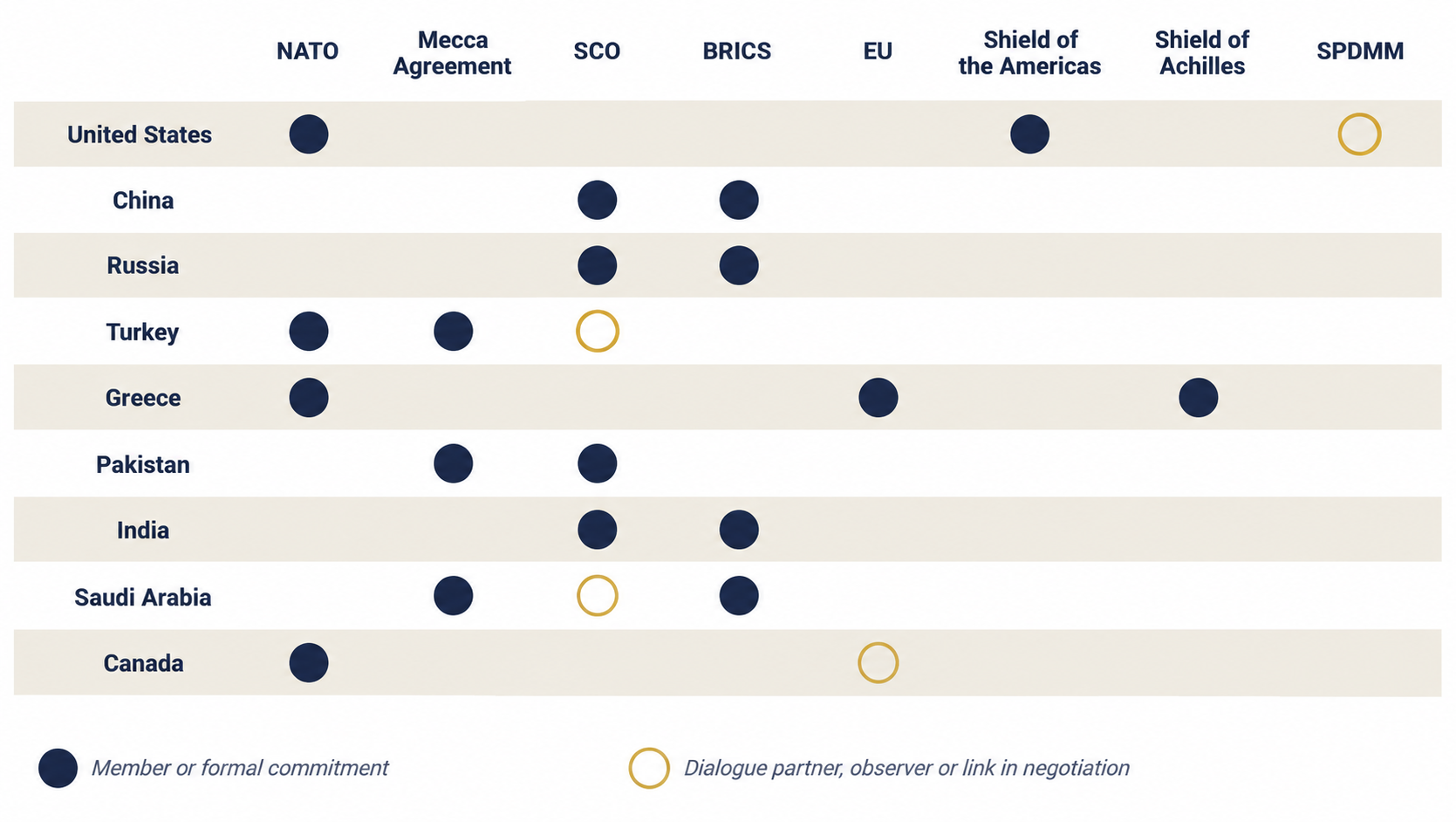
Source: Authors’ elaboration.
DIVERSIFYING TO AVOID BEING LEFT UNPROTECTED
When the environment becomes more unstable and guarantors less predictable, the risk of being left unprotected grows, and states respond by diversifying their sources of security and economic access. Diversification does not seek to win on every board, but to avoid losing on all of them at once. That explains why mechanisms proliferate without any of them displacing NATO or the relationship with the United States, and why each new initiative declares that it is not directed against anyone. Türkiye said so when the Makkah Pact was announced, the Bishkek Declaration says so of the SCO, and the European Commission said so of the proposal to Canada. The Shield of the Americas, for its part, names no extra-hemispheric actor against which it seeks protection.
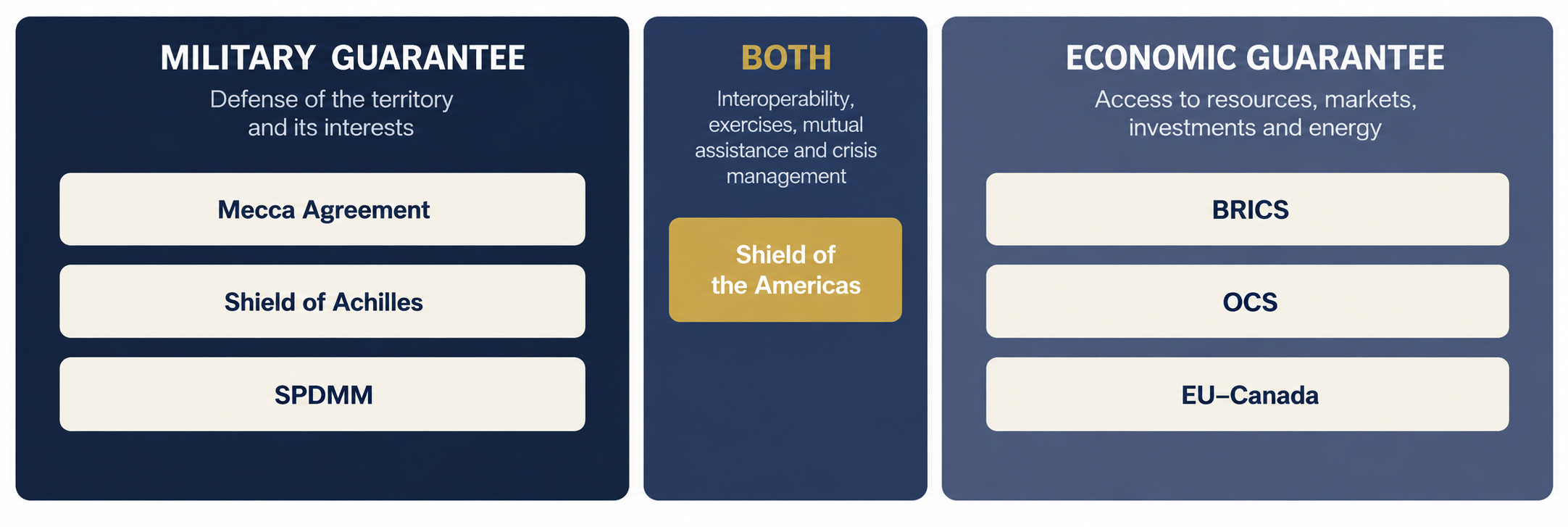
The seven milestones can be ordered by the type of guarantee they seek to secure. Military, in the Makkah Pact, the Achilles Shield and the SPDMM. Economic, in BRICS, the SCO and the EU’s proposal to Canada. The Shield of the Americas is the only one that combines both, because it joins criminal intelligence and coordinated sanctions with a pillar on critical minerals and trusted suppliers. That combination is what makes it a distinct platform within the recent landscape.
In sum, a single state can take on guarantees of more than one type with different partners, and therein lies a difference from the alignment logic of the Cold War, when the military and economic guarantor coincided and membership of a bloc covered both needs at the same time.
Figure 4. The seven milestones by the type of guarantee they seek to secure, with the Shield of the Americas at the intersection.
Source: Authors’ elaboration.
THE SUPERPOWERS ARE ALSO REALIGNING
While their partners diversified commitments over the past month, the United States and China stabilised their rivalry bilaterally. Xi Jinping’s state visit to Washington extended the tariff truce, set two further summits before the end of the year and resolved none of the underlying disputes. What it did produce was a political signal. An arms package for Taiwan worth some 14 billion dollars was put on hold so as not to disturb the meeting, after Trump had described it in May as a “bargaining chip”[4].
The episode shows how stabilisation between the superpowers can affect the interests of third parties tied to them. In that context, each bilateral rapprochement may increase the incentives for those states to diversify their ties and reduce their dependence on a single power.
WHAT IS THE COST OF REALIGNMENT?
Diversification reduces the risk of being left unprotected, but raises that of potential entrapment. In its cross form, this risk arises when the obligations derived from two different alliances or alignments of the same state collide. That is the specific problem that overlapping alignments can generate.
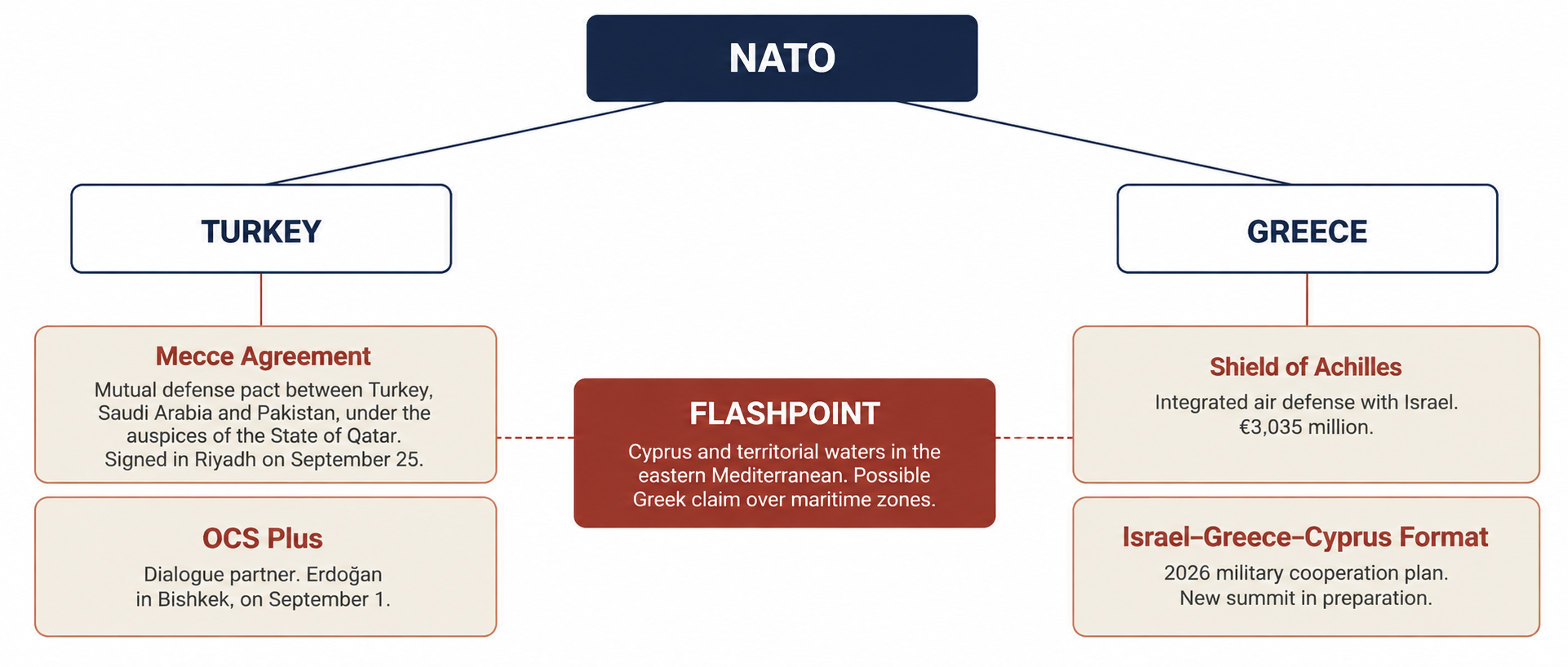
An emblematic case is that of Türkiye and Greece, NATO allies that have just deepened external commitments in different directions. Greece made Israel the supplier of its air defence and maintains a 2026 military work plan with Israel and Cyprus. Türkiye, by contrast, broke off trade relations with Israel in 2024 and, through the Makkah Pact, took on defence commitments with Saudi Arabia and Pakistan. Both ties can coexist as long as the Eastern Mediterranean remains stable. But a crisis between Greece or Cyprus and Türkiye over maritime zones or gas could place external partners on opposite sides of the same dispute, with no clarity as to which of those commitments would prevail.
Figure 5. An emblematic case of overlapping alignments: Türkiye and Greece.
Source: Authors’ elaboration.
FOLLOW-UP INDICATORS
- Whether the original milestones produce capability or remain declarations. A commitment changes the order when it generates something new, such as deployments, force integration or effective sanctions. This can be observed in the Makkah Pact, which has already convened its chiefs of staff, and in the Shield of the Americas, which committed to sanctions against twenty-four organisations.
- Whether the continuity milestones become institutionalised. Reforming charters, creating secretariats or adopting binding agreements shows the move from alignment towards more stable structures. This can be observed in the SCO, with its first amendments in two decades, and in the SPDMM, which moved from an annual meeting towards a status of forces agreement.
- Whether overlapping alignments collide. Realignment is sustainable as long as the commitments of a single state are not activated in opposite directions. The risk appears if Türkiye and Greece end up tied to opposite sides of the same crisis, and in India if its tensions with Pakistan and China increase.
- Whether the superpowers stabilise their rivalry at the expense of third parties. A rapprochement between the United States and China may alter the value of the guarantees its partners receive. The November (APEC) and December (G20) summits, and the fate of the arms package for Taiwan, will be key to watch.
DIEGO SAZO
Head of Research in International Relations
YESCARY MARTÍNEZ
Research Assistant

[1] Glenn H. Snyder, Alliance Politics (Cornell University Press, 1997). Snyder defines alliances as formal associations of states for the use, or non-use, of military force, under specified circumstances, against states outside their membership. Alignment is the broader phenomenon, the expectations of support or opposition in future interactions, of which alliances are only the formal subset.
[2] The relationship between Pakistan and the United States is undergoing a cycle of rapprochement due to Pakistani mediation between Washington and Tehran, among other issues. Husain Haqqani, “Understanding the Upswing in US-Pakistan Relations,” Hudson Institute, June 1, 2026, https://www.hudson.org/foreign-policy/understanding-upswing-us-pakistan-relations-husain-haqqani
[3] “‘Stronger Together’: Carney Welcomes EU Invite for Canada to Become First-Ever Associate Member,” CNBC, September 17, 2026, https://www.cnbc.com/2026/09/17/trump-canada-european-union-tariffs-associate-member-ukraine-.html
[4] The New York Times, “Trump, Taiwan, Arms, and China,” May 18, 2026,
https://www.nytimes.com/es/2026/05/18/espanol/mundo/trump-taiwan-armas-china.html