On the Underfunding of Chile’s National Defense
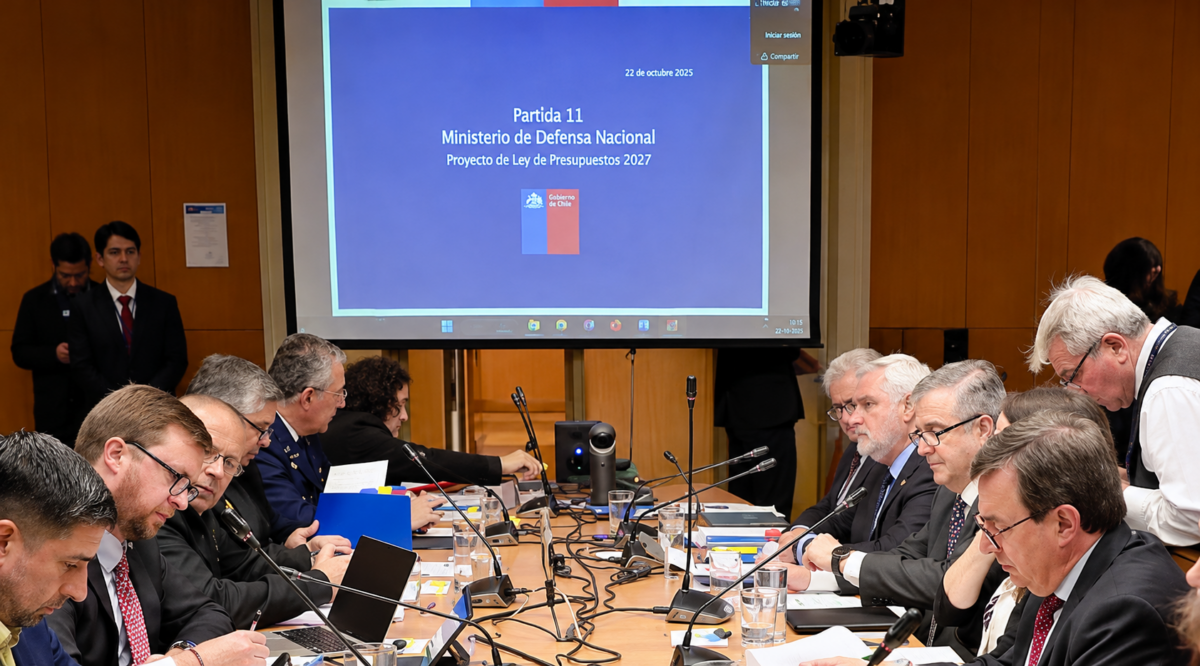
On September 30, the government submitted the 2027 Public Sector Budget Bill for legislative consideration. The outlook is unfavorable: a context of economic adjustment and a fiscal debt that is not declining clearly constrain the funding of State activities and make it difficult to meet public spending reduction targets and commitments.
Nonetheless, the increase in the Defense budget items stands out favorably, although it remains insufficient to reverse a long and progressive financial neglect of this public function. As this analysis shows, over the last quarter century the Chilean State has reduced the share of resources it allocates to the Armed Forces, with an impact that remains barely visible but no less severe.
Current defense funding in Chile, which relies mainly on the Budget Law, the Multiyear Fund for National Defense Strategic Capabilities (FPC, for its Spanish acronym), and the Strategic Contingency Fund (FCE, for its Spanish acronym), does not suffice to maintain and develop the strategic capabilities that allow the defense institutions to carry out the tasks that society itself demands of them. Publicly available data do not allow a precise determination of which basic functions receive full funding and which do not. However, it is possible to identify two types of insufficiency. The first is conceptual: the country expects the Armed Forces to fulfill a growing set of tasks with resources whose relative weight keeps declining, so the gap widens every year. The second is structural and concerns the composition of spending, which limits the capacity to allocate resources to operations, maintenance, and investment.
This document explores four issues that help explain this situation. First, it reviews the 2027 Budget Bill currently under discussion in the National Congress, specifically the provisions concerning the Ministry of National Defense and the armed institutions. Second, it analyzes the behavior of defense resources as a percentage of gross domestic product (GDP) over the last quarter century, which shows a progressive reduction. Next, it shows that demand for Armed Forces tasks has increased over the same period in which resources have declined in relative terms. It then compares Chile with other countries to demonstrate that growing personnel expenditure dominates the structure of the Chilean defense budget, which limits the resources available for other relevant tasks, such as training and equipment maintenance. Finally, given the regional strategic context expected in the coming years, it argues for investment in capability development to maintain a favorable strategic balance and thereby contribute to national deterrence.
CHILE’S NATIONAL DEFENSE BUDGET
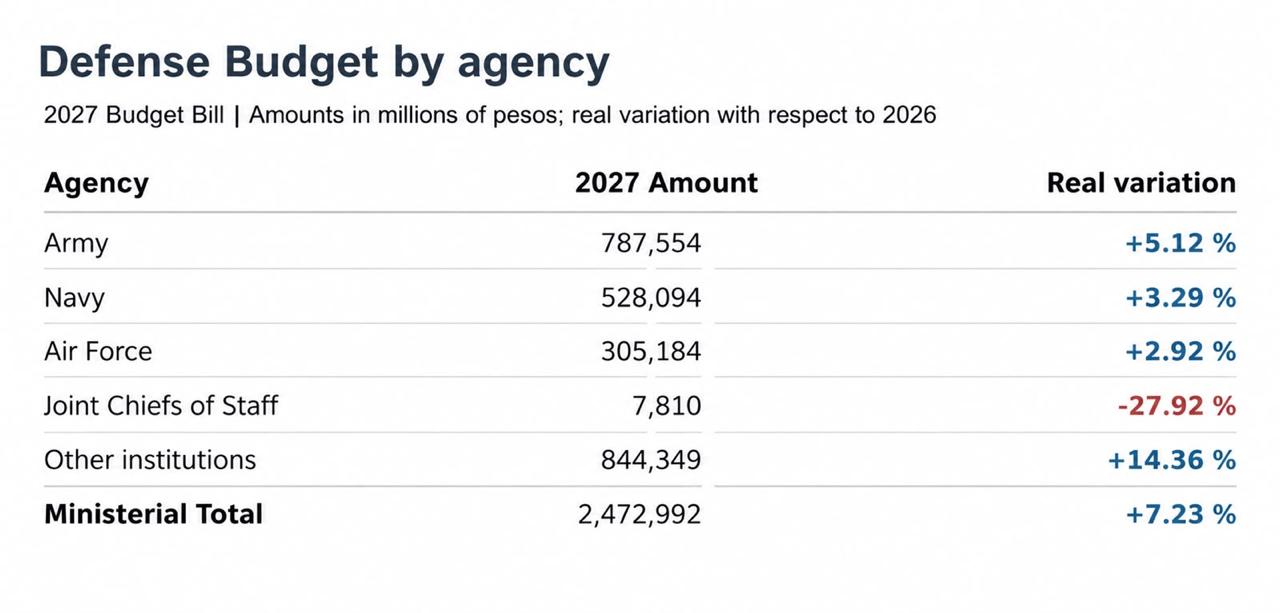
The government plans to allocate CLP 2,472,992,708,000 (about CLP 2.47 trillion) to the Ministry of National Defense for 2027, a real increase of 7.23% over 2026[1]. To show the distribution of the 2027 allocations, Table 1 consolidates the projected amounts in pesos for each agency under the Ministry of National Defense and compares them with the 2026 budget adjusted for inflation[2].
Table 1. 2027 budget of the Ministry of National Defense by agency and real change relative to 2026, in CLP[3]
Source: Authors’ compilation based on data from the Budget Office (DIPRES, for its Spanish acronym) (2026 Budget Law[4] and 2027 Budget Bill).
As Table 1 shows, the increase is uneven: the Army (5.12%), the Navy (3.29%), and the Air Force (2.92%) record real increases, whereas the Joint Staff (EMCO, for its Spanish acronym) faces a real reduction of 27.92%, equivalent to about CLP 3,025 million. The ministerial total also includes other agencies and programs; therefore, it does not equal only the sum of the four institutions presented.
That said, defense funding in Chile does not come solely from the budget items of the Ministry of National Defense. Since the repeal of the Reserved Copper Law (Law 13196 of 1958) and the entry into force of Law 21174 in 2020, the system has relied mainly on three channels: the annual Budget Law allocation mentioned above; the FPC, designed to give stability to medium- and long-term investments in military materiel, associated infrastructure, and sustainment costs[5]; and the FCE[6].
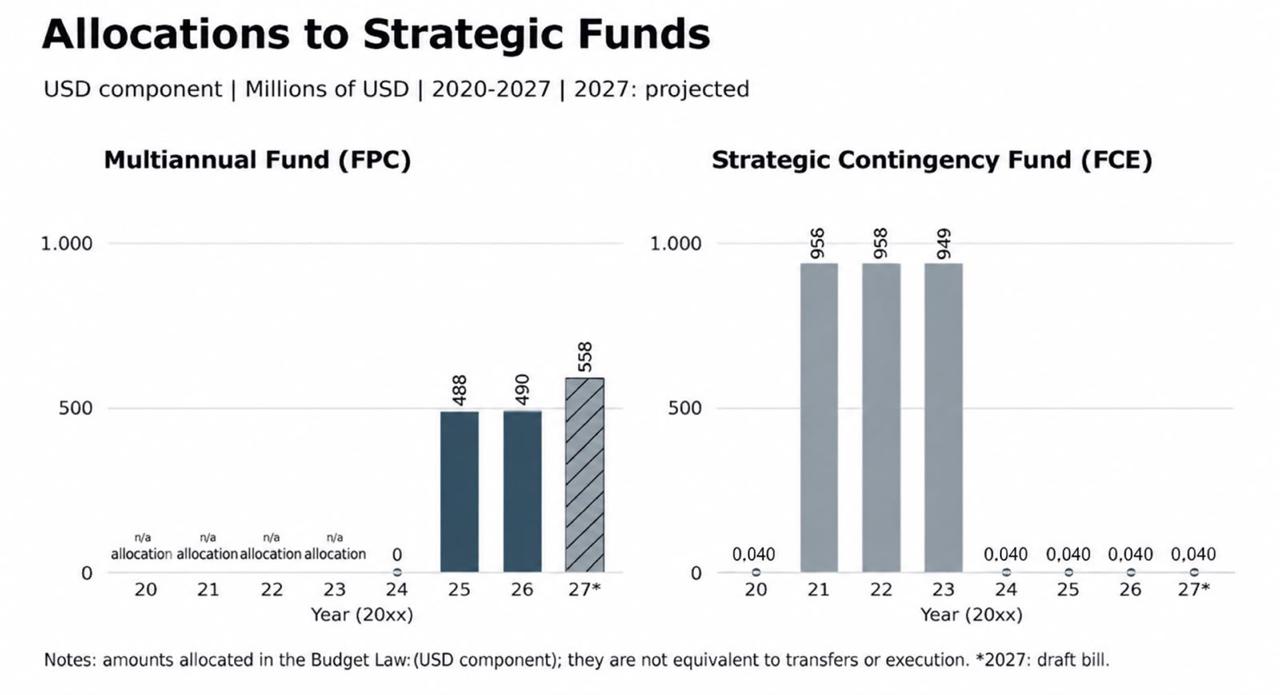
As for the funds, the 2027 bill allocates US$588.4 million to the FPC, while the FCE once again receives only a token allocation, contrary to what the law establishes[7].
HISTORICAL TREND OF MILITARY SPENDING IN CHILE AND ITS DECLINE RELATIVE TO GDP
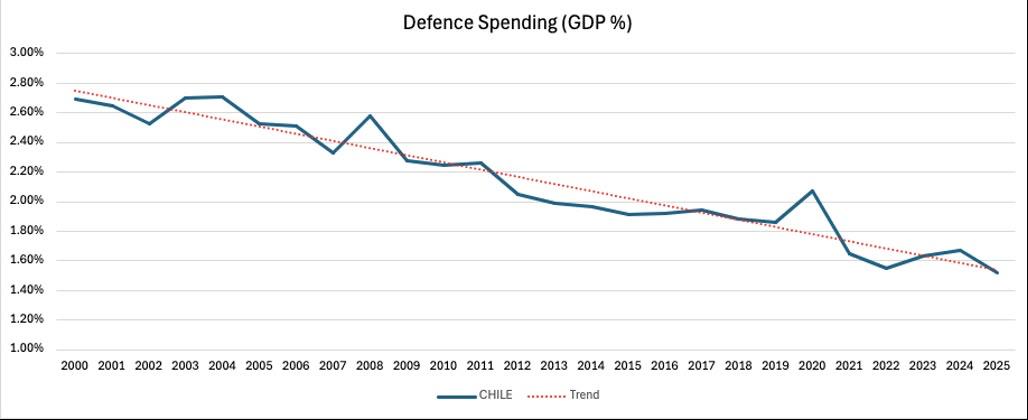
Beyond the amounts proposed for 2027, the most representative observable measure of this situation is the share of GDP that Chile devotes to defense and how this indicator has evolved over the long term. As Figure 1 shows, between 2000 and 2025 Chile went from allocating 2.69% of its GDP to defense (including resources for the National Defense Pension Fund, Capredena, for its Spanish acronym) to 1.52%[8]. The only significant rebound, in 2020, coincides with the contraction of GDP (−5.8%)[9] rather than with an increase in spending in dollars, which remained practically stable that year. The decline is relative: in dollar terms, spending has shown no major variations over the period, but its weight relative to the size of the economy has decreased, in a cycle in which assigned tasks have increased.
Figure 1. Chile’s military expenditure, 2000–2025: percentage of GDP
Source: Authors’ compilation based on SIPRI data[10].
Another problem affecting defense funding concerns the change in the regime for acquiring weapon systems. The Reserved Copper Law (Law 13196) assigned defense resources from a levy on Codelco’s sales[11]. Its repeal and replacement by the FPC and the FCE through Law 21174 sought to stabilize funding through a baseline contribution and four-year planning[12]. In addition, the law transferred 55% of the reserves to the FPC and 20% to the FCE, which also strengthened democratic control over expenditures[13]. However, the new regime has not achieved its first purpose. The 2024 Budget Law provided no resources for either fund, since its Article 35 suspended the obligations of Law 21174[14]. For the FCE, the same situation recurred in both the 2025 Budget Law[15] and the current year’s law[16]. Thus, after receiving about US$936 million per year between 2021 and 2023, the FCE[17] has received only token allocations since 2024[18]. In short, the new system, intended to bring stability and certainty to funding and reassurance in the face of contingencies, did not fulfill that purpose.
Figure 2. Summary of Budget Law contributions to the strategic funds, 2020–2027
Source: Authors’ compilation based on information from the Budget Office (DIPRES), Item 50: Public Treasury[19].
OPERATIONAL OVERLOAD: GROWING DEMANDS
Alongside the progressive relative reduction of defense funding, Chilean society, through successive governments, has increased its demands on the defense institutions.
The Political Constitution, the defense white papers and policies, and the laws derived from them establish what Chile’s Armed Forces must do. The Constitution provides that the Army, the Navy, and the Air Force exist for the defense of the homeland and are essential for national security[20]. On that basis, the National Defense Policy organizes them into five mission areas: (a) defense; (b) contribution to national development and to State action; (c) international cooperation and support for foreign policy; (d) territorial security and interests; and (e) national emergencies and civil protection[21].
These missions include highly visible responsibilities, such as safeguarding electoral processes, deployments during states of exception, and disaster response, as well as less visible ones, such as intelligence, infrastructure development, international support, and training. To sustain them, the National Defense Policy states that the country aspires to maintain and develop strategic capabilities, understood as a relevant asset for the security and defense of Chileans[22]. Consequently, the problem goes beyond how much the country spends; it must address whether that spending enables the preservation and renewal of the capabilities that make it possible to carry out the tasks that both public policy and citizens request, without ceasing to assume the demands of the security environment, should the need arise.
In recent years, a security context marked by regional instability, problems in maintaining public order, the emergence of organized crime, border crises in the Northern Macrozone (MZN, for its Spanish acronym), and the conflict in the Southern Macrozone (MZS, for its Spanish acronym), in addition to obligations related to emergencies, disasters[23], and elections[24], has increased the number of missions. Naturally, this has caused a progressive strain on the armed institutions.
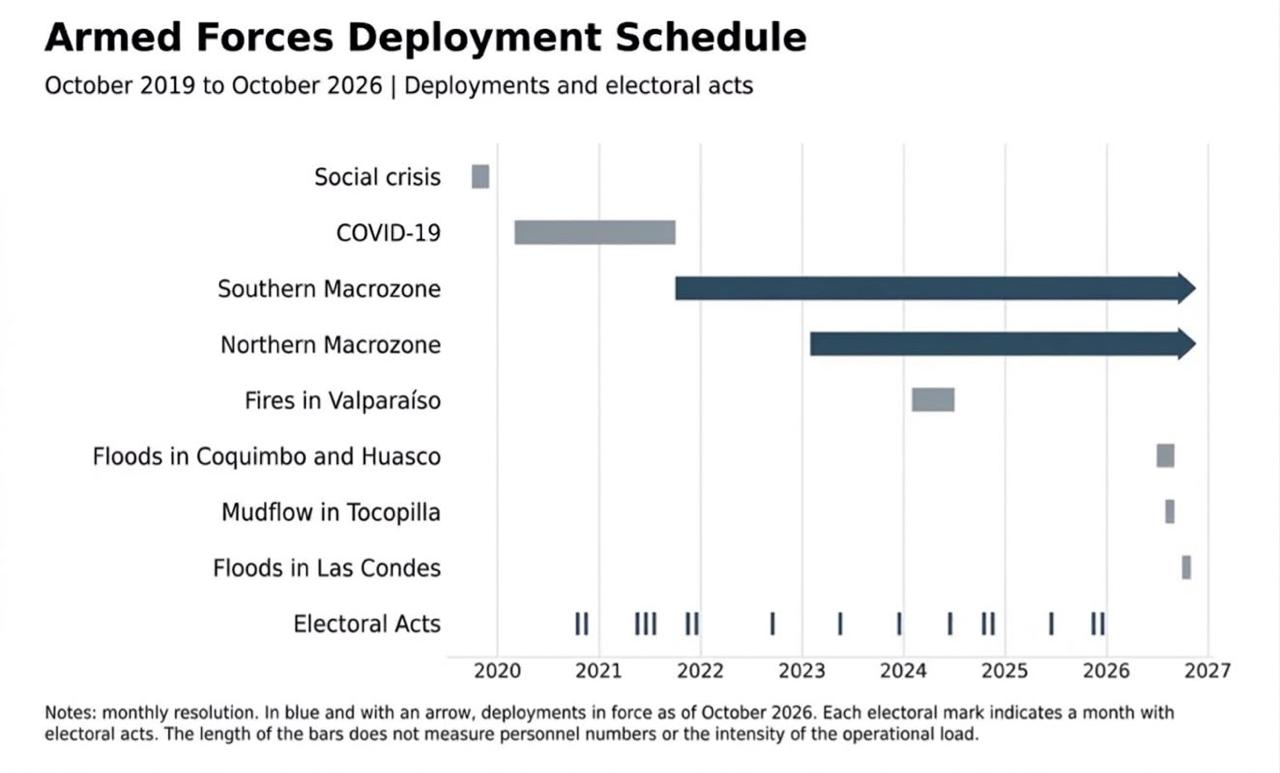
The uninterrupted duration and geographic breadth of deployments, together with a greater number of missions, generate a growing demand for personnel and assets. Moreover, this situation coincides with a lower availability of conscripts[25]. Figure 3 makes this evident by showing the number and duration of Armed Forces deployments for emergencies or disasters.
Figure 3. Armed Forces deployments since 2019
Source: The authors.
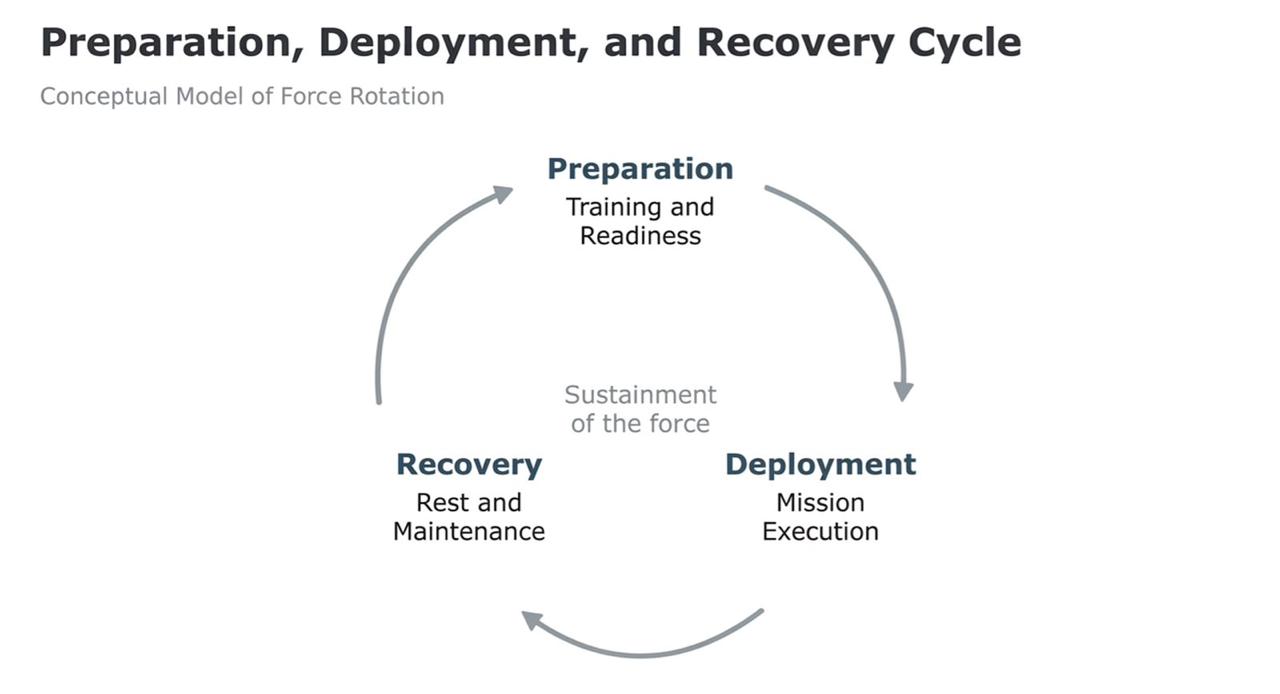
As Figure 3 shows, the Armed Forces have remained continuously deployed in recent years: the COVID-19 health emergency lasted 18 months[26], while the deployments in the MZS (five years)[27] and the MZN (three years)[28] remain in force. In these scenarios, including constitutional states of exception, the deployment itself requires resources, and so does the ecosystem that sustains the interventions. Sustaining the effort demands at least three times the force: one third of the assets deployed, one third in preparation, and one third in post-deployment. Therefore, the real cost of this type of sustained operation extends beyond the personnel in the field and involves the entire rotation cycle.
Figure 4. Force preparation, deployment, and recovery cycle
Source: The authors.
To these tasks one must add the Armed Forces’ support for electoral processes, which mobilize a significant share of their personnel to cover a growing number of polling stations, as well as their response to natural disasters whose frequency shows no sign of declining, as the recent floods in the Metropolitan Region and northern Chile demonstrated. Moreover, recent proposals have even contemplated their involvement in public order matters for prolonged periods[29].
One could argue that the reduction in defense spending is irrelevant if earlier resources were excessive. However, nothing indicates that this was the case, and the decline in relative funding has occurred in parallel with an increase in the operational burden. As a result, the relationship between resources and tasks has deteriorated on both sides, which has also undermined the proper operational maintenance of platforms.
This tension also appears in numerical terms, through the cash deficit and the carried-over debt that the deployments in the MZN and the MZS have generated. In October 2025, before the Senate’s Second Joint Budget Subcommittee, the Army Commander-in-Chief, General Javier Iturriaga, warned that the institution would struggle to close the year, with a financial deficit of nearly CLP 40 billion[30]. Of that amount, more than CLP 14 billion corresponds to the deployments alone, and the situation led the institution to suspend reserve refresher training, postpone bonus payments, and freeze new hiring. Former Minister of Defense Adriana Delpiano acknowledged pending expenses related to the macrozones and the elections and stated that the government would pay them, in part, through transfers from the Ministry of the Interior[31].
This debt plausibly constitutes one of the explanations for the increase in the Ministry’s budget for 2027 (Table 1). Nevertheless, even if injections of resources settle it, the 2025 deficit sends an urgent signal about the budgetary situation of the Armed Forces, all the more so as deployments continue to consume resources permanently.
Beyond the efforts on the northern and southern fronts, the Armed Forces bear other obligations, such as those arising from the Antarctic strategic plan, consistent with the essential nature of this territory for Chile’s sovereignty. In Antarctica, the Armed Forces contribute three of the State’s four Antarctic operators, alongside the Chilean Antarctic Institute (INACH, for its Spanish acronym). According to the 2026–2030 Antarctic Strategic Plan[32], the Ministry of Defense holds responsibility for part of the coordination of research, training, and infrastructure development, functions that it carries out largely through the EMCO.
PREDOMINANCE OF PERSONNEL SPENDING OVER RESOURCES FOR OPERATIONS AND MAINTENANCE
Added to the above is a characteristic feature of defense spending in Chile: the high share of personnel expenditure. This reality reduces the funding available for other relevant functions, such as the operation, training, and maintenance of the units and systems that the armed institutions operate.
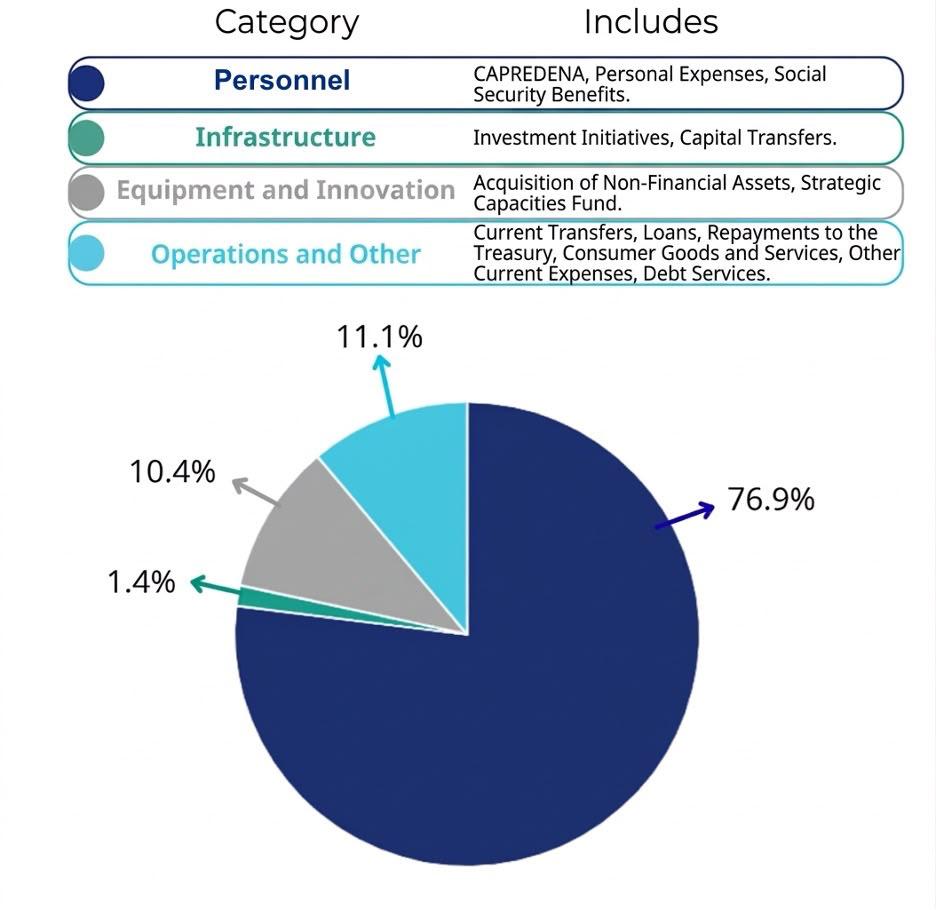
As a reference, it is useful to review international experience, particularly that of the member countries of the North Atlantic Treaty Organization (NATO) and the European Union (EU). An adequate comparison requires an attempt to standardize spending categories and redistribute national budget items among them, following the classification logic that NATO[33] and the European Defence Agency (EDA)[34] apply. For this purpose, this analisys defined four categories, which Figure 5 summarizes. The first, Personnel, comprises all remuneration plus pensions for retired personnel, which Chile finances through the National Defense Pension Fund (Capredena), outside Item 11 of the Budget Law. Both NATO and the EDA include pensions in this category, so the comparison is consistent on this point. The second, Infrastructure, covers, among other items, the construction, modernization, and maintenance of fixed assets such as barracks, airfields, ports, and strategic facilities. The third, Equipment and innovation, includes equipment procurement, research, technology, and investment in innovation, which the Public Treasury currently funds largely through the FPC and the FCE. The fourth, Operations and other, corresponds to day-to-day operational functioning: fuel, routine repairs, spare parts, national and joint maneuvers and exercises, food, clothing, and lodging, as well as capital transfers to other countries for aid purposes. After consolidating defense spending and including the Capredena pension items[35] and the special institutional funds, the total defense spending considered for Chile amounts to CLP 4,771,319,222 (in thousands of CLP), equivalent to US$4,980,500 (in thousands of USD)[36].
Figure 5. Chile’s 2026 defense budget, consolidated by standardized categories (percentage of total; total in millions of pesos)
Composition of consolidated defense spending, Chile 2026
Total: 4,771,319 million pesos
Source: Authors’ compilation based on DIPRES data (Open Budget 2026).
This reclassification shows that, although the overall consolidated spending figure may appear high to the public, the weight of personnel spending, which reaches 76.95% of the total, severely constrains the resources actually available for operations and training. By comparison, Operations and other account for 11.13%, Equipment and innovation for 10.48%, and Infrastructure for barely 1.44%. Although this arithmetic exercise admits review and refinement, methodological adjustments are unlikely to alter this conclusion substantially, given the magnitude of the difference.
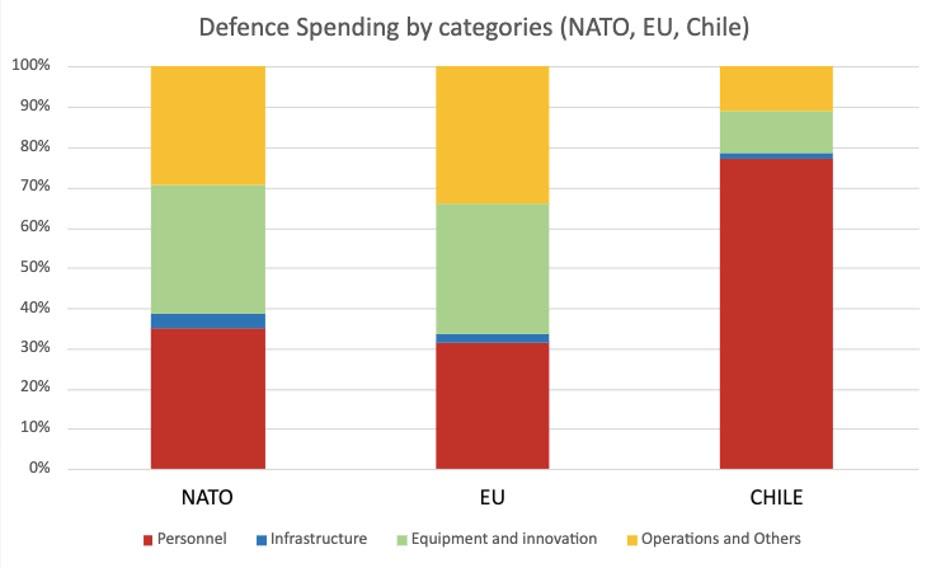
Figure 6. Composition of defense spending by category: NATO, EU, and Chile (percentage of total)
Source: Authors’ compilation based on NATO, EDA, and DIPRES data.
After reclassifying the distribution of spending according to NATO and EU principles, Figure 6 shows a large share for the Personnel category and very small shares for the items allocated to Operations and other and Infrastructure. Whereas in NATO and the EU personnel spending represents approximately one third of the total and about two thirds of resources go to equipment, technological development, ongoing operations, and logistical sustainment, Chile concentrates almost 77% on personnel remuneration and social benefits. Equipment and innovation and Operations and other together account for about 21.6% of Chilean spending, a markedly insufficient fraction to maintain the operational responsiveness of the units, to which one must add the 1.44% allocated to infrastructure. Even allowing for the methodological differences between the classifications, the contrast with Europe is telling: in 2025, EU member states devoted more than 32% of their spending to investment, above the 20% benchmark[37], while Chile devotes 10.48% to equipment and innovation. This does not mean that personnel resources in Chile are excessive; rather, growing tasks require more personnel, not fewer. The problem is that the State invests minimal amounts in its other needs.
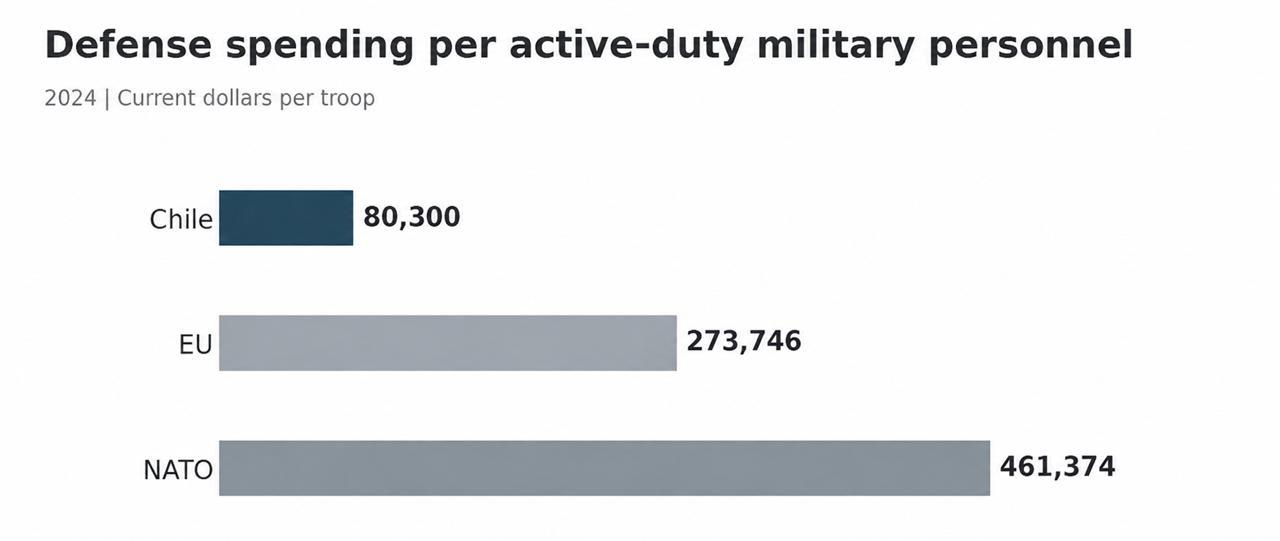
A second point of international comparison is spending per soldier, an indicator that the EDA defines as total defense spending divided by the number of active-duty military personnel in a given year. In the EU, this indicator reached US$273,746 in 2024[38], whereas in Chile spending per soldier for the same year amounted to approximately US$80,300[39], and in NATO to US$461,374[40]. This comparison uses current dollars and does not adjust for differences in prices or wages, so the gap partly reflects those differences. Even so, the gap directly affects the ability to improve equipment and sustainment, which limits the modernization of the assets in service.
Figure 7. Defense spending per active-duty service member, 2024 (current dollars)
Source: Authors’ compilation based on EDA, SIPRI, and NATO data.
POTENTIAL FUTURE STRATEGIC IMBALANCE
Chile bases its strategic position on defending its national interests through deterrence. In addition to political will, this deterrence requires a set of strategic capabilities that, together with other national instruments, make it possible to inflict unacceptable damage. The situation this document has sought to describe reveals a State function that, over time, has had fewer relative resources and has received more tasks. Besides preventing the renewal of systems that have reached the limit of their use due to technological obsolescence, this situation worsens because the greater demand for Armed Forces action has increased the wear on existing materiel, shortening its service life and requiring its replacement or modernization earlier than its life cycle anticipated.
Meanwhile, South America is moving toward the renewal of defense capabilities. In September 2025, the US Department of State approved a possible sale to Peru of 12 F-16 Block 70 fighters, at an estimated cost of US$3.42 billion (maximum authorized amount), intended to control airspace, defend borders, and support operations against drug trafficking and terrorism[41]. In April 2026, the manufacturer announced that the Peruvian government had selected that model to modernize its fighter fleet[42]. Argentina, for its part, agreed with Denmark in 2024 to purchase 24 F-16 fighters, which Denmark is replacing with F-35s[43]. Moreover, Bolivia has put forward a defense plan with a horizon to 2050 and the acquisition of vehicles, patrol units, and interceptor aircraft. In Bolivia’s case, this responds to a new military leadership focused on hybrid warfare, the importance of resources such as lithium, and the fight against drug trafficking[44].
This does not imply an arms race, an imminent threat, or a security dilemma. What this document argues is that deterrence depends significantly on the relative capability a country maintains over time and that, given the maturation timelines of these capabilities, funding decisions not adopted today will shape the strategic balance of the next decade. Chile faces that horizon with the funding uncertainty described above. If relative defense funding declines, tasks increase, and about 77% of resources go to personnel, one cannot reasonably expect those resources to suffice to maintain strategic capabilities, much less to develop those the country aspires to have and thus provide adequate support for deterrence.
CONCLUSIONS
– However welcome the increase in the Ministry of Defense’s 2027 budget may be, defense funding remains clearly insufficient to meet the responsibilities that society demands of the Armed Forces. Over the last quarter century, successive governments have reduced the share of GDP allocated to the sector from 2.69% in 2000 to 1.52% in 2025.
– Over the same period, the tasks and responsibilities of the Armed Forces shifted from traditional defense and disaster relief roles to almost permanent deployments for emergencies, border control, and other public security matters.
– The cumulative effect on materiel and personnel remains invisible to much of society, but it is real and could soon limit the employment of units and assets. The responsible authorities must assess this situation and take the necessary measures to prevent it.
– Compared with NATO and EU countries, Chile spends a low proportion of its resources on operation, training, and maintenance, as well as on the renewal and development of military capabilities. This directly affects the strategic capabilities of national defense and, consequently, the country’s ability to deter, especially in a potential regional context of capability renewal by neighboring countries that could alter the military balance.
– The development of strategic capabilities is a process that demands long-term planning; therefore, political investment decisions must take place now, before the accumulated deterioration becomes irreversible.
– We estimate that demand for Armed Forces tasks will not decrease; on the contrary, it will increase. Under these circumstances, reducing personnel would be clearly irresponsible. The natural option, therefore, is to secure the resources to operate, train, and maintain existing assets while replacing them or developing new capabilities.
– A national methodology for assessing strategic capabilities, tailored to the country’s reality, culture, and needs, emerges as an indispensable complement and an instrument that supports the political direction of defense and better decision-making.
MARCELO MASALLERAS
Director of Research, AthenaLab
MICAELA TRAMER
Research Assistant, AthenaLab
[1] Proyecto de Ley de Presupuestos año 2027. Partida 11, Ministerio de Defensa Nacional. Santiago: DIPRES, 2026. https://www.dipres.gob.cl/597/articles-432167_doc_pdf.pdf?ts=1791250272.
[2] Inflation adjustment factor of 1.028, obtained from the ratio between the 2027 budget and the 2026 base budget in the 2027 budget bill of the Ministry of Defense. The variation between the two amounts (2.83%) represents the inflation projection that DIPRES applied in that formulation (DIPRES, Proyecto de Ley de Presupuestos del Sector Público año 2027).
[3] Real changes represent the effective net growth in institutional spending capacity; the ratio between the 2027 budget and the adjusted 2026 base (factor of 1.028, subsequently applied to the other amounts) avoids the distortion caused by the loss of purchasing power. https://www.dipres.gob.cl/597/articles-432167_doc_pdf.pdf?ts=1791250272.
[4] Ley de Presupuestos de 2026. Partida 11, Ministerio de Defensa Nacional. Santiago: DIPRES, 2025. https://www.dipres.gob.cl/597/articles-397476_doc_pdf.pdf.
[5] Lopes da Silva, D., and Nan Tian (September 16, 2019). Ending Off-Budget Military Funding: Lessons from Chile. Stockholm International Peace Research Institute. https://www.sipri.org/commentary/topical-backgrounder/2019/ending-budget-military-funding-lessons-chile.
[6] Law 21174 of 2019. Establece nuevo mecanismo de financiamiento de las capacidades estratégicas de la defensa nacional. September 26, 2019. D.O. No. 42.462. https://bcn.cl/2esg7; Libertad y Desarrollo (LyD), “Para Defensa nuevamente sin presupuesto,” Temas Públicos, No. 1663, October 2024, https://lyd.org/wp-content/uploads/2024/10/TP-1663-DEFENSA-2025.pdf.
[7] Proyecto de Ley de Presupuestos año 2027. Partida: Tesoro Público. Santiago de Chile: Ministerio de Hacienda, 2026. https://www.dipres.gob.cl/597/articles-430771_doc_pdf.pdf?ts=1791209335.
[8] Stockholm International Peace Research Institute (SIPRI) [2026]. SIPRI Military Expenditure Database. SIPRI. Excel data file, accessed November 2, 2026. https://doi.org/10.55163/CQGC9685.
[9] Banco Central de Chile. Cuentas Nacionales de Chile 2013-2020. Santiago: Banco Central de Chile, 2021. https://si3.bcentral.cl/estadisticas/Principal1/Informes/AnuarioCCNN/pdf/ANUARIO_CCNN_2020.pdf.
[10] SIPRI, “SIPRI Military Expenditure Database.”
[11] Biblioteca del Congreso Nacional de Chile. Aportes de Codelco por Ley Reservada del Cobre. Valparaíso: Departamento de Estudios, Extensión y Publicaciones, September 7, 2016. https://obtienearchivo.bcn.cl/obtienearchivo?id=repositorio/10221/23425/1/Ley%20reservada%20del%20cobre_edPM.pdf.
[12] LyD, “Para Defensa nuevamente sin presupuesto.”
[13] Law 21174.
[14] Law 21640 of 2023. Ley de Presupuestos del Sector Público correspondiente al año 2024. December 18, 2023. D.O. No. 43.728-B. https://bcn.cl/3h3fa.
[15] Law 21722 of 2024. Ley de Presupuestos del Sector Público correspondiente al año 2025. December 13, 2024. D.O. No. 44.023-B. https://bcn.cl/sVH2FK.
[16] Law 21796 of 2025. Ley de Presupuestos del Sector Público correspondiente al año 2026. December 12, 2025. D.O. No. 44.322-C. https://bcn.cl/RshiJs.
[17] Proyecto de Ley de Presupuestos para el año 2027. Cuadro Comparativo Analítico Años 2026-2027. Partida: Tesoro Público, Capítulo: Fisco, Programa: Fondo de Contingencia Estratégico. Santiago: Ministerio de Hacienda, 2026. https://www.dipres.gob.cl/597/articles-431264_doc_pdf.pdf?ts=1791248956.
[18] Masalleras, M. (September 12, 2025). Financiamiento de capacidades estratégicas: creer o no creer”. AthenaLab. https://www.athenalab.org/publicaciones/analisis-es/2025/09/12/comentario-financiamiento-de-capacidades-estrategicas-creer-o-no-creer/.
[19] Dirección de Presupuestos. 2026. Proyecto de Ley de Presupuestos para el Año 2027: Cuadro Comparativo Analítico Años 2026 – 2027. Partida: Tesoro Público, Capítulo: Fisco, Programa: Fondo Plurianual para las Capacidades Estratégicas de la Defensa. Santiago de Chile: Ministerio de Hacienda. https://www.dipres.gob.cl/597/articles-431265_doc_pdf.pdf?ts=1791248960.
[20] Decree 100 of 2005 [Latest Version – 16-APR-2026]. Fija el texto refundido, coordinado y sistematizado de la Constitución Política de la República de Chile. September 17, 2005. D.O. No. 38.268.
[21] Ministerio de Defensa Nacional, Política de Defensa Nacional de Chile 2020 (Santiago: Ministerio de Defensa Nacional, 2020).
[22] Ministerio de Defensa Nacional, Política de Defensa Nacional.
[23] Decree 112 of 2026 [Ministerio del Interior; Subsecretaría del Interior]. Declara estado de Excepción Constitucional de Catástrofe por Calamidad Pública en la Provincia de Huasco de la Región de Atacama y en la Región de Coquimbo. July 20, 2026. https://bcn.cl/JrXcaU.
[24] Servicio Electoral de Chile, “Resultados electorales Históricos,” accessed November 2, 2026, https://www.servel.cl/biblioteca-de-documentos/resultados-electorales-historicos/.
[25] Dirección General de Movilización Nacional. Response to information request No. AD013T0004163, May 2024.
[26] Ejército de Chile (October 1, 2021). “Fin del estado de excepción: Participación del Ejército en la Emergencia Sanitaria.” Prensa y Multimedia. https://www.ejercito.cl/prensa/visor/fin-del-estado-de-excepcion-participacion-del-ejercito-en-la-emergencia-sanitaria.
[27] Horzella Cutbill, B. (2026). Estado de Excepción Constitucional de Emergencia en la Macrozona Sur: Antecedentes normativos y despliegue de las FF.AA. No. SUP 153150. Biblioteca del Congreso Nacional de Chile, Asesoría Técnica Parlamentaria. https://obtienearchivo.bcn.cl/obtienearchivo?id=repositorio/10221/38281/1/Informe_BCN_Estado_de_Excepcion_Constitucional_de_Emergencia_en_la_Macrozona_Sur_Antecedentes_normativos_y_despliegue_de_las_FFAA.pdf.
[28] Decree 143 of 2023. Prórroga declaración de estado de excepción constitucional de emergencia en las zonas del territorio nacional que indica. [Decree 143 of May 19, 2023]. D.O. No. 43.560-B, May 25, 2023. CVE 2322043. https://www.diariooficial.interior.gob.cl/publicaciones/2023/05/25/43560-B/01/2322043.pdf.
[29] Cámara de Diputadas y Diputados de Chile. Proyecto de reforma constitucional, iniciado en Mensaje de Su Excelencia el Presidente de la República, que fortalece el sistema nacional de seguridad pública y crea un nuevo estado de excepción constitucional de seguridad pública. Message No. 134-374, Bulletin No. 18.597-07, Santiago, August 10, 2026. https://www.camara.cl/verDoc.aspx?prmID=18828&prmTIPO=INICIATIVA.
[30] “Discusión del Presupuesto: Ejército y Armada alertan dificultades económicas para terminar el año,” El Dínamo, October 9, 2025, https://www.eldinamo.cl/politica/2025/10/09/discusion-del-presupuesto-ejercito-y-armada-alertan-dificultades-economicas-para-terminar-el-ano/.
[31] Zapata, J. (October 10, 2025). Gobierno descarta desfinanciamiento del Ejército y asegura entrega de recursos durante 2025. Radio Universidad de Chile. https://radio.uchile.cl/2025/10/10/gobierno-descarta-desfinanciamiento-del-ejercito-y-asegura-entrega-de-recursos-durante-2025/.
[32] Consejo de Política Antártica. Plan Estratégico Antártico 2026-2030. Santiago: Ministerio de Relaciones Exteriores, 2025. https://bibliotecadigital.ciren.cl/server/api/core/bitstreams/3ba8b07c-88c5-4647-afb9-cc90bea7748d/content.
[33] North Atlantic Treaty Organization (NATO) [2026]. Defence Investment of NATO Countries (2014-2026). NATO. https://www.nato.int/content/dam/nato/webready/documents/finance/def-exp-2026-en.pdf.
[34] European Defence Agency (EDA), Defence Data 2025–2026 (Brussels: EDA, 2026), https://eda.europa.eu/docs/default-source/eda-publications/2026-eda_defencedata_webpublic.pdf.
[35] Serie Histórica Años 2022-2026. Información de Ejecución Presupuestaria. Partida: Ministerio del Trabajo y Previsión Social, Capítulo: Caja de Previsión de la Defensa Nacional, Programa: Caja de Previsión de la Defensa Nacional. Santiago: Ministerio de Hacienda, 2026. https://www.dipres.gob.cl/597/articles-432669_doc_pdf.pdf?ts=1791251271.
[36] Figures in US dollars (USD), calculated using the reference exchange rate of CLP 958 per US dollar, in accordance with the macroeconomic assumptions for fiscal year 2026 that the Budget Office (DIPRES) established in its Public Finance Report. https://www.dipres.gob.cl/598/articles-386772_doc_pdf.pdf.
[37] EDA, Defence Data 2025–2026.
[38] Ibid. Equivalent to €253,000, converted into dollars using the European Central Bank’s reference exchange rate for 2024, https://www.ecb.europa.eu/stats/policy_and_exchange_rates/euro_reference_exchange_rates/html/eurofxref-graph-usd.en.html.
[39] Authors’ calculation: US$5.5 billion in defense spending (Stockholm International Peace Research Institute [SIPRI], SIPRI Military Expenditure Database [Stockholm: SIPRI, 2026], https://www.sipri.org/databases/milex) divided by 68,500 active-duty personnel (International Institute for Strategic Studies [IISS], The Military Balance 2024 [London: Routledge, 2024]).
[40] Authors’ calculation: US$1,482,905 million in defense spending divided by 3,214,100 active-duty personnel (https://www.nato.int/content/dam/nato/webready/documents/finance/def-exp-2026-en.pdf).
[41] Defense Security Cooperation Agency (DSCA). “Peru – F-16 Aircraft.” Press release No. 25-96, September 15, 2025. https://media.defense.gov/2025/Sep/15/2003799962/-1/-1/0/PRESS%20RELEASE%20-%20PERU%2025-96%20CN.PDF.
[42] Lockheed Martin (April 23, 2026). Perú selecciona el F-16 Block 70 de Lockheed Martin para fortalecer su soberanía y alianza estratégica con EE. UU. Lockheedmartin.com. https://news.lockheedmartin.com/2026-04-23-peru-selecciona-el-f-16-block-70-de-lockheed-martin-para-fortalecer-su-soberania-y-alianza-estrategica-con-ee-uu.
[43] Danish Ministry of Defence (March 26, 2024). “Denmark and Argentina Agree on Sale of 24 Danish F-16 Fighter Jets.” News. Danish Ministry of Defence. https://www.fmn.dk/en/news/2024/denmark-and-argentina-agree-on-sale-of-24-danish-f-16-fighter-jets/.
[44] Instantáneas (August 7, 2025). Arce propone nueva política de defensa para Bolivia hasta 2050. Instantaneas.org. https://www.instantaneas.org.bo/2025/08/07/medio-ambiente/arce-propone-nueva-politica-defensa-bolivia-2050; Hernández, C. (January 3, 2026). Bolivia plantea nuevo enfoque de política de defensa. Infodefensa. https://www.infodefensa.com/texto-diario/mostrar/5716961/bolivia-plantea-nuevo-enfoque-politica-defensa; Meglioli, L. E. (February 14, 2026). Bolivia redefine su estrategia de defensa con un ambicioso plan a 2050. Escudo Digital. https://www.escudodigital.com/internacional/latinoamerica/bolivia-redefine-su-estrategia-de-defensa-con-un-ambicioso-plan-a-2050.html.