Chile, Tonga, and the South Pacific
This article was translated automatically and may contain differences from the original. For reference, read the original.
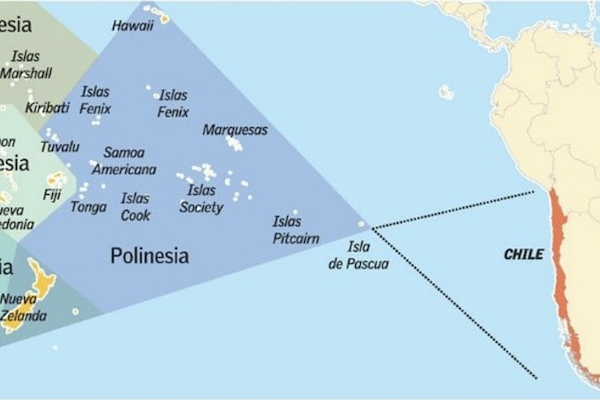
In the midst of summer, millions of Chileans were alerted to the impact on the coasts from the eruption of a volcano in Tonga, an island nation thousands of kilometers away. Fortunately, there was nothing to lament, thanks to an improved tsunami alert system; nonetheless, the emergency served as a reminder of how interconnected we are with the South Pacific, especially through Rapa Nui.
Chile’s Projection to the South Pacific
The South Pacific also has the largest number of non-independent territories and a great diversity of political-administrative situations. Democracies predominate there, and coordination among these states and territories occurs through the Pacific Islands Forum.[1], to which Chile is associated as a “dialogue partner.”
It is in this area that the Kingdom of Tonga is located, the only monarchy in this part of the world. It has a population of 100,209 inhabitants and a land area of 720 km², but it possesses an exclusive economic zone of 700,000 km². The stark difference between the limited land area and the vast maritime expanse is a constant among all countries in the three regions.
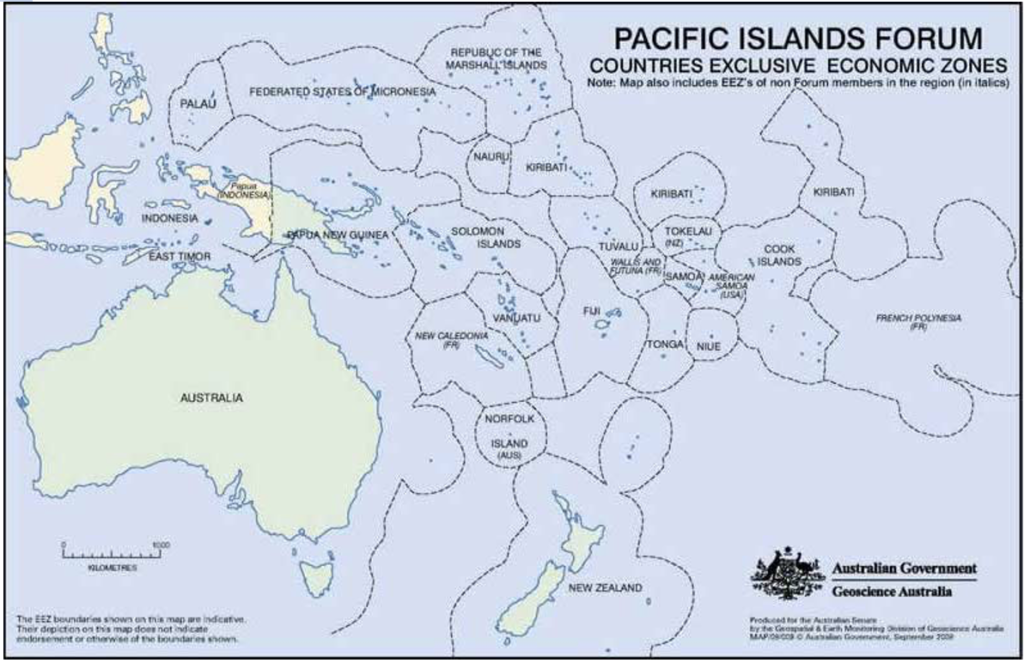
Given its morphology and location, these island countries are territories that are highly exposed to the effects of natural disasters. Situated in the Pacific Ring of Fire, they, along with Chile, are in an area where seismic events impact collectively. Additionally, ongoing climate change, with the consequent rise in sea levels, could reduce several territories or leave them completely underwater.
For all the above reasons, Chile cannot be excluded from the discussion about what happens in that area. Not only do our maritime trade routes cross the region on the way to our main trading partners, but there are also shared realities resulting from a geographical and cultural connection.
Interests
Recently, the South Pacific has also become a geographical area of rivalry between the U.S. and China. Both countries have developed strategies that include establishing bilateral defense ties with island nations, making investments, and providing development aid. However, Washington has an advantage in the region, as it has territories that allow for a permanent presence, such as the Marshall Islands, American Samoa, and especially Guam. Furthermore, it has allies like Australia and, to a lesser extent, New Zealand.
China takes advantage of the fact that a significant number of island states have economies that are highly dependent on external factors and low levels of development to increase its presence through trade or diplomacy. Its fishing fleets are also deployed in the area, which is not always well received.
Recently, two Chinese transport planes landed in Tonga with humanitarian aid to address the disaster caused by the latest volcanic eruption. This is part of a development support program for the kingdom that has been ongoing for several years. Items for agriculture, fishing, education, health, and environmental protection have been delivered. The delivery of eight tractors, along with computers and teaching materials, was received by Prime Minister Hu’akavameiliku himself. This dynamic is expected to continue over time, as stated by the Chinese ambassador to the kingdom.[2]
In this way, the competition among great powers in the region extends to areas where it is possible to contest their influence, and the islands of the South Pacific are no exception. Additionally, all these island states have representation in the United Nations and, therefore, become one more vote in the plenary of the organization.
Secondly, this particular area represents a strategic zone for both Australia and New Zealand, which serve as development references for our country, as well as becoming relevant partners in economic and security matters. Chile, along with these two states, represents the largest economies in the South Pacific, which constitutes both a challenge and an opportunity. We share common values such as respect for freedom, democracy, free trade, the rule of law, and human rights. We are open economies dependent on foreign trade, and our natural area of relations is marked by the Pacific Ocean.
The importance of the South Pacific for Oceania is clear and is evidenced by the fact that the first countries to react to the volcanic eruption in Tonga were Australia and New Zealand. In both cases, as soon as the events occurred, they dispatched air and maritime resources to assess the situation, establish links, and transport aid.[3]
What We Can Do in the Region
The position of Rapa Nui and the growing economic and political ties with Australia and New Zealand should lead Chile to strengthen its projection to the South Pacific. In this regard, national participation in regional forums and instances is key to consolidating our position in this area.
The presence of Chinese fishing fleets in the South Pacific, including areas close to exclusive economic zones, represents a threat and requires adequate coordination among countries, their navies, and air forces for control. This is defined in various international agreements that assign our country a series of obligations and responsibilities in the areas of maritime and aerial security over an extensive area of the Pacific.
It is also important to consider the cultural ties that exist among the indigenous peoples of the various islands. Chile, Tonga, New Zealand, and others are states that have populations of Māori descent.
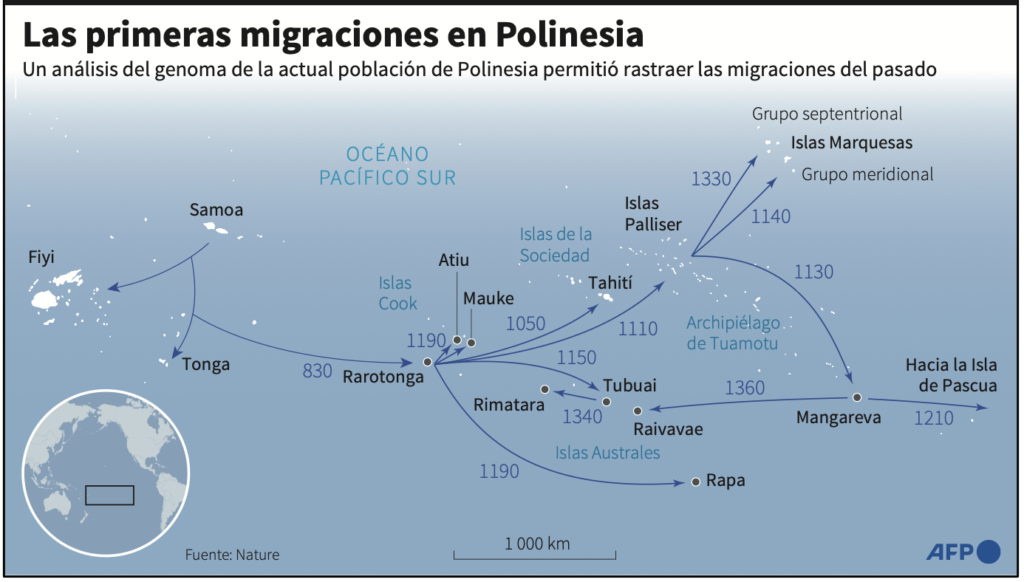
Chile’s recent incorporation into the Pacific Islands Forum as a “Dialogue Partner,”[4] represents a good opportunity to generate ties and cooperation opportunities. Within this initiative, coordination with Australia and New Zealand is of utmost importance.
Preparation for natural disaster response represents, for example, an aspect of cooperation in the region to which Chile can contribute significantly due to its experiences with earthquakes and tsunamis.
Finally, considering that the majority of Chile’s trade moves through the Pacific and that its largest partners are coastal states such as Australia, China, and the U.S., a situation of instability, a security crisis, or a major natural disaster could affect maritime traffic or undersea fiber optic cables, and therefore, the country. In other words, it is worth being concerned about Tonga.
[1] The Pacific Islands Forum was founded in 1971 as the South Pacific Forum and was renamed in 2000 as the Pacific Islands Forum. Its mission is to implement the decisions of leaders for the benefit of the people of the Pacific and to seek to stimulate economic growth, strengthen political governance, and enhance security in the region through political advice.
[2] http://pmo.gov.to/index.php/2022/01/13/prc-donates-tractors-and-educational-materials-to-tonga/
[3] https://www.euronews.com/2022/01/22/tonga-volcano-eruption-australia-and-new-zealand-deliver-water-and-telecommunications-aid
[4] https://minrel.gob.cl/noticias-anteriores/chile-se-incorpora-como-socio-de-dialogo-del-foro-de-las-islas-del-pacifico