Urban Violence: A Public Security Alert for Chile
This article was translated automatically and may contain differences from the original. For reference, read the original.
- por Pilar Lizana
- Análisis
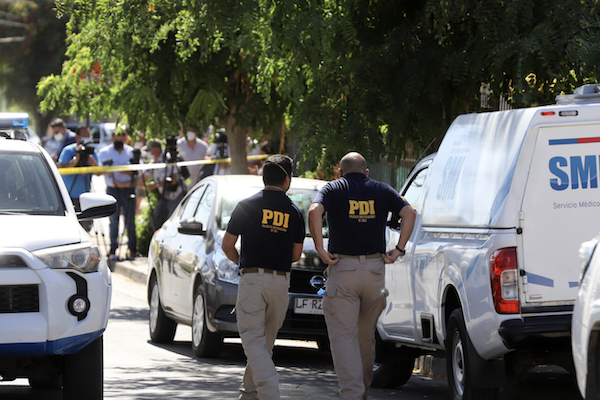
The beginning of summer was violent. The main hotspots were large urban centers in central and northern Chile. There were murders with signs of contract killing, extortion, and kidnappings that concerned citizens and the government. However, despite everything, we still maintain one of the lowest homicide rates in all of Latin America. While it is not difficult to hold that position when we are located in the most dangerous continent in the world, the culture of gangs associated with transnational organized crime will not be kept at bay for much longer.
In Chile, ten years into the 21st century, the security landscape was very different; violence had not yet reached the cities, and it was thought that it would not. The discussion was not about urban violence but rather victimization; property crimes were the norm, and the homicide trend was downward. Today, the situation is very different. The country is witnessing imported crimes, and the media report an increasing number of murders. What is happening around us and how we have evolved are matters worth reviewing.
THE VIOLENCE LANDSCAPE IN LATIN AMERICA 2021
Today, violence in Latin America has a strong urban component. Gangs involved in organized crime are fighting for territorial control and taking over cities for drug storage and distribution, which is the main cause of this violence. These organizations have constructed social orders based on misinterpreted loyalties and corruption that have changed the face of many cities in the region.
In this context, in 2021, most countries showed increases in their homicide rates, framed within a moment when drug trafficking and other organized crime activities found new opportunities as the world reopened after lockdowns.
Ecuador exhibited the largest increase in urban violence indicators, nearly doubling the murders from 2020. Colombia experienced a rise in deaths not seen in seven years. In Venezuela, security forces killed six people daily.
Mexico is the best example of how drug trafficking has gained ground over the state. In 2021, there were more than 90 daily deaths, and the most violent elections in history took place.
There is little information about how violence behaves in our neighboring countries. However, Peru has shown a concerning situation: in Lima, a state of emergency was declared due to citizen insecurity, and the jungle area of Vraem, the largest coca producer, has experienced massacres at the hands of Sendero Luminoso. In Argentina, the city of Rosario has shown an escalation of violence that could be attributed to gang control. Bolivia has no known data.
Thus, our environment shows a very deteriorated security context that repeats patterns across different countries. Compared to them, we live in a privileged situation. But what happens when we compare ourselves to our own past?
EVOLUTION OF URBAN VIOLENCE IN CHILE
Our country has the lowest homicide rate in the region, with 3.6 murders per 100,000 inhabitants according to the annual report from Insight Crime. We are infinitely better off than other Latin American countries, and there is no doubt that, in terms of the number of deaths, 2021 was less violent than 2020, but it does not feel that way. In recent years, a change in the nature of crime has been observed, with an alarming increase in violence levels. After carjackings came highway ambushes, followed by territorial disputes between illegal trade gangs in urban centers, narco-funerals as a demonstration of the organization of drug trafficking groups, and confrontations in hospitals between those seeking to protect the injured and those waiting to finish the job.
We have transitioned to a public security context where organized gangs associated with transnational crimes have brought a different way of doing things to the country. Homicides have increased by 43% in the last five years, clearly evidencing the arrival of settling scores as a cause of deaths.
The gangs and cartels that cause so much harm in Latin America are getting closer. The Venezuelan Tren de Aragua is already in Chile, and the Mexican Sinaloa and Jalisco New Generation cartels began their explorations to establish themselves in the country a few years ago. Hierarchies have been replicated in prisons to operate from within, and Iquique has attracted the attention of arms traffickers. Additionally, the migratory collapse at the northern border has not helped reduce the perception of insecurity.
In this regard, the Regional Prosecutor of Tarapacá, in his annual public report, stated that the emergence of violent criminal gangs is accompanied by human trafficking, arms trafficking, and crimes associated with organized crime. In this context, he noted that homicides increased by 183% and migrant trafficking by 501%.
The state has proposed laws and operational plans to combat organized crime. Notable among them is the recently enacted law that penalizes illegal trade and the V plans against highway ambushes and VI anti-drug plans developed by Carabineros de Chile since last year. However, these will not be fully effective unless they are integrated into a public security system that generates synergies between arrests, crime prosecution, and reintegration. Research, information, and intelligence must be complemented by the need for coordination among agencies.
However, it is important to consider that national, regional, and even communal realities are not the same. Each area of Chile must deal with different types of crime and issues, but a constant for all is the change in the homicide trend in the country during the first 20 years of the 21st century. The first decade showed a less complex landscape for Chileans, while in other parts of the region, urban violence was rapidly increasing. The number of homicides was relatively stable with a slight downward trend. However, the landscape began to change in 2011 with a small increase compared to the previous year, which became more pronounced in 2017 and reached its peak in 2020, indicating a clear upward trend.
Fig. 1: Total Homicides Nationwide Comparative Period 2006-2010 and 2011-2020
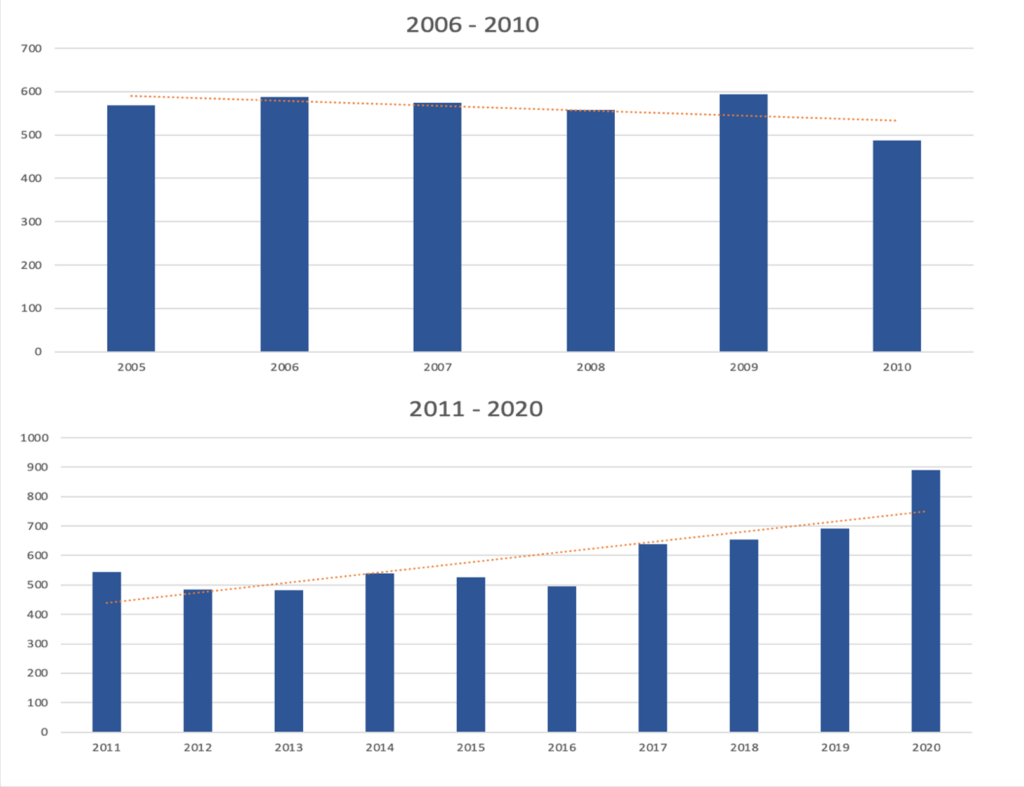
Source: Crime Study and Analysis Center, Ministry of the Interior
Additionally, there is a concerning increase in the relationship between drug-related and violent crimes. Both reports of crimes associated with narcotics and homicides, as well as between drugs and deaths, have shown an upward trend when analyzing the last decade.
Fig. 2: Reports of Homicides, Drugs, and Weapons 2010 – 2020
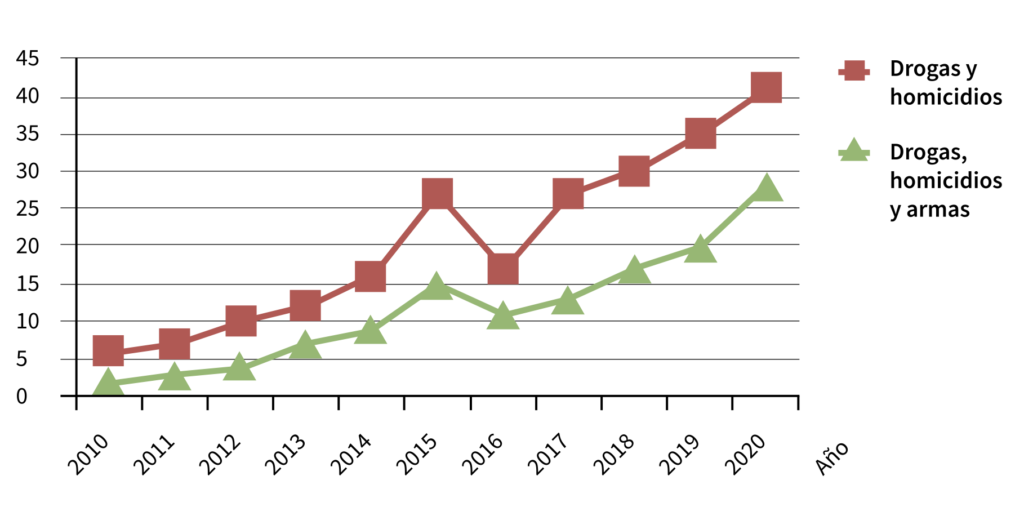
In Latin America, the main causes of violence are related to the actions of organized crime gangs that dispute territories among themselves and with the state. Therefore, considering the context in which Chile is situated, an increase in violence levels and the change observed in the nature of crime could be an indicator that the situations experienced in other countries may be permeating our borders.
Nonetheless, Chile remains better positioned than other countries in the region. The problem arises when we compare ourselves to our own past. There, we see a change in trend and concerning figures. Undoubtedly, the levels of institutional strength and transparency help. However, given our high global interconnection, the establishment of organized crime is inevitable. The arrival of new criminal methodologies and increased violence in crimes is proof of this.
THE CURRENT SITUATION
During the first month of 2022, we witnessed a noticeable increase in homicides in certain areas. The regions of Tarapacá, Valparaíso, and Metropolitana were the scenes of violent crimes, where there was a clear indication of contract killing. Additionally, it should be noted that these regions face particular public security issues. In the north, the Tarapacá region suffers the consequences of a very porous border through which irregular migration has begun to arrive in large numbers, while drug seizures at sea continue unabated, and Iquique has received arms smuggling. In Valparaíso, alongside significant marijuana seizures at one of its ports in 2020, urban centers in the region still bear the consequences of the social outbreak. The Metropolitana region, which concentrates more than 40% of the national population, is a major drug consumption center, which has allowed organized gangs to respond to that demand while coexisting with the deterioration of its cities as a consequence of October 18.
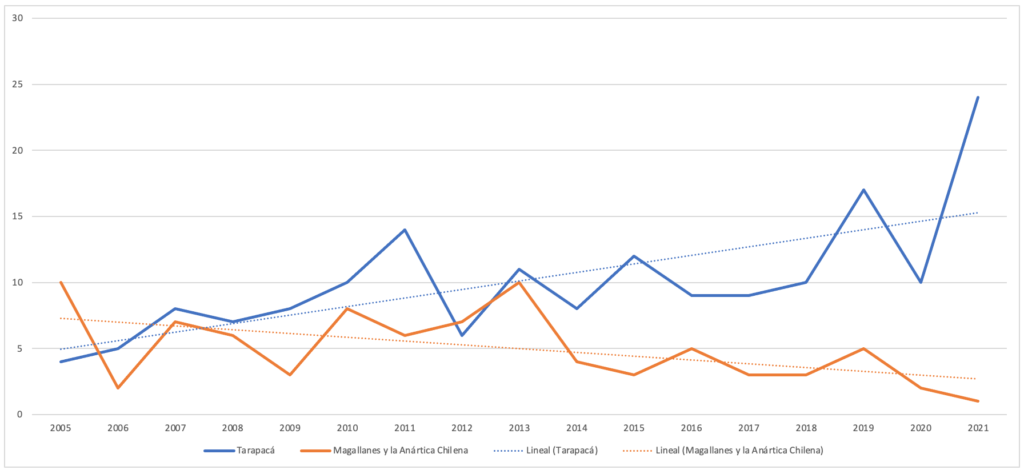
When reviewing the figures from the last year, a general decrease in homicides is observed. However, the regions of Arica and Parinacota, Tarapacá, and Ñuble show an increase in murders. Among them, the first region shows the highest increase, with more than double the deaths compared to 2020.
Almost 70% of murders are concentrated in four regions: Metropolitana, Valparaíso, Biobío, and Tarapacá. Of these, Santiago accounts for nearly half. However, it is relevant to monitor the behavior of the first region, as irregular migration and drug trafficking create conditions for the development of homicide crimes. In contrast, Magallanes and the Chilean Antarctic show a downward trend.
Fig. 3: Evolution of Homicides in the Tarapacá and Magallanes Regions 2005 – 2021
Source: Crime Study and Analysis Center, Ministry of the Interior
Thus, the data reveals a concerning situation at the national level regarding the upward trend in homicide crimes. The alert comes alongside the increase in deaths caused by settling scores. The arrival of new criminal methodologies for which we were unprepared is evident.
Additionally, the contrast between Tarapacá and Magallanes reflects the different realities experienced in Chile, highlighting the need for the national strategy to have specialized focuses in each region. We need a public security system that addresses the new criminal reality but has sufficient flexibility to adopt regional approaches that integrate into the national objective.
REFLECTIONS
The context of urban violence in Latin America provides relevant information for the development of projections and security strategies in Chile. It also highlights the clear influence of transnational phenomena and how they impact the state, confirming that today, a security strategy cannot lack an international component and must be based on a broad vision of the concept of security, which includes threats such as drug trafficking, organized crime, and money laundering, among others.
The national situation could be positive when compared to the regional context. However, the outlook changes when reviewing the national evolution of violence. Chile in 2010 was very different from that in 2020. In two decades, the trend changed, and crimes became more violent. This must be understood as an alert that compels agencies to modernize their planning, act in coordination, and adopt a comprehensive approach to the phenomenon. It is essential to understand that the nature of crime is being driven by the connections brought about by the process of globalization.
We live in a complex neighborhood; from north to south, states suffer the consequences of organized crime. We cannot think that it will not reach our country. With the current interconnection, it is inevitable. The important thing is to get ahead and design combat policies that will allow us to keep it under control to avoid replicating situations like those in Mexico. In this regard, Latin America provides important examples.