The Strategic Importance of Lithium
This article was translated automatically and may contain differences from the original. For reference, read the original.
- por Pilar Lizana
- Análisis
Global interest in securing access to strategic resources for development has placed Chile in a significant position in the race for lithium. At the national level, the bidding for 80,000 tons has opened a debate where little has been discussed about the importance of this metal, its share in global production, and the positioning it can achieve in areas of global interest such as electromobility and climate change.
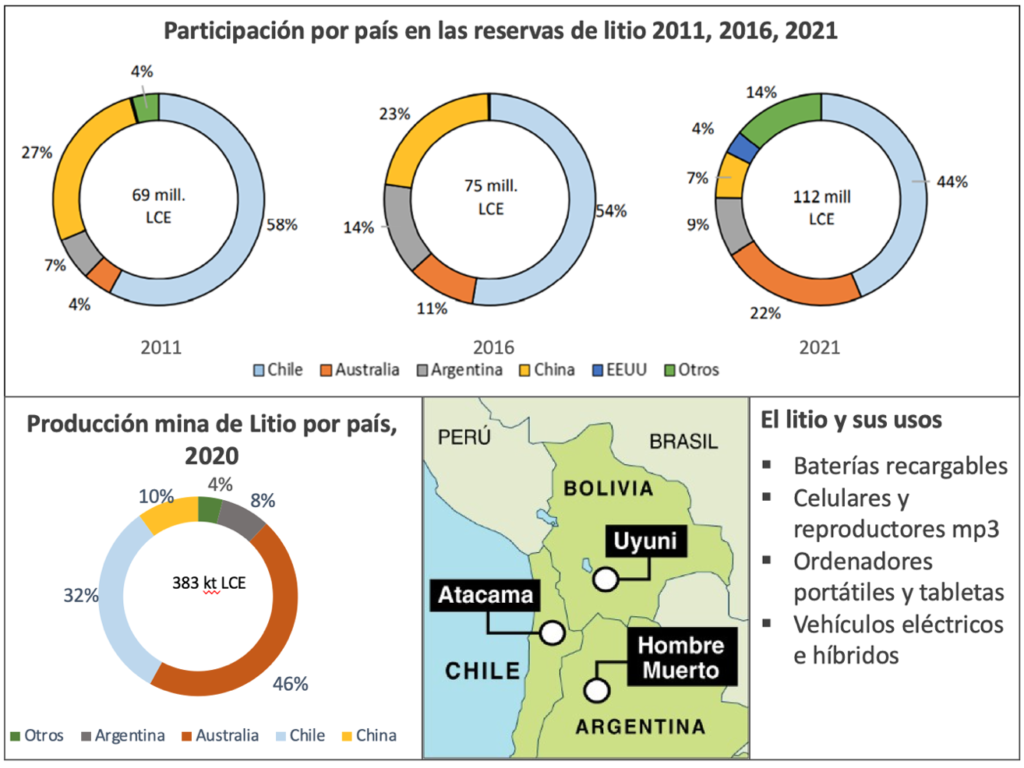
Our country holds just over half of the world’s total lithium reserves and has a production share of around 30%. In a global context where the planetary demand for the lightest metal is expanding, it is worth questioning the importance of this resource for Chile and the role the country will play in the competition for it.
In a world rapidly transitioning to electric vehicle production, where countries have set electromobility goals alongside their automotive industries, and considering that a quarter of global greenhouse gas emissions come from transportation, Chile cannot remain on the sidelines of the competition for a resource that has half of its reserves within its national territory.
LITHIUM: WHAT IS IT AND WHAT IS IT USED FOR?
It is the lightest of solid metals and its production is concentrated in lithium carbonate. It is primarily found in natural brines and possesses significant properties that allow for a variety of uses.
Fig.1: Uses of Lithium

Source: Cochilco
Currently, the demand for batteries driven by the global transition to electromobility has generated worldwide interest in this metal. States and companies are competing to secure its production.
Moreover, lithium plays a relevant role in combating climate change. Transportation accounts for 25% of greenhouse gas emissions, so those who possess and exploit the reserves are in a position of significant power in the environmental debate by contributing to the transition to electric vehicles. Regardless of their size, nations that develop the lithium industry could increase their influence, achieving important leadership levels in this matter.
Its strategic relevance is such that in 2018, the United States included it in the list of critical minerals for its economic and national security interests, while in 2020, the European Union defined it as a critical raw material.
There are six main sources of lithium: natural basin salars, pegmatite rocks and granites, lithium-enriched clays, brines from oil fields, geothermal brines, and lithium-enriched zeolites. However, the majority of the mineral comes from brines and pegmatite rocks.
THE GLOBAL LITHIUM MARKET
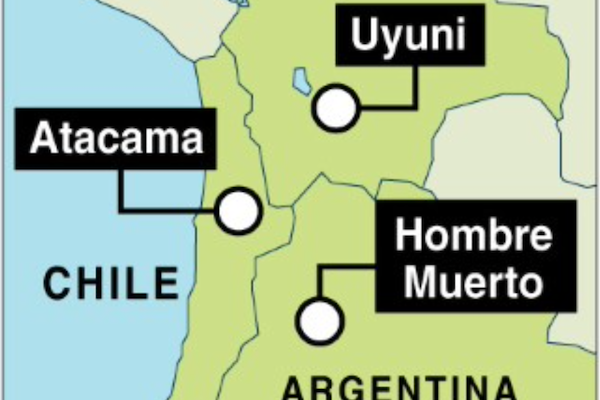
More than half of the world’s resource is located in South America in the area known as the lithium triangle, composed of Argentina (Salar Hombre Muerto), Bolivia (Salar de Uyuni), and Chile (Salar de Atacama). Of these, our country holds 52% of the world’s reserves.
Fig.2: Global Distribution and Use of Lithium
Source: Cochilco, AFP
Global lithium production is driven by its consumption. China, Japan, and South Korea are the main consumers, representing 93%, with China contributing 39% of total consumption and 50% of battery consumption.
On the other hand, the largest producer of lithium is Australia, accounting for nearly half of global production. Chile follows, with China in third place. However, it is estimated that if current production levels are maintained, Chile could be surpassed by China and Argentina.
In 2020, Australia produced about 40,000 metric tons, while our country lagged behind with 18,000. The main compound produced was lithium carbonate, accounting for 66% of production.
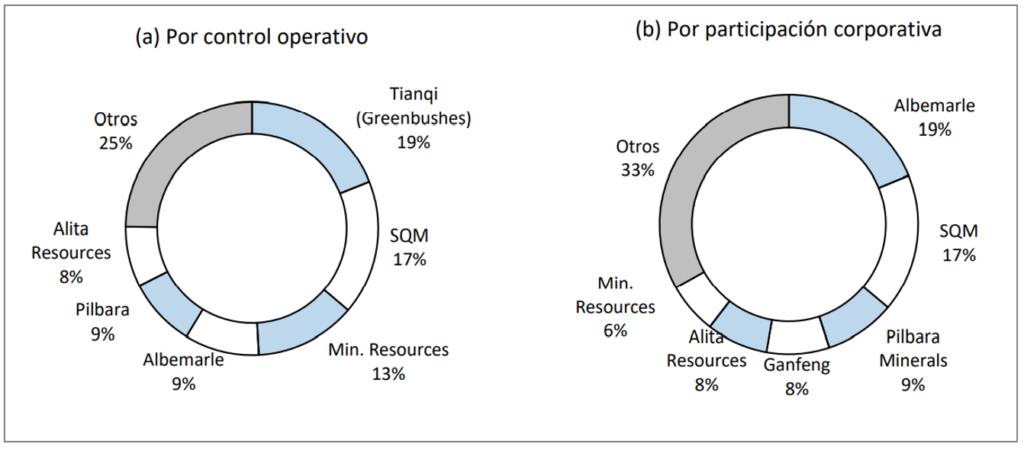
Regarding production by company, the market is highly concentrated. Albemarle leads in corporate share (share in controlling companies of operations), while Tianqi leads in operational control (companies in charge of operations).
Fig.3: Lithium Mine Participation by (a) Operating Company and (b) Controlling Company, 2020
Source: Cochilco based on S&P Global Market Intelligence 2021
The advancement of electromobility has conditioned global lithium demand, which is expected to grow at a compound annual rate of 21% between 2020 and 2030. By that year, the combined consumption of electric vehicles will represent 73%. In this context, Chile cannot lose its strategic position, so lithium production should occupy an important place on the national political agenda. On one hand, positioning the country as the main producer of the metal, while enhancing its role in climate change by contributing to the electromobility market.
NATIONAL LITHIUM PRODUCTION
Lithium deposits in Chile are located in the Salar de Atacama and Salar de Maricunga, in the Antofagasta and Atacama regions, respectively. The Atacama deposit corresponds to the largest aquifer reservoir of the metal. There, SQM and Albemarle are the main operators, who are also expanding their capacity.
Three months ago, the government opened a bidding process seeking to award 400,000 tons of lithium equivalent, which could produce more than 2 million tons of lithium carbonate. With this, Chile would remain among the top global producers. Otherwise, in a world where demand is expanding, it would fall to a 17% share by 2030.
Currently, the lithium industry, compared to copper, is in a very distant position: in 2020, lithium exports represented 2% of copper exports. However, when looking at other sectors, such as wine or salmon, lithium represented half of the former and one-fifth of the latter in that same year.
Like other products, lithium exports are primarily directed to Asia, specifically to South Korea, Japan, and China. These three countries account for about 80% of the metal’s exports.
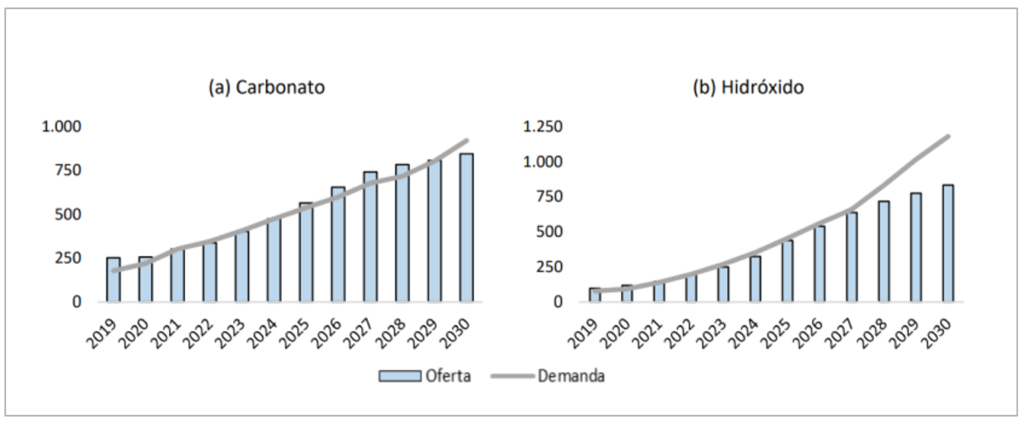
Although the lithium market occupies a minor place in national exports, the projected demand for this mineral indicates that efforts should be made to expand its production. Both the supply and demand for lithium carbonate and hydroxide show a sustained growth projection towards 2030, so the country with the largest global reserves cannot be left out.
Fig.4: Projected Supply and Demand for (a) Lithium Carbonate and (b) Lithium Hydroxide (kt LCE) 2019 – 2030
Source: Cochilco
REFLECTIONS
It is a reality that lithium has become an increasingly demanded critical resource. Furthermore, its importance goes beyond the economic aspect, placing it at the center of the international power debate. Those who control production and ensure the supply of the lightest metal will be able to win the race for electromobility, while states that achieve greater participation in that market will gain significant relative power in the fight against climate change.
For Chile, a small country fully integrated into the globalized world, participation in such markets is of special relevance. Expanding its production capacity would not only position it as one of the main players in the development of electric vehicles but also place the country in the fight against climate change. By becoming a fundamental player in the electromobility market, our country could achieve a leadership position in the global debate on the environment. Thus, lithium, more than just a mining resource contributing to the expansion of the export sector, becomes a tool of foreign policy that would deepen Chile’s international influence.
Therefore, when thinking strategically about the country, the conversation about lithium is essential. The state, government, private sector, and research and study centers must work together to actively contribute to building the country’s international role and how lithium contributes to national development. All indications suggest that the lightest metal will play a significant role in the future.