The Security and State of Chile
This article was translated automatically and may contain differences from the original. For reference, read the original.
The international order is in transition; the system has become more unstable, and conditions of increased conflict are emerging. The competition among great powers, particularly the geostrategic confrontation taking place in the Pacific basin, places Chile in a sensitive position. These and other conditions compel states to consider their security from the highest levels. The protection of their interests, as well as the obligation to ensure the common good of their nationals, are non-negotiable aspects for those who guide the destinies of countries.
From this perspective, such responsibilities cannot be left to improvisation; they require adequate levels of stability, structure, and rigor. For Chile—just as for any country in the world—these are fundamental aspects that cannot and should not be neglected.
Thus, the purpose of this document is to review the general security environment of Chile, revisit the concept of national or state security, and identify which levels of political and strategic leadership in the country should be responsible for these matters, identifying the organizations and entities directly accountable.
SECURITY ENVIRONMENT
The international system has been characterized by volatility, ambiguity, uncertainty, as well as complexity and disruption. As stated at the beginning of this text, the world is in the midst of competition among great powers such as the United States and China. Additionally, Russia’s invasion of Ukraine has injected a dose of realism into international relations that states like Chile must take into account.
While the structures and regimes of international security are not irreparably doomed, they are under significant stress and scrutiny regarding their real capacity to prevent phenomena such as war. However, war is not the only event that can affect countries; in fact, while it is persistent and real, it is less frequent than other current threats. Among these latter threats, and only considering violent manifestations that affect state security, we find civil wars, ethnic conflicts, terrorism, insurgency, guerrilla warfare, and organized crime, many of which are transnational in nature and require multilateral responses.
On the other hand, it cannot be overlooked that Chile is located in a region that is not secure, at least comparatively. In Latin America, various manifestations of organized armed violence coexist. On one hand, insurgent movements persist, such as the National Liberation Army (ELN) and dissidents of the Revolutionary Armed Forces (FARC) in Colombia, or the Paraguayan People’s Army (EPP). On the other hand, the terrorist group Shining Path continues to operate in jungle regions, currently in Peru, and criminal organizations—many of them transnational—are a reality in numerous countries, including the First Capital Command, Comando Vermelho (Brazil), Gulf Cartel (Colombia), and Tren de Aragua (Venezuela).
Some regional data. South America is home to the three largest coca producers in the world (Colombia, Peru, and Bolivia), not to mention other natural and synthetic drugs. Similarly, in terms of homicide rates, Latin America holds the unfortunate record of being the most violent region on the planet.[1]. The problem does not end there. In terms of governance, according to World Bank data, Latin America presents lower indicators than Europe, Asia, and North America in areas such as “Economic Stability and Absence of Violence,” “Government Effectiveness,” “Control of Corruption,” and “Rule of Law.”[2].
While it is true that the security problems affecting states arise from their own realities, contexts, and environments, it must be acknowledged that security is indivisible; thus, what affects some will, in many aspects, ultimately affect others.[3]. Countries are not isolated entities, especially in a globalized and interconnected world, where Chile has taken advantage of these relational spaces but has had to bear the cost of such openness, unable to abstract itself from the risks and threats it entails for its security.
Chile is still far from the average in all the indicators mentioned; however, in most of them, the country has shown a progressive deterioration in recent years.[4]. Additionally, there is the presence of foreign criminal organizations, such as the Gulf Cartel and the Jalisco New Generation Cartel, to name just a couple, as well as the emergence of other phenomena and crimes to which Chileans were not accustomed. Uncontrolled immigration in the northern region has become an increasingly pressing security concern for Chileans.[5]. To complete the picture, Chile faces violent groups in the southern region that operate with terrorist and subversive methods, challenging the central political power and severely affecting the rule of law. All of the above, without considering the subjective realm, or perceptions, regarding security, as Chileans rank this area as one of their main concerns.
In summary, we live in an unstable world with multiple threats and in an immediate neighborhood that is unsafe, which is infecting Chile with some of the most dangerous phenomena for the security of its citizens. From this dimension, the obligation arises to take on the challenge of state security from a comprehensive, organized, professional perspective with a broad, deep, and de-ideologized vision.
IDEA OF SECURITY FOR THE NATION
The state, since the Peace of Westphalia in 1648, is recognized as the predominant form of political organization in the international system. This state, conceived and destined to safeguard the common good of society, must provide certain guarantees and services. One of the fundamental guarantees, along with development and well-being, is security. This condition encompasses both external and internal threats, with the state being responsible for arbitrating all measures and utilizing all instruments at its disposal to ensure the security of the country, society, and all individuals.
Conceptually, different levels are employed to address security, from the broadest to the most specific: international or global; state or national; and personal. Following this logic, there is little doubt about how the realm of security that pertains to the nation as a whole (internal and external) should be termed: National Security, Security of the Nation, State Security, or simply state security. At all levels, the state is the primary articulator.
The term “National Security” is widely and fundamentally used in academic, political, and international organizational environments; however, in Chile, it generates some adverse reactions. This occurs when this concept is related in a limited, mistaken, and exclusively to what was known as the “National Security Doctrine,”[6], which emerged in the context of the Cold War and affected the political stability of some Latin American countries. The term may be uncomfortable, but it cannot be asserted that national security does not exist or that this task should be abandoned.
The complex world described at the beginning of this document, characterized by the emergence of non-state threats, many of which are transnational and violent, as well as the adverse effects of climate change, is a reality from which Chile cannot escape. Additionally, there are territorial aspirations that other states have regarding Chile’s sovereign territory. All of this demands an organization that monitors the national and international situation, analyzing and anticipating scenarios.
Not every threat or phenomenon affecting the state and its inhabitants should be treated as a security matter. If that were the case, any problem could end up being addressed from a security perspective, which would be a mistake. While there are phenomena that affect citizens and the state, such as poverty, their effects are not determined in terms of security; rather, their impact is evident in the development of the nation and the consequent well-being of its citizens.[7]. To facilitate understanding and avoid “securitizing” any phenomenon that affects a society, threats or actions characterized by the use of violence—in all its forms and in all areas and dimensions—are recognized as security problems, which are intentional and whose effects entail effective or potential loss of human lives or material damage to critical infrastructure.[8].
To establish a conceptualization of national security—or state security if preferred—for the purposes of this document, we will use the definition proposed in the book Theory of Security and Defense in the American Continent, which states:
“State security is the condition of absence of violent conflict that directly affects the state, whether in its external or internal dimension. This type of security is primarily expressed in these two dimensions, giving rise to external security and internal security, respectively. The former is the function of National Defense through the use of the Armed Forces, while the latter is the function of Law Enforcement and Public Security Forces.”[9].
As security must be understood as an essential task of the state, it corresponds to a responsibility of an eminently political nature, regardless of the fact that it requires various tools and instruments, which include the armed forces and law enforcement, among many others. All these instruments must be integrated and coordinated through functional structures that give life to what is called security architecture, employing efficient methodologies.
The review of the experience of other states, especially countries that typically serve as models of organization and well-being, indicates the existence of a security structure for such purposes. These countries, after facing multiple and ongoing situations that affect their security and interests, have established instances like these. For example, New Zealand, Australia, the United Kingdom, the United States, and Spain.
In short, our country must fully embrace the challenge of state security, having a set of political and technical instances at different levels of responsibility that provide analysis, evaluation, and timely solutions to the various security scenarios faced. As will be seen in the next section, many of these levels or tiers already exist, but the higher level, which should guide and coordinate all the other subordinate levels, is currently absent.
THE STATE’S LEADERSHIP AND SECURITY
As reiterated, security is a basic function of the state, non-delegable and unavoidable. To undertake this crucial activity, the political organization of the state must be equipped with tools and structures that support the function, thus preventing such a significant activity from being left to chance or relegated to the discretion of certain public officials. From the highest level of political leadership in the state, there are levels at which the state must address security or the specific realm of security that corresponds. In this way, the following can be identified:
- National Political Level (President of the Republic)
- Sectoral Political Level (Ministries of the Interior, Foreign Affairs, Defense, Finance, and others as necessary)[10]
- Political-Strategic Level (Ministry of Defense)
From the last level downward, the levels of military leadership emerge, from the strategic level, through the operational level, to the tactical level, where the command of the units employed in war operations or different operations prevails.
Likewise, for adequate work that ensures at least an acceptable outcome, each stratum must include an organ or group that provides political and/or technical advice on matters related to security. As a result of the work of each level of responsibility, executive guiding documents must be issued that provide definitions, objectives, priorities, tasks, and mechanisms for evaluation and control to subordinate levels, as well as their coordination. Furthermore, it is deemed essential that each level has methodological tools that facilitate its work while ensuring a correct analysis process, which only increases the chances of success in its mission.
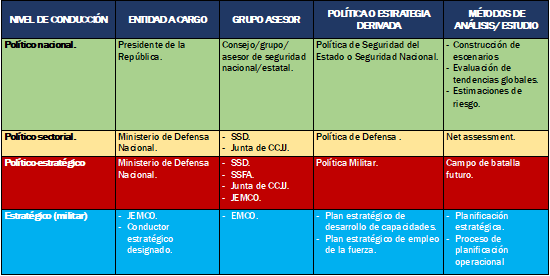
Table 1. Levels, Responsibilities, and Methodologies in the Leadership of State Security and Defense[11].
The previous table presents the levels of state leadership related to security and defense. The first three are evidently political, while the fourth responds to strategic-military needs. The level identified as National Political is represented by the President of the Republic, who directs and employs all instruments of national power. In the case of Chile, this important function lacks a formal structure to advise it and does not exhibit the implementation of working methodologies. Additionally, no National Security or state security policy or strategy has been issued to serve as a foundation for the entire structure and subordinate processes, in which all necessary organizations are coordinated and integrated to address security matters.
The problem this entails is that without this high-level technical body, eminently political and civil, it becomes difficult to visualize or construct scenarios—including conflict scenarios—evaluate threat trends, or assess risks in the international, regional, or national context, as well as opportunities to promote and/or defend national interests, allowing these relevant functions to be assumed in a decentralized and uncoordinated manner by various ministries or, in the worst case, not addressed in a timely manner, or not detecting and seizing opportunities for the country.
At the next level, Sectoral Political, the work that each ministry responsible for an area associated with state security (foreign relations, public security, finance, economy, etc.) must undertake is understood[12]. In this regard, concerning Defense, the ministry already has a more updated structure[13], which has allowed it to take control of the function and issue the necessary documents, notably the Defense Policy[14]. As a way to systematize the analysis process with an appropriate methodology for the current conduct of Defense, it is highly useful to implement the “Net Assessment” method[15], as the main and direct advisory body to the Minister of National Defense.Similarly, it is this same ministry—now in the Political-Strategic level—that assumes the task of issuing the Military Policy[16]
, as well as directing the planning for the development of strategic capabilities[17]. Up to this point, the political leadership of security and defense is concerned. Subsequently, the following levels of leadership correspond to military character, recognizing the strategic, operational, and tactical levels.FINAL CONSIDERATIONSThe international environment, and to a greater extent, the regional one, conspire to present an unsafe environment for Chile. Given this scenario, it is necessary to have structures that assume responsibility, at different levels, for tasks associated with national security or, as proposed in this text, state security.
It is difficult to understand, beyond ideological reasons, the denial of the use of the term national security, even going so far as to assert that this concept is obsolete, extinct, or out of use. The concept of national or state security is a term and a function that is fully relevant, whether in political, academic, or international organizational contexts. A significant portion of the most developed democracies in the world, as well as those countries that hold greater power, continue to develop their national security policies and strategies with established structures that form the architecture defining the decision-making process and responsibilities in a matter that is sensitive for states.
- Considering the importance of adequately assuming this task, each level of the political leadership of the state must have permanent advisory bodies that provide the tools and analytical inputs for appropriate and timely decision-making. Likewise, each must issue documents or policies that explicitly define the objectives and priorities of their respective areas and spheres of responsibility, starting with the President of the Republic with the State Security Policy.
- From that point, lower levels can distill their own assessments or analyses to carry out their work. Today, without either a presidential advisory body or a national security policy, it is difficult for the state to anticipate, prepare, and coordinate adequately and timely to face the various threats to its interests.
- It is highly beneficial for national interests that Chile establish a permanent body to oversee matters affecting national security and that acts closely as a political and technical advisor to the President of the Republic. This body, at the highest level, must be eminently civil.
- Likewise, just as advisory instances must be established, each level must adopt a methodological process that allows for better and more efficient work. At this time, it is considered that, for the ministerial level, the method proposed by the “Net Assessment” represents a tool that should be evaluated. Similarly, at the joint and institutional level, it is entirely logical to incorporate the structuring and visualization of possible future battlefield scenarios and their main characteristics.
- COMMENTARY DOWNLOAD
- [1]InSight Crime, “Homicide Balance 2021.” See at:https://es.insightcrime.org/noticias/balance-insight-crime-homicidios-2021/
Information available at: http://info.worldbank.org/governance/wgi/Home/Reports [3]
Dan Caldwell & Robert E. Williams Jr. Seeking Security in an Insecure World (Md.: Rowman & Littlefield Publishers, 2006), 4.
[4] Information available at: http://info.worldbank.org/governance/wgi/Home/Reports [5]
CEP Survey 86, “National Public Opinion Study.” Public Studies Center, April-May 2022. See report presentation at: https://www.cepchile.cl/cep/site/docs/20220608/20220608124401/encuestacep_abril_mayo2022.pdf [6]
Francisco Leal Buitrago, National Security Adrift: From the National Front to the Post-Cold War (Colombia: Alfaomega, 2002), 11-14.
[7] “Conceptualization Based on What Is Proposed,” by John Griffiths, in Theory of Security and Defense in the American Continent , p. 572.
[8] John Griffiths, Theory of Security and Defense in the American Continent(Santiago: RIL editores, 2011), 591.
[9] Ibid ., 597. [10]
This level involves an interagency process as a whole, known in English as a “whole of government approach.” [11]Regarding analysis/study methods, all information or products derived from the work of each level will be used as direct input for the lower levels.
[12] In this text, only the aspects related to the Ministry of National Defense are presented, and similar structures should be replicated in other fields of action.
[13] Law 20.424 “Organic Statute of the Ministry of National Defense.” Chile, 2010.
[14] Ministry of National Defense,
National Defense Policy of Chile 2020, Chile.
[15] To delve into the topic, see “A Question of Power: Towards Better UK Strategy Through Net Assessment,” by Gabriel Elefteriu in Policy Exchange . November 2018. See at:
https://policyexchange.org.uk/wp-content/uploads/2018/11/A-Question-of-Power-Net-Assessment-Gabriel-Elefteriu-Policy-Exchange-November-2018.pdf [16] Ministry of National Defense,National Defense Book 2017 . Chile. Chapter XIV, 186-205.
[17] Ibid , 108-114.