New Tanks for Ukraine
This article was translated automatically and may contain differences from the original. For reference, read the original.
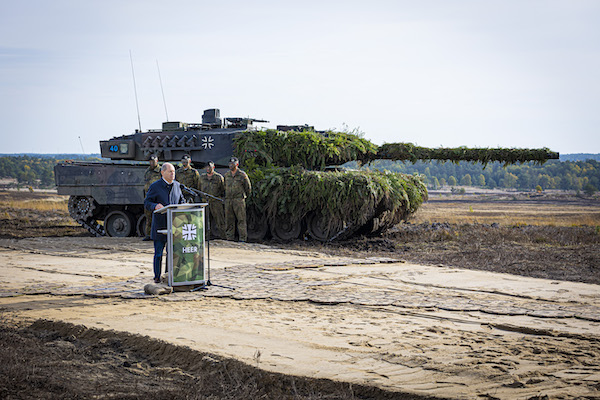
In recent months, a significant portion of the debate among Western powers has focused on the decision to supply tanks to Ukraine. Despite President Volodymyr Zelensky’s insistence, his counterparts in the United States and Germany had repeatedly opposed this move. Ultimately, both countries agreed to provide Kyiv with their main battle tanks.
The refusal to provide or authorize third parties to deliver tanks was primarily based—at least as publicly stated—on the belief that these weapons had “offensive” characteristics, which could provoke an even more extreme reaction from Russia. Two comments are pertinent in this regard. The first pertains to the classification of various weapon systems as “defensive” or “offensive.” This dichotomy, a significant part of what is known as the “Security Dilemma,” exists in the realm of perceptions, as one who acquires a weapon for defense cannot assure their opponent that it will not be used for offensive purposes. A combat aircraft, a howitzer, a frigate, or a tank—just to mention a couple of examples—can be employed for defensive or aggressive objectives, depending on the purpose assigned to their military forces by each state. Consequently, the classification of a conventional weapon (non-nuclear) as offensive or defensive generally has a strong subjective component and will be determined by the evaluator of the situation.
In the same vein, the attacked country, in this case Ukraine, has foreign forces within its sovereign territory. To recover what has been ceded, it must inevitably carry out offensive actions, which fall within its territorial defense, that is, counteroffensives. It is not possible for the Ukrainian defense to exclude weapons with the characteristics of tanks, as if the intention is to avoid provoking the Kremlin, support should be limited to machines for building defensive positions and ammunition to halt the Russian advance. However, reality demands that attacks be executed to expel the invaders from their own territory, which could in no case be labeled as a generally offensive attitude by Ukraine.
On the other hand, the news is positive for two reasons: political and technical. Politically, this reflects the Western commitment to the Ukrainian cause and the decision not to allow a state like Russia to impose its objectives beyond what is permitted by international law through the use of force. Additionally, it demonstrates that cohesion among NATO member states remains strong and that there is the capacity and willingness to reach agreements despite initial differences.
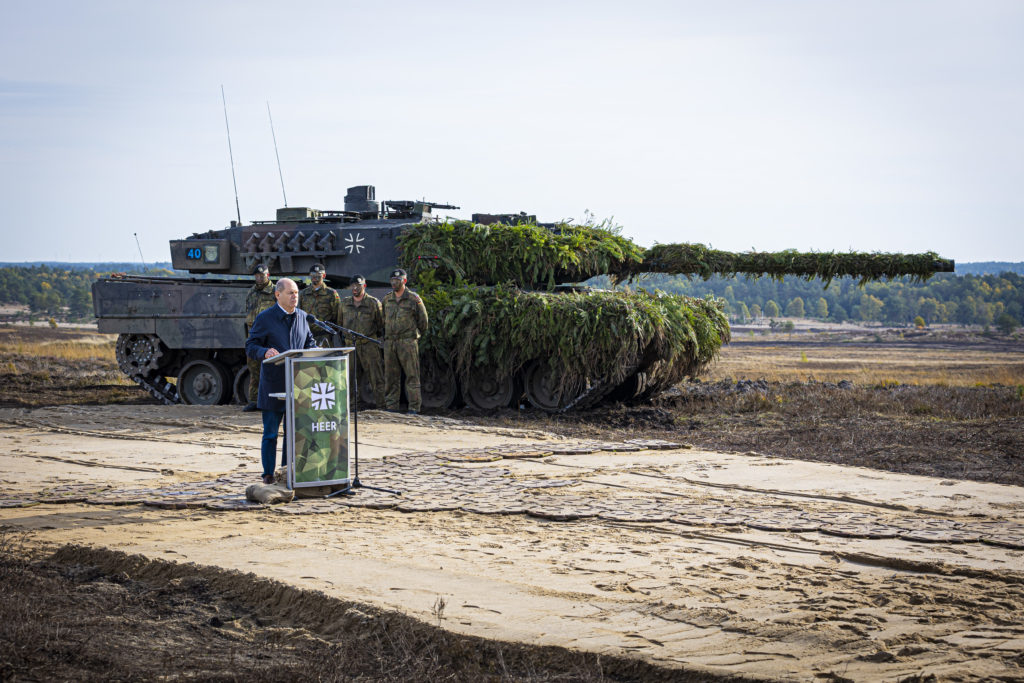
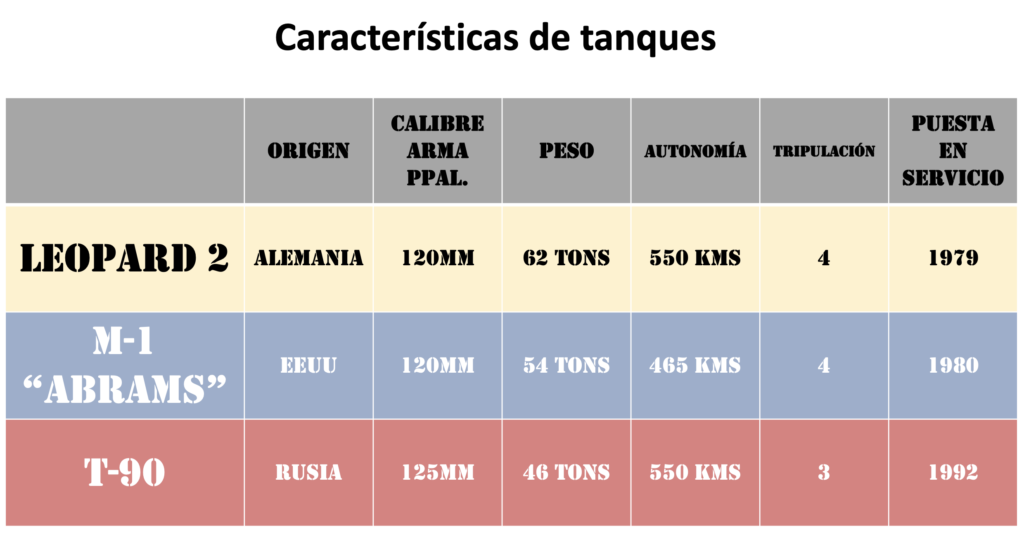
The second, of a technical military nature, refers to the fact that the incorporation of tanks such as the German Leopard 2 and the American M-1 Abrams represents a significant advancement, as both far exceed the capabilities of those available in Ukraine’s inventory. Until now, Kyiv has relied on Soviet and Ukrainian-origin tanks, primarily the T-64, T-72, and T-80 models (all in various versions), which must contend with their Russian counterparts (of Soviet and Russian origin) led by the T-90, along with T-80, T-72, T-64, and T-62, all in different versions.
Among the advantages of the German Leopard 2 tanks is the fact that it is a widely used combat vehicle in Europe, with over 2,400 units distributed across the continent (Chile also has three armored groups of the 2A4 model). This condition provides greater availability of units and spare parts. Furthermore, the capabilities of the German tank make it a formidable weapon, capable of firing projectiles effectively at 4,000 meters, with both vectors in motion and capable of combat 24 hours a day. Given the way this war has developed, it is not unreasonable to think that by now, some Ukrainian crews may already be trained and instructed in Western tanks. It is worth noting that the Polish government stated in early January 2023 that it would deliver Leopard 2 tanks with or without Berlin’s authorization.
In the same vein, another relevant factor is that Ukraine’s tank inventory is rather limited, making the addition of these weapons to its arsenal vital. According to data from the “Military Balance 2022” by the International Institute for Strategic Studies (IISS), Ukraine had 927 tanks at the start of the war (including 69 from the Marine Corps), while Russia had 3,417 (including 330 from the Marine Corps and 160 from airborne troops). As of January 25, 2023, according to records from the “Oryx” website (which only includes information with reliable documentation, so the actual numbers are likely higher; visit at https://www.oryxspioenkop.com), Kyiv has lost a total of 449 tanks and Moscow 1,642 units.
Nevertheless, the incorporation of Western tanks should be viewed with caution. This is because introducing complex weapon systems like those mentioned is a lengthy process that requires not only the training of crews and mechanics but also the adaptation of supply chains (which will demand significant logistical efforts for technicians, spare parts, ammunition, etc., which is not automatic) and, more importantly, their integration into large combat units under the concept of combined arms employment. Additionally, a single weapon system is unlikely to possess the virtue and capacity to change the course of the war. This has not been the case in history. It is different if, combined with other systems, integrated into the concept of “maneuver warfare,” doctrinally incorporated under the prism of “mission command,” with commanders trained in an environment of “freedom of action,” adequately communicated, synchronized in time, space, and purpose, this would generate an effective combat power capable of defeating, alongside forces from other domains of warfare (air, maritime, space, and cyberspace), the Russian invaders.
To think that the mere idea of having technology or quantity means victory would be to commit the same mistakes criticized in Russian forces over the past eleven months. However, the Ukrainian armed forces have clearly demonstrated the will to fight and the ability to adapt and incorporate weapon systems that have allowed them to make a difference. Initially, it was the anti-tank missiles “Javelin” and NLAW, along with the anti-aircraft “Stinger,” that characterized the defense. Later, the delivery of HIMARS systems provided capabilities that inspired and marked the Ukrainian counteroffensive. While these may not be sufficient, perhaps now, the Leopard 2 and M-1 Abrams tanks will usher in a new phase of the war and help create the conditions for the desired peace.