AUKUS in the Grand Strategy of Superpowers
This article was translated automatically and may contain differences from the original. For reference, read the original.
- by Cristián de la Maza
- Guest Contributions
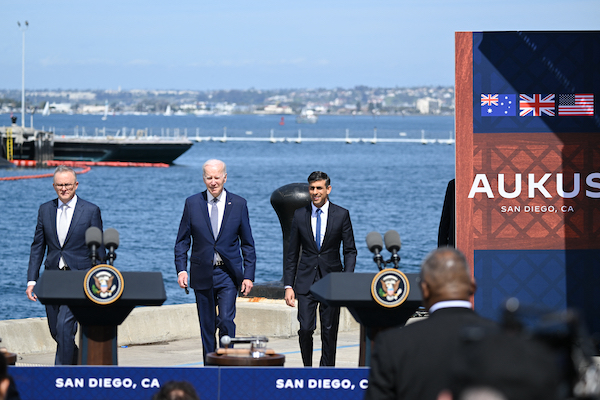
On March 13, the leaders of the United States, the United Kingdom, and Australia met at the naval base in San Diego to formally announce that Australia would acquire the capability to operate nuclear-powered attack submarines (SSNs) in the coming years.
In this regard, it is important to analyze the significance of this announcement in terms of its content and milestones of the planned program, as well as the military capability achieved, considering the elements that comprise it and its deterrent effect.
Furthermore, it is interesting to have a perspective on how this decision integrates into the evolution of the grand strategy pursued by the United States and China, both in relation to the Indo-Pacific region and on a global scale, with features similar to a Cold War.
THE AUKUS PACT
The pact includes the construction of up to eight SSNs by Australia, with a common model shared with the United Kingdom and technological support from the United States, referred to as SSN-AUKUS. However, the time required for this construction and capability is at least 20 years. From a deterrent effect perspective, this is clearly insufficient, as announcements of long-term programs, and even the possibility of building SSNs in that country, do not equate to a real military capability that could affect a potential adversary within a 20 to 30-year horizon.
To address this gap in enhanced military capabilities, the announcement includes some preliminary phases:
- In 2023, an increase in visits from U.S. submarines and subsequently from the United Kingdom (starting in 2026).
- In 2027, the initiation of a permanent rotation of SSNs (estimated to be three from the United States and one from the United Kingdom), operating from the Australian base HMAS Stirling, integrating Australian personnel in training and instruction.
- Starting in 2030, Australia will acquire three to four second-hand Virginia-class SSNs from the United States.
This follows an initial announcement of the AUKUS security pact (Australia, UK, USA) initiated in September 2021. The goal is to significantly enhance Australia’s military capability as an important element of the alliance strategy between the United States and regional countries that present a counterbalance to China’s growing military power.
The agreement allows for more direct cooperation among the three countries that share origins, visions, interests, and a history of fighting together dating back to World War I. This includes aspects of advanced cyber defense, artificial intelligence, autonomous vehicles, quantum computing, hypersonic weapons, and electronic warfare, among others. It is important to note that these three countries also form the intelligence-sharing alliance known as “Five Eyes,” which includes Canada and New Zealand.
The announcement of this pact in 2021 represented a significant diplomatic issue with France, a NATO partner of the countries that would provide the technological transfer to build nuclear submarines for Australia, as it effectively terminated a billion-dollar program for the construction of conventional submarines designed by France in Australia.
MILITARY POWER: FORCE X POSITION
From a strategic perspective, this decision marks a significant shift in the balance of power that the coalition of countries allied with the United States will be able to present against China in the future.
In the classical view of naval power assessment, understood as the integration of force x position, with the connector x being the will to employ, this decision reflects all three factors.
Force. The force is granted by the operational capability to act offensively, both against adversary naval forces and against strategic targets on land. Indeed, the capabilities of nuclear-powered submarines (SSNs) are far superior to those provided by the conventional submarines whose program was canceled.
Factors such as greater speed, autonomy, armament—Australian SSNs are expected to carry long-range Tomahawk missiles, which have been widely tested as military projection weapons in previous conflicts—and time operating submerged without the need to surface enhance the distinctive characteristics of submarines in terms of stealth and difficulty of detection. Additionally, one of the important roles of SSNs is defense against the threat of ballistic missile submarines (SSBNs) and the threat of adversary SSNs.
This projection weapon is the visible part but not sufficient to achieve its effectiveness, as it necessarily requires a high capacity for ISR (intelligence, surveillance, and reconnaissance), as well as integrated command and control, all aspects that are part of both the AUKUS pact and Five Eyes.
Position. The element of position, in this case, is granted by the Australian continent and the naval bases of that country, with comprehensive logistical support and protected by a sovereign defensive system. This would be enhanced through specific development for SSN operations at the Australian base HMAS Stirling in the Indian Ocean, on the western Australian coast. It is important to highlight that HMAS Stirling is located at a similar distance to the advanced U.S. base on the island of Guam, allowing access to the South China Sea or the Taiwan Strait.
With a force of SSNs operating from this position, the capacity to influence or impact the Indo-Pacific area increases, due to the possibility of effectively acting on vital maritime communication lines, both regionally and globally, as well as the potential to act against naval forces and strategic targets within an adversary power.
Strategic Will. The AUKUS pact represents for Australia an unprecedented long-term economic commitment and an irreversible alignment with the United States and its allies against Chinese military hegemony in the region; a country that is an economic power and from which Australia depends due to the magnitude of its trade exchange. It has also entailed a political, diplomatic, and economic cost with France; a country in the Western sphere that is naturally allied with Australia and has a significant presence in the Pacific Ocean.
For the United States, it means sharing a differentiating military capability currently restricted to very few countries. Additionally, it poses a risk of weakening the nuclear non-proliferation architecture, not due to the issue of nuclear propulsion, but because the nuclear fuel used in these submarines could provide the capability to produce nuclear weapons. This could also open the possibility for other countries, with support from current powers opposed to the Western bloc, to also incorporate nuclear-powered submarines and generate instability.
For the United Kingdom, AUKUS represents a more explicit expansion of its stance aligned with the United States against China, with which it also has a significant commercial relationship, and a commitment to operational deployment of its SSNs to the Indo-Pacific region. Furthermore, this pact will allow for economies of scale, technological transfer, and the necessary capital injection to maintain its SSN production capacity in the coming decades.
In addition to all of the above, there are evident risks of escalating tensions with China, a country that has already declared that this AUKUS pact threatens to damage regional peace and intensify the arms race, accusing the three signatory countries of maintaining an “obsolete Cold War mentality.” The spokesperson for the Chinese Ministry of Foreign Affairs, Wang Wenbin, stated that these three countries “are increasingly walking down the path of error and danger.”
Despite all the difficulties, costs, and risks assumed by the signatories of AUKUS, including the expected reaction from China, concrete steps have been taken to materialize it with specific goals, funding, and timelines. This indicates that there is an assessment of the need and political will to have an increased military presence in the Indo-Pacific region.
However, this implies the will to employ this new capability, primarily as part of a deterrence strategy, to prevent the growing Chinese military power from being used coercively against allies and Western interests in the Indo-Pacific, and if this deterrence fails, to have greater chances of success in a potential armed conflict.
AUKUS AS PART OF THE GRAND STRATEGY OF THE UNITED STATES AGAINST CHINA
For the People’s Republic of China (PRC), the view of the grand strategy of the United States regarding its country is described in five verbs (the five to’s): isolate, contain, degrade, internally divide, and
sabotage China’s leadership.
Under this conclusion, for the PRC, the effect on relations with the United States is summarized in that the main long-term bilateral issue will be “containment and counter-containment”[1].
On its part, the United States government has declared that the People’s Republic of China poses the greatest long-term challenge to the international order, as this country has both the intention to redefine the international order and the economic, diplomatic, military, and technological power to do so. In this sense, Beijing’s vision would move the world away from the universal values that have underpinned much of the progress achieved in the last 75 years[2].
The United States has proposed a strategy to confront China along three axes:
- Investing in its own competitiveness, innovation, and protection of its democracy.
- Aligning with countries and institutions with which there is a community of ideas and interests.
- Competing with China in key areas of the present and future, such as technology, artificial intelligence, access to strategic supplies, among others.
In this regard, the United States recognizes the need to maintain military superiority to utilize an “integrated deterrence” with allies and partners across different areas. This integrated deterrence involves the articulation of diplomatic, economic, informational, and military power instruments; some of these effects have been observable in recent months.
In this context, the strengthening of the Quadrilateral Security Dialogue (QSD), better known as QUAD, which diplomatically integrates democratic maritime powers in the region: India, Australia, Japan, and the United States, stands out.
At its latest summit organized by Japan in May 2022, its members reaffirmed their commitment to a free and open Indo-Pacific, the denuclearization of North Korea, and, following the Russian invasion of Ukraine, declared that unilateral changes to the statu quo cannot be tolerated in any region of the world[3], which can be understood to include the situation of territorial disputes with China in the South and East China Seas, as well as the situation in Taiwan.
Another important element is the change in Japan’s security and defense policy, with a significant increase in its military budget aimed at generating and sustaining capabilities not only for self-defense but also for offensive action with long-range missiles and a strengthening of security agreements with the United States.
Japan has also improved its relationship with South Korea, another important actor among the United States’ allies in the region, overcoming historical differences stemming from the Japanese invasion of Korea and the use of forced labor that Korea demanded compensation for.
In analyses regarding these relationships, there is consensus that the military threat from China and North Korea, combined with concerns about the impact of the security situation in Europe due to the Russian invasion of Ukraine, requires both countries to overcome the past and focus on these common problems, based on a community of values and interests in the region.
In this sense, high-level tripartite meetings between the United States, Japan, and South Korea (“Trilateral Partnership for the Indo-Pacific,” November 13, 2022)[4] are indicative of strengthening regional alliances, highlighting the alignment of their collective efforts in pursuit of a free, open, inclusive, resilient, and secure Indo-Pacific. This is complemented by the resumption of trilateral military exercises, including a ballistic missile defense exercise conducted immediately after a missile launch by North Korea.
The explicit mention and condemnation of the Russian invasion of Ukraine is a common element in the statements of various regional alliances with the United States, defending the universal principle that unilateral force should not be used to “alter the statu quo”, which, applied to the Indo-Pacific region, clearly alludes to China and its increasingly assertive attitude in territorial disputes with various countries in the region.
In this regard, the sequence of visits to express support for Ukraine by Western leaders, including President Biden’s visit last February, is complemented by the recent visit (March 21) of Japanese Prime Minister Fumio Kishida.
The visit of the Japanese Prime Minister to Ukraine coincides with Chinese leader Xi Jinping’s trip to Russia, where he describes it as a “new impetus” to the healthy and stable relations between China and Russia, a country he refers to as a “good neighbor” and “reliable partner.”
In practice, due to the growing isolation and economic sanctions imposed on Russia, China has positioned itself as Russia’s only powerful ally, both economically and diplomatically, by refusing to condemn the invasion and presenting a peace plan that could be the only way out of a humiliating defeat for Putin, while also having the capacity to militarily support Russia to extend the armed conflict.
This makes Russia, and particularly President Putin, a country with an increasing dependence on China’s will for its political survival, thus allowing China to hold the key to the potential prolongation or resolution of the conflict according to its interests and strategy regarding the United States and its allies.
Thus, the hegemonic dispute between China and the United States, whose main geographical axis appears in the Indo-Pacific region, with economic, technological, and military dimensions, also reaches a global dimension, this time with Russia as a proxy in the strategic competition between the two powers.
FINAL COMMENTS
The AUKUS pact is another element in the military dimension of a coherent strategy by the United States that incorporates military and diplomatic alliances with other powers in the Indo-Pacific, such as Japan, South Korea, Taiwan, India, and others that share similar values and recognize the threat of China’s expansion in their geographical areas.
This pact will generate a relevant offensive capability operating from the Australian continent, under an expected combined operational strategic leadership, with the United States as the main ally.
The possibility of Australia constructing its own nuclear-powered submarines, while a requirement for acceptability due to economic benefits and technological transfer, does not generate real capabilities in the next two decades at least and, therefore, is not a factor that contributes to deterrence during this period.
Therefore, the importance of the latest AUKUS announcement is the imminent start of allied SSN operations from Australian bases, followed by the incorporation of current Virginia-class SSNs into the Royal Australian Navy.
AUKUS, along with the other mentioned initiatives, increases the combined military capacity among different allied countries, aimed at deterring China from using its growing military power to unilaterally alter the statu quo in the region. These alliances also consider North Korea as a disruptive factor to stability in the region and share the common goal of achieving the denuclearization of that country.
This use of military power as a deterrent has been accompanied by significant efforts in diplomatic, economic, and informational instruments in a containment strategy, within the framework of a global hegemonic competition.
The strategic competition between China and the United States is not limited to the Indo-Pacific region but encompasses the rest of the world and also integrates political, cultural, technological, and economic dimensions. In particular, the antagonistic approaches and positions regarding the Russian invasion of Ukraine demonstrate this competition between superpowers extending to other regions and the use of other countries in conflict as part of each of their grand strategies.
If the above is not termed a new Cold War, it at least resembles one, with new actors, in a more interconnected and globalized world, and with different tools and instruments of power.
[1] Further development can be found in: De la Maza, C. “Taiwan and the Thucydides Trap,” published by AthenaLab in August 2022. Available at https://www.athenalab.org/ensayo-taiwan-y-la-trampa-de-tucidides/
[2] Blinken, A. Secretary of State of the United States, in his speech: “The administration’s Approach to the People’s Republic of China.” The George Washington University, May 26, 2022. Available at https://www.state.gov/the-administrations-approach-to-the-peoples-republic-of-china/
[3] The official statement issued by the government of Japan can be found at https://japan.kantei.go.jp/101_kishida/statement/202205/_00013.html
[4] Phnom Penh Statement on US–Japan–Republic of Korea Trilateral Partnership for the Indo-Pacific, available at https://www.whitehouse.gov/briefing-room/statements-releases/2022/11/13/phnom-penh-statement-on-trilateral-partnership-for-the-indo-pacific/