False calm before the (new) storm
This article was translated automatically and may contain differences from the original. For reference, read the original.
Today, little is said about the Russian invasion of Ukraine in the national press. It is true that Chile has more urgent issues to address, particularly regarding public security. However, the few references tend to describe a sort of stagnation or paralysis of the conflict, with little or no movement suggesting that both belligerents are reaching points of exhaustion, while on the other hand, there are references to an imminent offensive from both Ukrainian and Russian sides. In this regard, three points should be noted: there is no such calm, the new offensive will indeed be a reality in the short term, and finally, what to expect from this conflict.
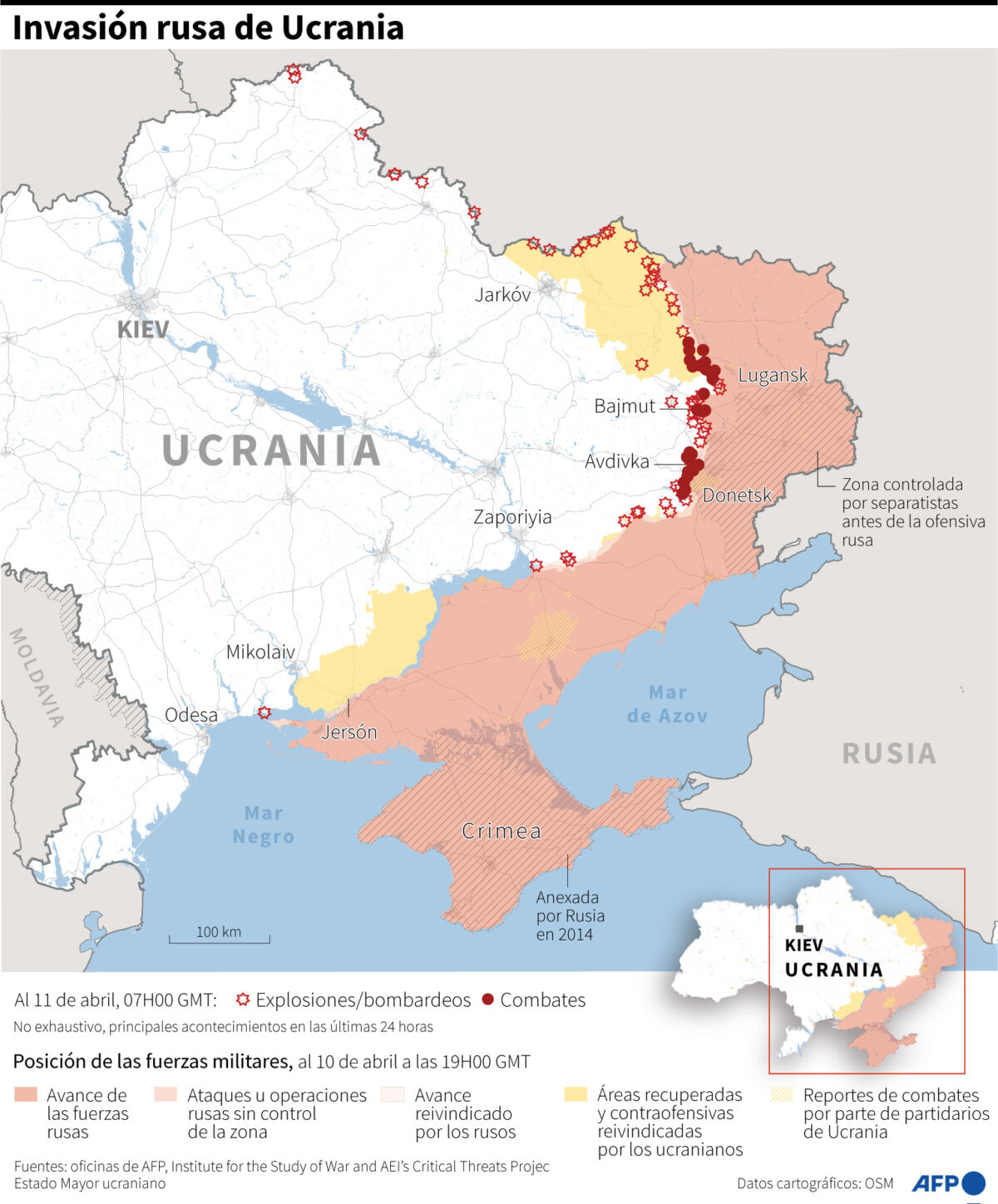
First, regarding the mentioned stagnation or paralysis of the conflict. While it is true that the war in Ukraine has lost the dynamism observed in 2022, with that movement of larger ground units redrawing the battlefield—first the Russians, then the Ukrainians—it is incorrect to relate a more or less static front to its paralysis. Since the fourth quarter of last year, when the Ukrainian counteroffensive lost momentum and the Russians managed, with considerable difficulty, to stabilize their defense at the cost of sacrificing their position in Kherson, the battlefield has not changed significantly. However, this situation is far from being described as ‘paralyzed or static.’ Casualty figures have risen considerably as days go by, as much or more than in the first months of the war. The battlefield extends over more than 2,000 kilometers, which, with varying intensity, shows permanent signs of activity throughout its length.
Today, the main confrontations are concentrated in areas such as Kupyansk-Svatore-Kreminna, along the Avdiivka-Donetsk City line, in Zaporizhia, and, most notably, in the city of Bakhmut.[1] The latter has garnered international attention because, while it is not a point of major strategic value, it has become a symbol of Ukrainian resistance and tenacity, and, simultaneously, of Russia’s ability to demonstrate a greater victory to its population. This does not mean that the rest of the areas are on pause; it simply reflects the reality that in war, no opponent is strong enough to be everywhere. Similarly, Russian missile and drone attacks on Ukraine’s critical infrastructure, while having decreased compared to the months of January and February, continue to be a permanent feature of the conflict.
Second, the anticipated offensive. Both sides have been preparing to initiate offensive actions, as this is the only strategic posture that allows for seizing the initiative and leads directly to military victory. On the Russian side, at this point, there are well-founded reasons to doubt their real effectiveness, considering the depletion of their forces, the demonstrated inability to form units with high combat value, the obsolescence of their available equipment, and, above all, the deteriorated morale of the deployed contingent. Nevertheless, the actions they have been executing across most of the front since the beginning of 2023 are believed to have been aimed at maintaining pressure on Kyiv’s forces, complicating their reorganization, or testing various defensive positions with the intention of identifying weak points to attack with greater force, which aligns with Moscow’s combat doctrine.
On the other hand, Ukrainian forces have been preparing—albeit with significant difficulties—for a new phase in the war. Their forces have also suffered substantial casualties, especially among their better-trained veteran soldiers, but their outstanding ability to generate new combat-capable units has been repeatedly demonstrated over the past thirteen months. Unlike their opponent, the Ukrainians possess higher morale (among the people, the government, and the armed forces), have received more modern weaponry (it appears that the first Western tanks have already entered Ukrainian territory), have been able to adequately integrate these technologies (radars, HIMARS, Stinger, Javelin, etc.), and have also shown flexibility and adaptability in the design and execution of operations. This is not synonymous with success, of course, as they face numerous Russian forces with large reserves.
Considering the change in weather conditions in Ukrainian territory, the generation of operational capabilities in both belligerents, and the political pressure on the military forces of both countries to achieve successes on the battlefield, it leads to the conclusion that the new phase in the war should occur starting in mid-April. This provides sufficient time to achieve and consolidate operational objectives, benefiting from the best circumstances offered by the northern spring and the imminent arrival of summer in the northern hemisphere.
Third, the future of the conflict. While it is impossible to determine what will happen in the war, as previously stated by Athenalab (Working Document No. 21 ‘One Year After the Russian Invasion of Ukraine’),[2]the future of the conflict will depend on three factors. The ‘moral’ factor, where the Ukrainians present greater strength in defending their homeland; time, a factor that would favor Russia due to its greater reserves of material and manpower to mobilize for the fight; and external support from the West to Ukraine.
Regarding the latter, Western military aid has been decisive in maintaining Kyiv’s war effort. Today, their forces dramatically and fundamentally demand artillery ammunition (missiles, rockets, and shells), to replenish air defense systems, new armored vehicles (infantry and tanks), and combat aircraft capable of challenging Russian air power (whether of Russian origin or, especially, Western). All of this is needed as quickly as possible to avoid total Russian mobilization and the uncertain but plausible military support that China could eventually provide to Putin’s regime.
The fate of the war and who will emerge victorious remains open and uncertain. It is very difficult for either state to win in absolute terms, so perhaps it will be necessary to assess who will lose more and who will lose less, and once again review the fulfillment of each party’s political objectives to draw conclusions. Many factors, little clarity. As always, the fog of war obscures the possibility of perceiving events with relative certainty.
[1] See: https://www.understandingwar.org
[2] See: http://www.athenalab.org/wp-content/uploads/2023/02/doc_21_guerra-final.pdf