Security Agenda: How Fast is the Fast Track Progressing?
This article was translated automatically and may contain differences from the original. For reference, read the original.
- por Pilar Lizana & Agustín Soto
- Análisis

With the second deadline of 150 days for the processing of security-related bills having passed, it is worth reviewing how quickly parliamentary discussions are advancing and what it would mean for Chile if all projects were approved.
It can be stated that the need to advance in security matters stemmed from a “bottom-up” process[1], where citizens gradually began to push for concrete measures to combat crime and the new criminality that was rapidly growing throughout the country.
The Criteria survey from March of this year showed that the main concern among people was combating crime and drug trafficking (49%), followed by the need to control immigration (34%). Additionally, when reviewing Chileans’ perceptions of security issues, 58% stated that we are in conditions of high or extreme violence, and 32% considered that we live with considerable violence. Regarding the forms in which this violence manifests, crime and citizen security were ranked first at 56%, followed by drug trafficking at 43% and organized crime at 40%[2].
In this context, the turning point was marked by the murder of First Corporal Daniel Palma during an operation in downtown Santiago. Prior to this, Sergeant Rita Olivares had been killed in Quilpué, and First Corporal Álex Salazar in Concepción, respectively. Three police officers killed in 23 days forced the government to approve the Naín-Retamal Law and completely change its programmatic aspirations, which did not prioritize public security.
Thus, on April 14, the presidents of the Senate and the Chamber, Juan Antonio Coloma and Vlado Mirosevic, respectively, along with the Minister of the Interior, Carolina Tohá, agreed to advance and accelerate a security agenda, or fast track, which prioritized a total of 31 projects. Of these, three had a limited deadline for the “next few days”[3]; thirteen, 75 days[4], and seven, 150 days[5], leaving another seven for the end of the year[6]. However, after the 150 days, only eight have been published in the Official Gazette[7].
Built on three pillars, the security agenda aims to update the public security structure for the country. In this regard, the Minister of the Interior specified that “some (projects) are focused on strengthening institutions; this is a very important part because we need the State to be better prepared with more modern and robust institutions to face violent crime. Other projects are aimed at improving the effectiveness of criminal prosecution, identifying those responsible for crimes, enforcing and fulfilling sentences. There is a third type of project aimed at strengthening our capabilities to prevent crimes, creating conditions so that they do not occur”[8].
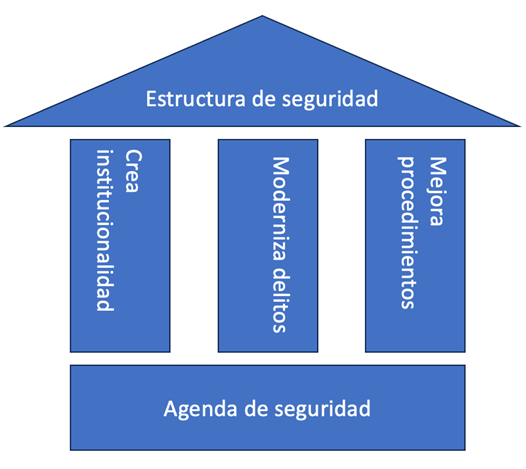
At the core of the process lies the greatest challenge: achieving political agreements. The three pillars mentioned by the minister can be summarized as follows: (i) Create institutions, (ii) Modernize crimes, and (iii) Improve procedures, which in turn support the security structure that, if successful in political negotiation, would provide Chile with a backbone for combating security threats, generating synergies among various institutions, coordinating the work of agencies, and imparting greater flexibility and adaptability to the State’s response.
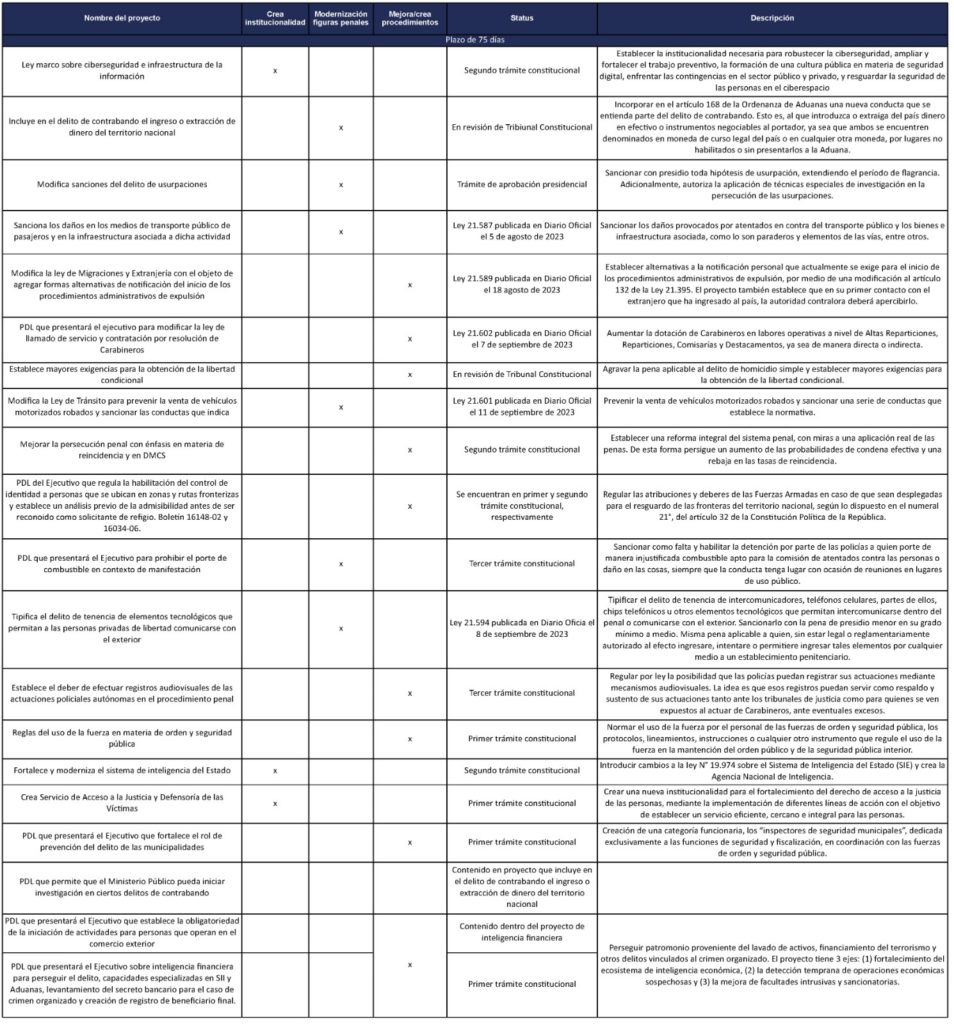
- Regarding the projects with a 75-day deadline
Only five projects have been published as law in the Official Gazette: the one that penalizes damage to public transport; the one that amends the Immigration Law; the one that changes the call to service for police officers; the one that rectifies the Traffic Law regarding the sale of motor vehicles, and the one that criminalizes the possession of technological devices.
Of the published projects, three modify criminal types, while the other two improve or create procedures.
In this category, there is only one project that creates institutions, the Framework Law on Cybersecurity and Critical Information Infrastructure. This particular project is of great importance in a context where cyberspace facilitates the actions of organized crime. It allows, among other things, for organization, secure communication, money laundering, and the buying and selling of illegal goods.
In this sense, having an institution focused on this area would significantly contribute to prevention.
Of the unpublished projects, it is important to mention the one related to the crime of usurpation. Its delay has been associated with political discussions regarding privileged self-defense, which, for example, can be used by a landowner. In this regard, the Minister of the Interior stated that “the most important thing is to regulate legitimate self-defense reasonably, so that it does not turn into a ‘law of the jungle,’ which is, in some way, what this project enabled”[9].
The problem associated with the Executive’s veto presentation relates to the possibility of reaching an agreement among the parties, which seems difficult, especially after the minister stated that “we cannot ensure that there is a hundred percent agreement, because there was no agreement at all”[10].
Status of the projects
- Regarding the projects with a 150-day deadline
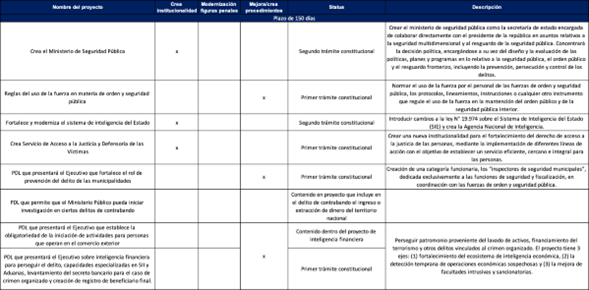
None of the eight projects defined for the mentioned deadline have been published. Additionally, it is worth noting that the one requiring those engaged in foreign trade to initiate activities has been incorporated into the financial intelligence project; an initiative aimed at improving the prosecution of assets. Likewise, the one allowing the Public Ministry to initiate investigations in certain cases of smuggling was included in the project that incorporates the entry or extraction of money from the national territory into the crime of smuggling. This means that this category now has six projects.
Of these six, three fall under the pillar aimed at creating institutions, while the other three improve or create procedures. Regarding the first three, it is important to mention that both the new Ministry of Public Security and the intelligence system are significant steps in security matters; however, some clarifications are necessary.
In the case of the Ministry of Public Security, the aim is for it to be a coordinating body for security efforts, incorporating relevant aspects such as organized crime, delinquency, and borders, among others. It also contains a strong analytical area.
This new institution appears to be quite robust; however, merely transferring the Undersecretariats of Security and Crime Prevention to the new ministry is not sufficient. A state agency of this level requires much more than the transfer of services. Rather, it should consider a recruitment aspect that allows it to have updated and trained personnel in security matters, in order to conduct all the analysis and study that the project proposes. Additionally, it must have the power to generate effective coordination; it is not enough to define that it must coordinate. In other words, if it is not granted the power to do so, coordination will not be successful.
Furthermore, the intelligence system also presents a relevant discussion and falls within the need for coordination posed by the previous project. Having information is crucial for understanding the phenomenon and developing rapid responses. In this sense, it is important to clarify the current intelligence capabilities to propose a national agency that meets the challenges.
Status of the projects
- Final Considerations
Certainly, security remains a priority for Chileans. In a survey conducted in Chile by the Universidad San Sebastián in August of this year, respondents stated that crime has increased in the country (73.8%) and that it will increase in the next six months (70.2%)[11]. Fear remains at very high levels, and according to the UC Center for Surveys and Longitudinal Studies and Verisure, 26.9% say they always or almost always hear gunfire in their neighborhood[12].
In this context, the fast track legislative process for security is of vital importance to address citizens’ urgent needs and modernize the way the State confronts a new type of crime. However, the fact that only 25% of the bills have been published creates the perception that the legislative agenda is progressing slowly.
The political discussion surrounding these projects highlights the difficulties that some official sectors face in this matter. In this sense, the greatest challenge that the security agenda must overcome is political. Certainly, there is agreement that issues related to crime must be addressed; how to do so is what remains unclear.
Regarding the structure proposed by this agenda, it is relevant to mention that merely creating institutions and procedures does not solve the problems to be faced. Highly flexible organizations with rapid adaptability are required. Certainly, replicating the current way of working in new ministries and procedures would be counterproductive.
The structure must be clear, simple, and lightweight, with mobile work teams that respond to challenges on an ongoing basis, with rapid actions to control threats once they occur and with the capacity to prevent them from happening.
So far, significant progress has been made, such as the approval of those projects that allow for the prosecution of organized crime and the assets associated with it. However, there is still a long way to go. The effort must be cross-cutting and always focused on the need to change the State’s work culture. Without that, the results will be minimal.
Finally, legislative advances must align with political objectives and a full commitment to making security a state policy.
[1] The “bottom-up” process is one that arises from the needs and urgencies of individuals and progressively escalates to the political leadership of the State, which designs public policies to respond to those needs and urgencies.
[2] Criteria, “Criteria Agenda,” March 2023, available at: https://www.criteria.cl/descargas/Agenda_Criteria_Marzo_2023-4cLg5.pdf
[3] Law that penalizes preparatory acts of contract killing (bill 15.559-07), economic crimes law (bill 13.204-07), amendment to Law 20.931 (bill 15.270-07). All published in the Official Gazette between April and August 2023.
[4] Of the thirteen projects, five have been published in the Official Gazette, namely: Law that penalizes damage to public passenger transport and the infrastructure associated with that activity; amends the Immigration and Foreigners Law to add alternative forms of notification for the initiation of expulsion administrative procedures; amends the call to service and hiring by resolution of police officers; amends the Traffic Law to prevent the sale of stolen motor vehicles and penalize the indicated behaviors; law that criminalizes the possession of technological devices that allow incarcerated individuals to communicate with the outside.
[5] None have been published in the Official Gazette.
[6] Of the seven projects to be dispatched by the end of the year, only one has been published, namely: Law that authorizes the Public Ministry and police to request the list of passengers of air transport.
[7] The projects of the security agenda have been analyzed from the perspective of how many have been published, since for practical purposes, without their publication, the project is not law and does not begin to apply.
[8] Ministry of the Interior and Public Security, “Executive and Legislative Powers Agree on 31 Priority Projects in Security Matters,” April 14, 2023, https://www.interior.gob.cl/noticias/2023/04/14/poderes-ejecutivo-y-legislativo-acuerdan-31-proyectos-prioritarios-en-materia-de-seguridad-prioridad/
[9] Radio Universidad de Chile, “Tohá Confirms Dialogue with Various Sectors on Veto to Usurpation Law,” September 24, 2023. Available at: https://radio.uchile.cl/2023/09/24/toha-confirma-dialogo-con-distintos-sectores-por-veto-a-ley-de-usurpaciones/
[10] Ibid.
[11] Universidad San Sebastián, “Chile Speaks to Us,” August 2023. Available at: https://cdn.uss.cl/content/uploads/2023/09/14120101/230914-Encuesta-Chile-Nos-Habla_Seguridad.pdf?_gl=1*1jcck69*_gcl_au*MTExNTEzMzQzMy4xNjk1ODI1MTIz
[12] UC Center for Surveys and Longitudinal Studies and Verisure, “Security Barometer,” September 2023. Available at: https://www.verisure.cl/alarmas/pdf/Presentacion-David-Bravo.pdf