New UN Mission in Haiti: Kenya Takes the Lead; South America Steps Back
This article was translated automatically and may contain differences from the original. For reference, read the original.
- by Juan Pablo Toro
- Analysis
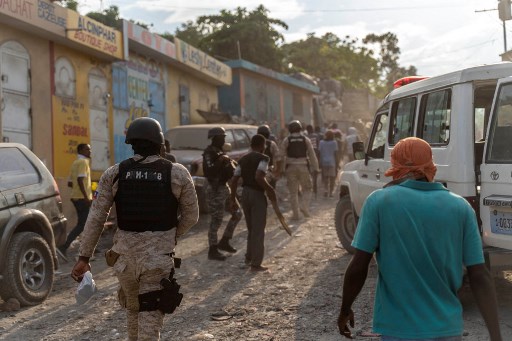
In response to the wave of violence unleashed by gangs, the United Nations Security Council approved a resolution, with 13 votes in favor and two abstentions (Russia and China), for the deployment of a new mission in Haiti, which will be led by Kenya and aims to stabilize the impoverished Caribbean nation once again.[1].
The resolution approved on Monday was primarily promoted by the United States and opens the door for the entry of foreign forces for a renewable year, a measure that the Haitian government had requested months ago, as the Haitian police lack the capacity to confront dangerous criminal gangs.
Following the assassination of President Jovenel Moïse in July 2021 by a group of mercenaries, in a dark plot involving powerful politicians and businessmen linked to drug trafficking, the poorest nation in the Americas is adrift.
Citing figures provided by the United Nations, Human Rights Watch, in its report “Living a Nightmare”[2], states that gangs killed more than 2,000 people between January and June 2023, a 125% increase compared to the same period in 2022. There were also 1,014 kidnappings during the same period and tens of thousands of forced displacements in contested neighborhoods.
In this context, the implementation and projection of the new UN mission appears very complex. Below is a brief analysis.
FAMILIAR TERRAIN. Various press reports agree on highlighting the little or no interest from South American countries to return to Haiti, which led the United Nations Stabilization Mission in Haiti (Minustah) from 2004 to 2017, such as Brazil, Chile, and Argentina.
Those who were on the ground can attest that the mission helped reduce violence, allowed for the continuity of electoral processes, and created an environment for slight economic progress. However, it also had aspects that damaged its reputation among the local population, such as the introduction of cholera by Nepalese soldiers and sexual abuses committed by some peacekeepers.
Nonetheless, the 2010 earthquake was the main factor that undermined much of the progress achieved in the country. With over 200,000 dead, its capital and economy were left in ruins.
In terms of assessments, Minustah served many purposes, such as creating ties between neighboring armies marked by rivalry and acquiring experience in hostile urban environments for troops, although many soldiers ended up performing a more police-like role. However, it is impossible to deny that the foreign deployment was merely a palliative, as its departure led to a resurgence of violence. This explains the doubts about the effective reach of a new mission.
Additionally, the wave of crime affecting South America has forced governments (which previously did not do so) to deploy military forces for public order control, as seen in Ecuador, Peru, and Chile[3], or to employ them in increasingly frequent natural disasters, all following the pandemic. Unlike in 2004, these are highly overstretched forces facing budgetary issues.
The United States Southern Command (Southcom), always interested in Haiti, will likely be responsible for channeling the $100 million that President Joe Biden’s administration intends to allocate to the Pentagon for this task, along with another $100 million for the State Department. Certainly, the situation in Congress is very complicated for the Democratic leader.
AFRICAN LEADERSHIP. One of the most striking aspects of this new mission is Kenya’s interest in leading it, for which it requested a United Nations resolution.
The deployment of about 1,000 soldiers, expected to take place starting January 1, 2024, will aim to protect critical infrastructure and government facilities while also targeting criminal groups, where they will likely encounter resistance.
“This will be an intervention force. These are forces that will need to go disarm the thugs and gangs,” said Kenya’s Foreign Minister Alfred Mutua in an interview with the BBC[4].
Mutua stated that he does not foresee much violence, as so far criminals act because no one can overpower them and because they lack popular support.
Kenyan forces have experience in security and stabilization missions, as they have been part of the African Union contingent in Somalia since 2011. They are also engaged in combat against the Somali terrorist group Al Shabab, linked to Al Qaeda, which increasingly launches cross-border incursions from its strongholds.
Beyond the language barrier, as Kenyans speak English and not French or creole, perhaps the greatest difficulty they will encounter in Haiti will be navigating the true labyrinths that make up its cities. Some assistance may come from forces from the Bahamas, Jamaica, and Antigua and Barbuda, which could join the contingent.
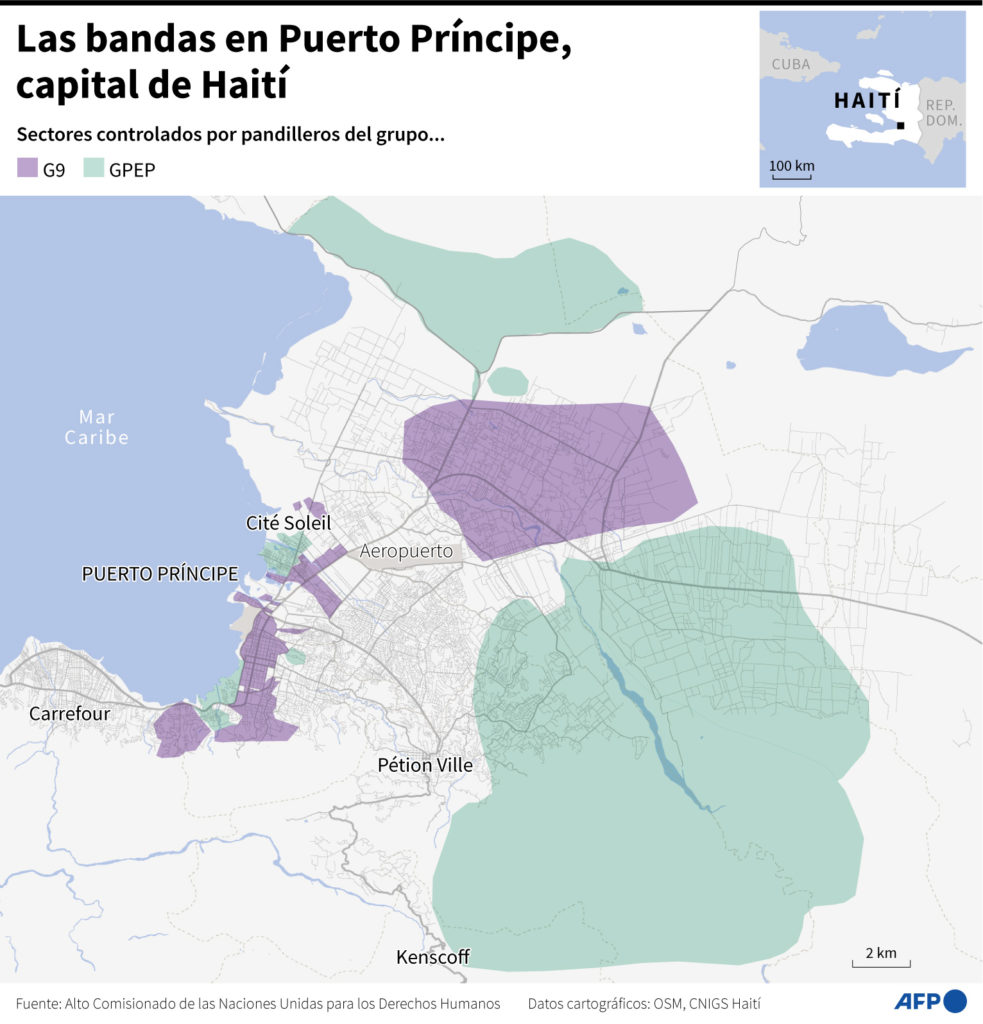
A STRONGER RIVAL. There are two federations of gangs that dominate the criminal landscape of Haiti, and their disputes are the main source of violence. On one side is G9 and Family, and on the other, GPEP, both connected to political movements. According to a CBS report, there are about 20,000 gang members in Port-au-Prince alone[5].
However, the main actor is the criminal leader Jimmy Chérizier, alias “Barbecue,” who is already under financial sanctions and international travel restrictions for threatening Haiti’s security and committing all kinds of crimes with his G9 gang and its current allies.
Chérizier’s “troops,” for example, have blocked key terminals for the unloading of fuel and food in the Caribbean nation, effectively paralyzing the economy of the capital and demonstrating their enormous territorial power. Thus, it can be observed that G9 or GPEP act as true criminal insurgencies, similar to what is seen in Mexico with the Jalisco New Generation Cartel or in Brazil with the First Capital Command.
In statements to Al Jazeera, the former police officer, who often presents himself as a revolutionary fighting for his country’s sovereignty, has promised to combat “to the last breath” against foreign forces that commit abuses[6].
CONCLUSIONS. The so-called “multinational security support mission” in Haiti, which is established under Chapter VII of the UN Charter, through which the Council can authorize the use of force after all other measures to maintain international peace and security have been exhausted, faces enormous challenges.
Kenya’s willingness, as an East African country looking toward the Indian Ocean, to engage in this Caribbean nation is intriguing but highly risky, given past experiences. The 1,000 soldiers do not seem sufficient, and the prospects for achieving sustainable results in the medium term are difficult. Although Haitians are Afro-descendants who gained independence in 1804, perhaps Nairobi’s objective relates both to its ability to project itself far from its immediate environment and to the exercise of the responsibility to protect.
This also calls attention once again to countries or extra-continental powers that are increasing their presence in Latin America and the Caribbean, including Chinese and Saudi investors, European diplomats, Iranian military personnel, Russian spies, etc.
Both the past experience of South Americans and their current security crises do not create any possibility or convenience for a military deployment in the Caribbean nation. Undoubtedly, a measure in that direction would be highly unpopular. Therefore, targeted advisory roles or training for Haitian forces are seen as more plausible options.
It is not beneficial for anyone to have a failed state in the region or anywhere, as in a globalized world, the possibility of exporting insecurity is high through the expansion of criminal groups beyond borders and through massive irregular migration flows. The option of leaving Haiti to its fate seems to have concluded once again, as always, for the moment.
[1] https://news.un.org/es/story/2023/10/1524557
[2] https://www.hrw.org/es/report/2023/08/14/viviendo-una-pesadilla/haiti-necesita-una-respuesta-urgente-y-basada-en-los
[3] Between 2004 and 2017, about 12,000 Chilean troops were deployed in Haiti.
[4] https://www.bbc.co.uk/sounds/play/p0ggz781
[5] https://www.cbsnews.com/news/haiti-un-mission-international-force-kenya/
[6] https://www.aljazeera.com/news/2023/8/17/haitian-gang-leader-warns-potential-foreign-force-against-any-abuses