The Power of Criminal Insurgency: The Signal from Haiti
This article was translated automatically and may contain differences from the original. For reference, read the original.
- by Juan Pablo Toro
- Analysis

Amid the severe security crisis in Haiti caused by the actions of a myriad of gangs, Prime Minister Ariel Henry submitted his resignation after the criminal leader Jimmy Chérizier, alias “Barbecue”, threatened to unleash a “civil war” if the authority did not step down.
Henry, who had been managing the country temporarily with the support of the international community following the assassination of President Jovenel Moïse in 2021, announced his departure from Jamaica to pave the way for an uncertain transition of power.
“If Ariel Henry does not resign, the country is heading directly toward genocide. If the international community continues to support Ariel Henry, we are heading directly toward a civil war that will end in genocide,” Chérizier (in the photo) warned, ensuring the prevention of the Prime Minister’s return by complicating the normal operation of Port-au-Prince’s international airport.
At that moment, Henry was outside his country, having signed an agreement with Nairobi to allow the arrival of a force of 1,000 Kenyan police as part of a Multinational Security Support Mission promoted by the United Nations, which has seen little success and will now face further delays due to recent events.
Meanwhile, Haiti seems to be sinking into criminal anarchy, being the poorest country in the Americas and the most fragile state on the continent, according to all indicators. What has occurred allows for a focus on criminal insurgencies or criminal groups that, due to their high firepower and military organization, can challenge both national and local governments. A new form of violence characteristic of the 21st century.
BACKGROUND. With varying intensity over time, powerful criminal groups have chosen to go beyond confronting the police and have opted for a frontal war against the State. This includes explosive attacks on public buildings and assassinations of authorities, as well as roadblocks or the immobilization and attack of critical infrastructure.
In this regard, the Colombian State faced a significant challenge when Pablo Escobar unleashed the fury of the Medellín cartel to prevent extraditions to the United States. A minister, presidential candidates, judges, military personnel, and police, among others, fell under the bullets.
Escobar was practically able to impose the terms of his surrender to the authorities in 1991, as the government of César Gaviria guaranteed that he would not be extradited and allowed him to operate a prison to his liking. Ultimately, the drug lord escaped and was killed by the police after a pursuit, which, as investigative journalist Mark Bowden recounts in the book “Killing Pablo” (2001), also included the collaboration of U.S. agencies, rival cartels, and paramilitary groups.
Since then, there has not been a challenge of similar magnitude to a State by a criminal group. However, Salvadoran gangs at one point represented an uncontrollable threat, to the extent that various governments negotiated pacts with the maras, sometimes promoted as “peace agreements,” where, in exchange for reducing violence, criminals received prison benefits.
In the case of alias “Barbecue” and the federation “G9 Family,” in addition to forcing the Prime Minister’s resignation, they also blocked Haiti’s main refinery for two months, causing a fuel shortage. The gangs also released 3,500 prisoners in a raid on prisons earlier this month and have compromised the operation of the capital’s airport.
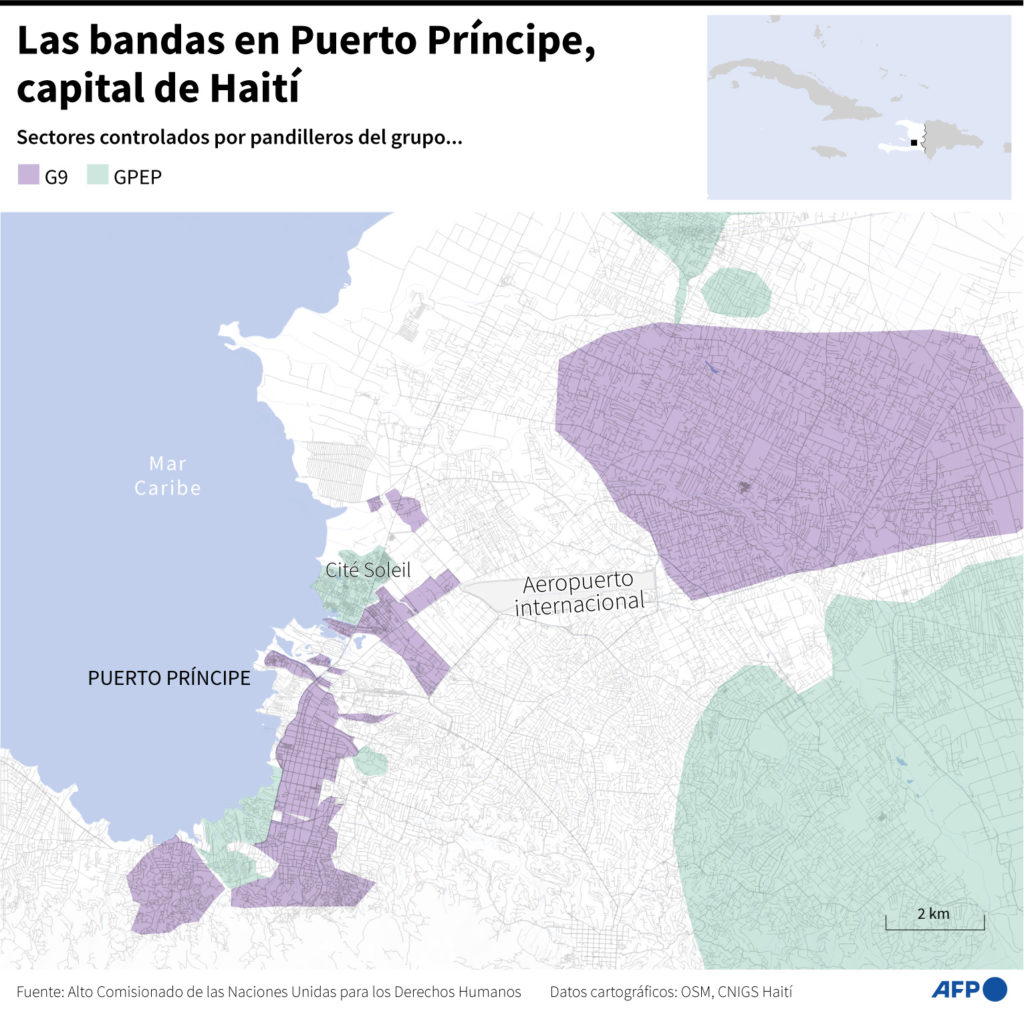
THE NECESSARY CONNECTION. Drug cartels or major criminal groups have always had resources to acquire weapons, but that does not guarantee they can develop shock structures capable of confronting and prevailing over the police and the State as a whole.
In the case of Brazil’s First Command of the Capital (PCC), which is now capable of launching cross-border incursions into Paraguay, the coincidence of gang members and guerrilla fighters imprisoned in the same jails has facilitated an exchange of experiences and tactics that benefited the PCC, allowing it to better organize itself to the point of carrying out coordinated and simultaneous attacks in cities.
But the experience and services provided by former uniformed personnel have also been key for cartels and gangs. The Zetas emerged in Mexico as an armed wing of the Gulf Cartel, composed of former members of the Army’s special forces who decided to serve drug trafficking. And in the case of “Barbecue,” who holds Haiti in suspense, he is nothing less than a former elite police officer who perceives himself as a social fighter rather than a dangerous criminal.
Finally, we have the cases of guerrilla leaders who transitioned from rebel organizations with political purposes to becoming heads of criminal organizations with military structures, but dedicated solely to profiting from drug trafficking and other activities. Dairo Antonio Úsuga David, alias “Otoniel,” the extradited leader of Colombia’s Gulf Clan, and the commanders of FARC dissidents who never left the drug business are clear examples.
GUERRILLA OR GANG? Researcher Max Manwaring from the U.S. Army War College was one of the pioneers in establishing the symbiosis between gangs and insurgencies, as the instability caused by the former to governments is similar to the actions of a guerrilla, along with the challenge to state sovereignty that this entails. His monograph “Street gangs: the new urban insurgency” from 2005 is a classic in the field . He continued to develop the topic in the books “Insurgency, terrorism & crime” (2008) and “Gangs, pseudo-militaries and the other modern mercenaries” (2010) . Now, his conceptual proposal has taken shape in Latin America and the Caribbean, especially in countries like Mexico, where the Sinaloa cartel subdued the Army in 2020 when President Andrés Manuel López Obrador ordered the halt of an operation to capture Ovidio Guzmán, son of Joaquín “El Chapo” Guzmán, to avoid a bloodbath after hitmen attacked soldiers and threatened military families in the city of Culiacán.Investigative journalist Ioan Grillo, after interviewing gang leaders throughout the region and noting the extremely high levels of violence (with 8% of the world’s population, Latin America and the Caribbean account for over 30% of global homicides), even speaks directly of “criminal wars” led by powerful criminal organizations, while establishing differences from the conflicts led by rebel groups in the 1960s, 70s, and 80s.In criminal wars, the objective is not to seize power, but to interfere with it. Gangs and cartels are concerned with selective territorial dominance, which implies control over access routes, economic activities, and management of security in their areas, but they need basic services for the people, such as health, education, sewage, etc. Governments find it uncomfortable to acknowledge that gangs or cartels threaten the nature of the State by challenging its monopoly on violence and the administration of justice, as these groups do not even have political proposals. They do not offer an alternative model of society. Although the main sources of income for the Revolutionary Armed Forces of Colombia (FARC) were drug trafficking, extortion kidnappings, and cattle rustling, what allowed President Juan Manuel Santos’s government to negotiate a peace agreement in 2016 with that guerrilla was the prior recognition of its character as a political actor — something still debatable today — not to mention the fact that the rebels did not return the ill-gotten funds to compensate their victims. Unlike guerrillas that sought prominence, criminal groups tend to be a power in the shadows rather than a real dominion. However, as impunity increases, so does the propensity of gangs and their leaders to emerge from anonymity. Members of the military wing of the Jalisco New Generation Cartel not only wear uniforms with insignia, but they no longer even bother to hide their faces in videos where they display their firepower and issue threats against their rivals. Ideally, they would prefer a weak and corrupt government from which they can benefit. Gang members do not recognize the legitimacy of the State. The great paradox is that, after the end of the Cold War, Latin America managed to build democracies and open markets, but this did not lead to the establishment of the rule of law in full, Grillo concludes in “Caudillos del crimen” (2016). Thus, in the region, very modern places coexist with terrifying levels of violence. So, guerrilla or gang? The generic term “criminal insurgency” seems to be the best option to describe this new and dangerous reality of criminal gangs that, with well-structured armed wings, manage to profit from illegal activities while progressively imposing their will in territories, cornering the authorities.
TYPE OF FORCES.
If a current government establishes that criminal insurgencies are indeed a national security problem, as the central institutions of the country and its population are threatened, they can effectively choose to employ military force to attack these groups.
This has been done regularly in Colombia and Peru for decades; in Mexico since 2006; in El Salvador since 2019 — especially under Nayib Bukele —; and sporadically in Brazil, as required by the authorities.
The most recent country to adopt this practice is Ecuador, where President Daniel Noboa declared the existence of an “internal armed conflict” and ordered the military to join the fight against criminal groups, which were classified as “terrorists.” Following the violence crisis in the city of Rosario, the Argentine government announced its interest in having the armed forces participate more in the fight against crime.
Undoubtedly, in light of the evolving security context of a country, authorities may decide to modify the roles of their armed forces and police. However, it is important that the decision has due political consensus and a strategic vision that withstands the medium and long term. Once military capabilities are modified to confront traditional threats, recovering them is neither easy nor quick.
At the beginning of the decade, with the Covid-19 pandemic in full swing, AthenaLab gathered the opinions of a series of specialists in the book “Challenges for Security and Defense in the Americas 2020-2030”
[2]
, who agreed that the armed forces in the region would increasingly take on more missions outside the military realm in an environment of budgetary constraints, thus blurring their nature. However, the speed of this reality has continued to surprise. CONCLUSIONS.
Criminal insurgencies appear to be gaining ground in Latin America and the Caribbean, especially in countries with less consolidated states and little effective presence of authorities over the territory, with Haiti being the most critical case of all. This is a nation that had its security entrusted to United Nations blue helmets between 2004 and 2017 (including Chileans) and failed to build viable police forces. This is influenced both by a lack of resources due to structural poverty and the presence of political parties that have used gangs as instruments of pressure, particularly during electoral periods.
The chronic institutional weakness of the region, exacerbated by the economic fallout from Covid-19 and prevailing political polarization, provides fertile ground for criminal insurgencies. Therefore, expanding groups must be addressed before they can challenge an entire State. Although this requires both a security strategy and firm political will without electoral calculation.
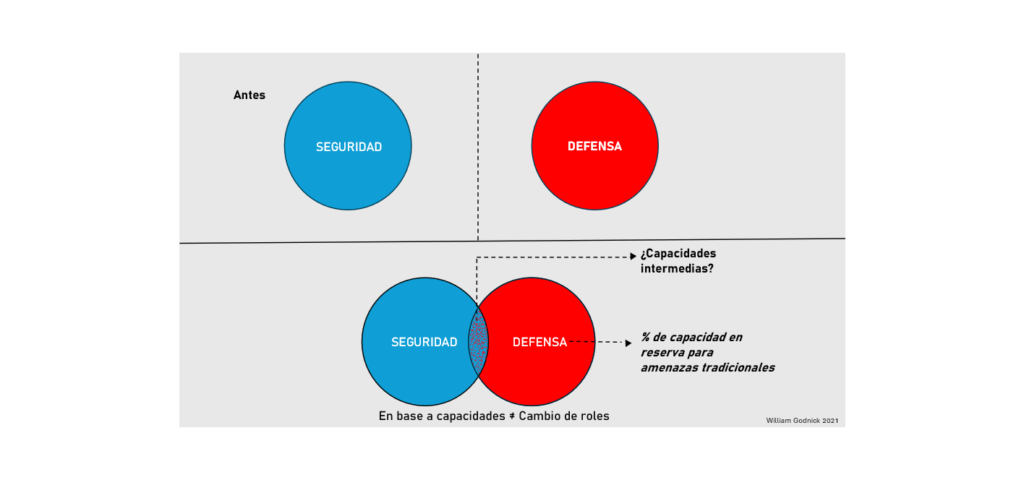
While it is a sovereign decision for governments to employ their armed forces for public security tasks typically assigned to the police, there is an increasingly frequent and growing use of this practice in the region. If this trend continues, it could open a serious and valid debate in some societies about recalibrating the role of state forces and the need for the development of intermediate capacities to face security and defense challenges (see graph).
However, the magnitude of the security crisis and the demands of a frightened citizenry should not lead to a distortion of the ultimate purpose of the military instrument — to win the war and guarantee peace — without first taking the time to modernize, strengthen, and politically support existing police forces. The pursuit of immediate results in reducing criminal violence, without addressing the underlying issues of law enforcement, the recovery of public space, and social development, does not create sustainable realities over time. Chile, apparently, is not immune to this debate, despite having the institutional conditions to address the problem without resorting to the armed forces.Sixteen Brazilian generals and admirals, who shared their experiences in the recent book “Armed Forces in Public Security in Brazil: The Military Point of View”
(2024) [3]
from the Getulio Vargas Foundation, admitted that military interventions can be decisive at first, but do not resolve the central problem when it is political and concerns the State, the law, and its citizens. Thus, a cycle of pressure, calm, and return of pressure is perpetuated.
The situation in Haiti is dramatic in itself, and its future is uncertain, but it must also be understood as a warning signal about the level to which security can deteriorate when political negligence leaves space for criminal insurgencies, which do not recognize the power vacuum and interpret any hesitation regarding police actions as a sign of weakness from a State afraid to enforce the law.
[1]
https://www.files.ethz.ch/isn/14325/Street%20Gangs_The%20New%20Urban%20Insurgency.pdf [2]https://www.athenalab.org/athenalab-lanza-su-primer-libro-sobre-seguridad-y-defensa-en-el-continente-americano/ [3]https://editora.fgv.br/produto/armed-forces-in-public-security-in-brazil-the-military-point-of-view-3853 https://editora.fgv.br/produto/armed-forces-in-public-security-in-brazil-the-military-point-of-view-3853
https://editora.fgv.br/produto/armed-forces-in-public-security-in-brazil-the-military-point-of-view-3853
https://editora.fgv.br/produto/armed-forces-in-public-security-in-brazil-the-military-point-of-view-3853 https://editora.fgv.br/produto/armed-forces-in-public-security-in-brazil-the-military-point-of-view-3853
https://editora.fgv.br/produto/armed-forces-in-public-security-in-brazil-the-military-point-of-view-3853 https://editora.fgv.br/produto/armed-forces-in-public-security-in-brazil-the-military-point-of-view-3853
https://editora.fgv.br/produto/armed-forces-in-public-security-in-brazil-the-military-point-of-view-3853 https://editora.fgv.br/produto/armed-forces-in-public-security-in-brazil-the-military-point-of-view-3853