Attention Armed Forces of Latin America: A swarm of drones lands at Fidae 2024
This article was translated automatically and may contain differences from the original. For reference, read the original.
- por Juan Pablo Toro
- Actualidad estratégica
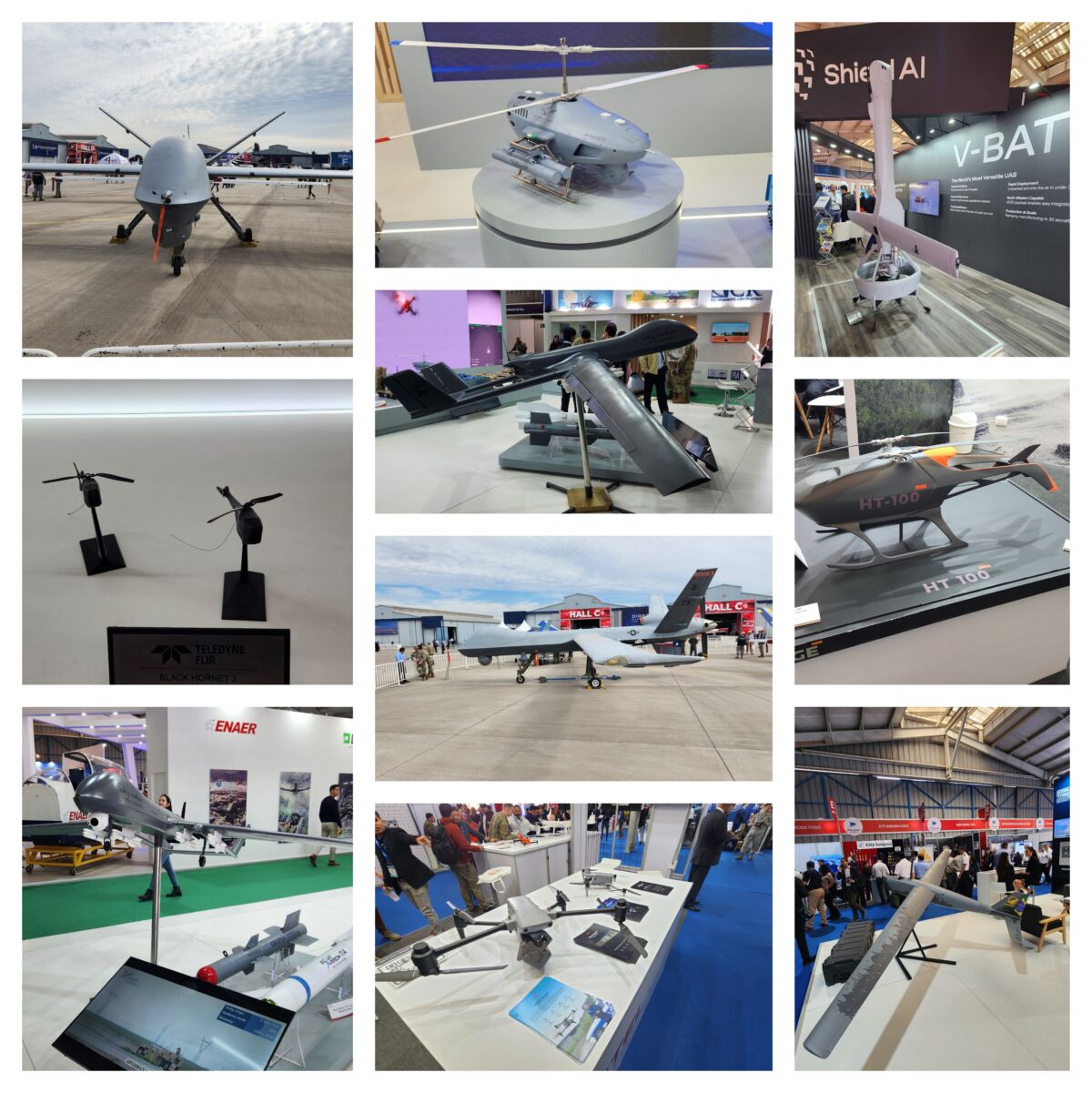
In the current edition of the International Air and Space Fair (Fidae) organized by the Chilean Air Force, the main attractions of the event no longer seem to be the increasingly scarce combat aircraft, but rather the drones that flood the exhibition halls. From those that can be assembled for targeted strikes to those used for border surveillance.
The breadth of the showcase allows for the appreciation of unmanned aerial vehicles (UAVs) from companies of very diverse origins and scales, with the MQ-9 Reaper from General Atomics leading the way, whose lethality in the hands of the U.S. Air Force could be better described by ISIS in Syria or other jihadist groups that have suffered from it.
Chinese company Norinco exhibits, among other models, the Sky Saker, whose similarity to the Reaper is striking, from its landing gear to its V-shaped tail—every plagiarism is a form of homage, as the well-meaning would say. As one of the representatives explains, it has up to 36 hours of flight autonomy. This would be sufficient to travel back and forth from the coast of mainland China to Taiwan several times.
Military companies from emerging countries—major beneficiaries of the collapse in Russian arms sales due to Western sanctions and their poor performance demonstrated on the battlefield in Ukraine—also have their own offerings.
While Brazilian Advanced Technologies is present with the HARPIA drone, which has already been used by the country’s Army in conjunction with rocket artillery, Turkish Baykar has brought models of the Bayraktar TB2, which in the hands of Ukrainian forces and armed with bombs has allowed them to counter a supposedly superior enemy.
Some countries, such as Colombia and Chile, already possess the Israeli-made Hermes 450 and 900 models, while Venezuela has the Iranian Mohajer-6, and Bolivia signed an agreement with Tehran last year to purchase unspecified UAVs, which would be used to combat drug trafficking and enhance border surveillance, according to authorities in La Paz.
However, those who have recently made headlines with the use of drones to attack their enemies have been Mexican and Colombian criminal groups, which are now beginning to venture into the air, not just for transporting drugs.
In Mexico, La Familia Michoacana and the Jalisco New Generation Cartel have employed commercially available UAVs, either to launch explosives or detonate them in a suicide mode, targeting rival gangs and soldiers.
The commander of the Colombian Armed Forces, General Helder Giraldo Bonilla, recently warned his troops to prepare for the use of drones by “criminal structures,” as they were able to observe in a video accessed by them, showing FARC dissidents training in the operation of commercial UAVs, which they then convert into weapons.
While the military forces of Latin America are already venturing into the world of drones, they have so far done so timidly and limited to observation UAVs rather than attack drones, as far as we know.
However, in a scenario of budget reductions and an increase in tasks, this trend could change. If an MQ-9 Reaper, like the one seen at Fidae, can cost around $55 million with its sensors, control stations, and link satellite capabilities, the solitary F-22 fighter, which performs all kinds of maneuvers, exceeds $140 million. Both are currently unaffordable for the air forces of the region; however, the swarm of drones filling the halls of the most important fair of its kind in the region is not, and of course, neither are the “rifles” displayed to shoot them down, especially those from innovative criminal groups.