Recognition of States and Governments in the Case of Palestine
This article was translated automatically and may contain differences from the original. For reference, read the original.
- por Paz Zárate
- Análisis

Highly relevant in the 1990s following the disintegration of the Soviet Union and the former Yugoslavia, this issue has resurfaced recently. Not only due to the case of Palestine, but also because of the war in Ukraine, as Russia used the “protection” of the Ukrainian regions of Donetsk and Luhansk as a pretext for its large-scale invasion of this country, which it later recognized as independent “republics” (2022) and ultimately annexed, although the majority of countries in the world continue to consider them as territory of Kyiv.
Recognition is defined as a unilateral act, either express or tacit, carried out by the government of the recognizing State. It indicates the willingness of this State to establish official relations with a new government or State, or it expresses an opinion on the legal status of a new authority or entity, or both.
Thus, although recognition expresses an individual will or opinion, it is not an entirely political act that lies within the discretion of the recognizing State. If it is unfounded or premature, it may constitute an unlawful act that gives rise to state responsibility. For this reason, recognitions, especially from State to State, are usually carried out with caution.
The first question that arises is: what is needed to be a State? The Montevideo Convention on the Rights and Duties of States (1933) is the starting point in this matter, establishing criteria on which there is much theoretical discussion. Under its parameters, for a State to be a “person” in international law, it must possess a permanent population, a defined territory, a government, and the capacity to enter into relations with other States. The recognition of others, then, is not a requirement for having the status of a State. An entity is not a State because others recognize it as such, but rather it is recognized for being a State.
The range of factual situations that present challenges to the requirements thus stated is broad, as is the doctrinal discussion on the creation of new States. In practice, the central requirement for the emergence of a State is the existence of a government that is capable of exercising sovereignty over a territory where there is a population that constitutes a community. In fact, the territory can be very small and even non-contiguous (as in the case of Palestine); and the existence of borders without clear definition, or even substantial territorial claims, has proven not to be an obstacle to the existence of the State, no matter how much it may complicate the exercise of sovereignty. The key is the existence of an authority that internally has the power to determine the form of constitution of the State (internal sovereignty); and as a consequence of this, the ability to relate to others independently, that is, assuming rights and obligations on its own (external sovereignty).
The Montevideo criteria are essentially based on the principle of effectiveness. However, there are entities that, despite adhering to this principle, are not considered States (for example, Taiwan). Conversely, some States have lost effectiveness and continue to be regarded as such, like those that were illegally annexed during World War II (Austria, then Czechoslovakia, Poland, the Baltic States).
Issues related to secession, disintegration, and the creation of new States, as well as climate change, alter the practice regarding recognition. For example, concerning the requirement of territory, we are moving toward an anomalous situation. Due to climate change, it is known that within a few decades, small island States in the Pacific will have most of their territory underwater. One of these small States (Tuvalu) has recently signed the first treaty that will allow the progressive migration of its population (to Australia) without losing its status as a State.
There are countries that only recognize States and not governments (such as the United Kingdom since 1980 and other EU member States); others that generally do not recognize governments but do so under exceptional circumstances and for political reasons (such as the United States); and others that formally recognize governments through official declarations. In any case, States must always decide whether a person or group of persons qualifies to act as the organ of that State and represent it internationally, especially when there are competing “governments” within the same State or attempts at secession.
The only criterion in international law for recognizing an authority as the government of a State is the exercise of effective control over the territory of the State: international law does not require a democratic origin. Attempts to introduce such a requirement, whether through treaties (Central American Treaties of Peace and Friendship of 1907 and 1923) or as a matter of national (Tobar, Wilson, and Betancourt doctrines) or regional policies (Santiago Commitment to Democracy, 1991), have failed.
The Palestinian Case
Recently, the UN General Assembly adopted a resolution that makes marginal adjustments to Palestine’s position in the United Nations, whose current status is that of a “non-member observer State.” However, such a resolution does not transform Palestine into a member State of the United Nations, as membership requires a recommendation from the Security Council, which has so far been blocked by the veto of the United States as a permanent member of the body.
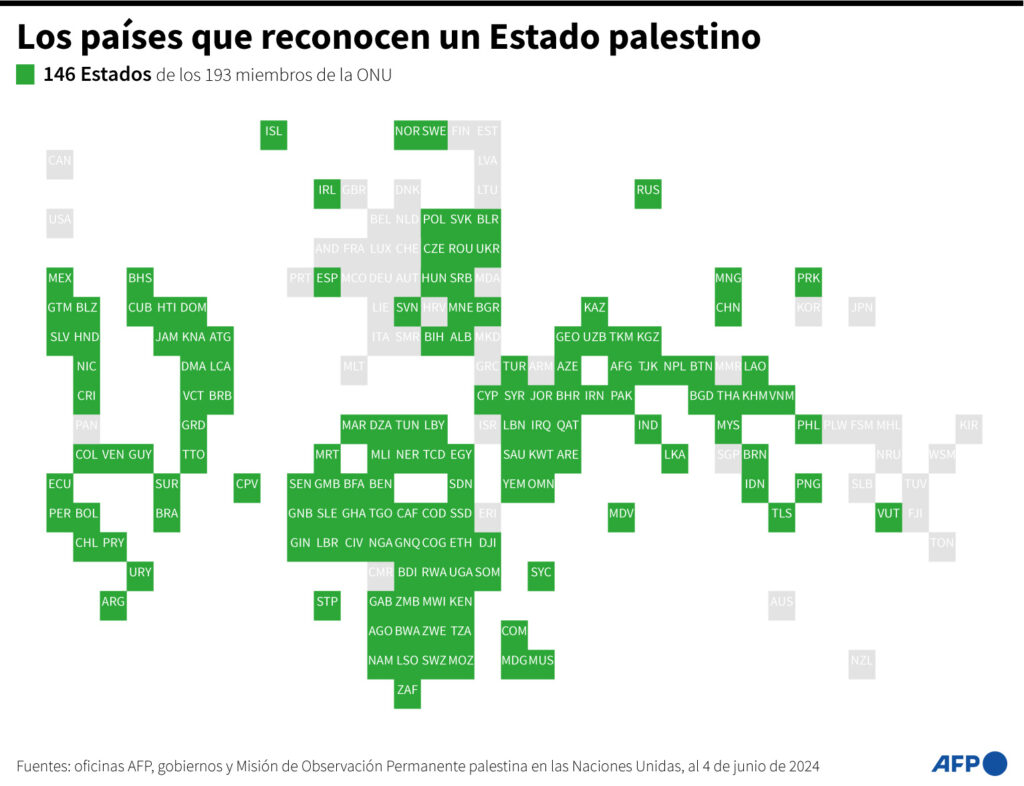
Admission to the UN as a full member is not a requirement for Palestine to be a State. And while this development may be hindered, Palestine has accumulated more than 140 bilateral recognitions, which is indicative of the intention to establish diplomatic relations (Chile recognized Palestine as a State in 2011, as an early expression of support for the two-State solution, Israel and Palestine).
The real question regarding Palestine concerns the recognition of its government, as in practice there are two governments in two geographically separated territories: the Palestinian Authority in the West Bank and Hamas in Gaza, with only the West Bank having a democratic origin. The only time there was temporarily a Palestinian unity government was a short-lived agreement between the Palestinian Authority and Hamas following Israel’s withdrawal from Gaza in 2005. A few months later, in 2006, Hamas won several seats in the elections for the Gaza legislature, which was followed by a coup in 2007, leading Hamas to gain total power in Gaza, which it has maintained since without holding new elections.
Thus, the question of Palestine as a State still presents significant viability challenges, which must be carefully weighed to ensure peaceful coexistence with Israel and the rest of the countries in the region.
Main photo: Spanish Prime Minister Pedro Sánchez announces recognition of the Palestinian State (France Presse)