After the Icebreaker "Almirante Viel": Naval Construction Continues
This article was translated automatically and may contain differences from the original. For reference, read the original.
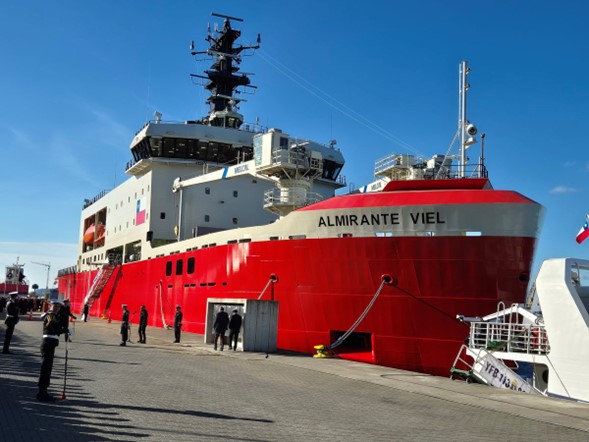
With a displacement of 10,500 tons, a length of 111 meters, a beam of 21 meters, and a cost of US$221 million, the Chilean Navy incorporated the new icebreaker “Almirante Viel” this week, thereby expanding its capabilities to operate in the Antarctic continent.
“This icebreaker will strengthen Chile’s presence in Antarctica, a region to which our country has an unwavering commitment and projection that demands we safeguard and preserve it for science and peace,” said Vice Admiral Leonardo Chávez, General Director of the Navy’s Services, during the incorporation ceremony on July 3 in Talcahuano.
Undoubtedly, this is one of the most important and emblematic public-private projects in the country, reflecting two relevant aspects for these times: first, that the country has a mature Maritime Industrial Base for Defense (BIMD) capable of facing complex technological challenges, which allows it to contribute to the struggling national economy; and second, it demonstrates the State’s interest in equipping defense institutions with capable means to achieve their objectives, in this case, safeguarding national interests in the white continent.
Naval construction in Chile should be studied as one of the alternatives the country has to promote its economy and improve its Research and Development (R&D) capacity. This state-of-the-art vessel was built through a partnership between the Navy, as the end user, the Navy Shipyards and Workshops (Asmar), as the builder, and VARD Marine, a Canadian company, as the providers of design and basic engineering. This partnership allowed, in about ten years—the normal timeframe for such projects—to determine the requirements, design, and ultimately construct this vessel, which is perhaps the most significant technological challenge undertaken by the state shipyard.
At the ceremony, President Gabriel Boric stated that this week he received a first draft of the National Naval Construction Policy, “the objective of which is to carry out an unprecedented industrial program that seeks the development and strengthening of the national industry through public-private partnerships, promoting research, technology development, and the improvement of our workforce.” However, he did not make any specific announcements or commitments on the matter.
The “Viel,” in addition to being an icebreaker, is a scientific research vessel equipped with state-of-the-art laboratories and sensors, allowing for the permanent accommodation of 30 scientists. Additionally, it has the capacity to logistically resupply national bases and those of friendly countries, with a load capacity of 19 containers, 400m3 of general cargo, and 400m3 of fuel. Moreover, more than half of the investment in this vessel remained in the country, demonstrating that the national industry possesses a BIMD capable of facing significant technological challenges and that, supported by long-term policies such as the National Continuous Naval Construction Plan, it can not only provide the Navy with the vessels needed to safeguard national interests at sea but also generate a significant source of business, with benefits extending to industrial and R&D fields by incorporating national technology into the Navy’s vessels.
Furthermore, certification as an icebreaker PC-5 will allow the “Viel” to conduct scientific campaigns for approximately six months, from October to March, even beyond the Antarctic Polar Circle, reaching as far as Alexander I Island and the Ross Sea. Its reinforced hull will enable it to operate in areas with ice up to 1 meter thick, allowing it to participate in search and rescue operations year-round in the South Shetland Islands, considering the increase in Antarctic tourism. These new capabilities, which nearly double those of the previous icebreaker “Viel,” will enhance the Navy’s presence in the white continent. Operating in conjunction with the new ocean tug “Lientur” and the ocean patrol vessel “Fuentealba,” all part of the Navy and based in Punta Arenas, will allow the State to exercise sovereignty in an area where international disputes are beginning to be felt despite existing treaties, thus helping to safeguard national interests in the southern cone of the continent.
Finally, considering the capabilities acquired by Asmar and the national industry, it is expected that naval construction in Chile will strengthen through a state policy aimed at further enhancing the industrial and technological capacity of the country, to build more technologically advanced units, such as frigates, that can safeguard national interests at sea, while also incorporating new national actors into this industry, especially in R&D, who can subsequently replicate their work in other areas of the country, thereby promoting the national economy.
Regional Overview
Despite the political instability and struggling economic situation that South America has experienced in recent years, naval construction has not halted in the region.[1]In fact, Asmar is already constructing two multipurpose vessels of 8,000 tons displacement designed by Vard Marine of Canada for a total of US$409 million. Four units of this type are projected.
However, Brazil’s case may be the most emblematic due to its scale. In that country, three of the four Scorpène-class submarines ordered by the Navy have already been built, and progress is being made on the construction of a long-awaited nuclear-powered submarine. The entire PROSUB project in partnership with Naval Group of France is valued at US$9 billion. Additionally, the construction of four frigates based on the Meko A100MB class has already begun by the Aguas Azules consortium, which includes Embraer and Thyssenkrupp Marine Systems of Germany, with a total project value of US$1.8 billion.
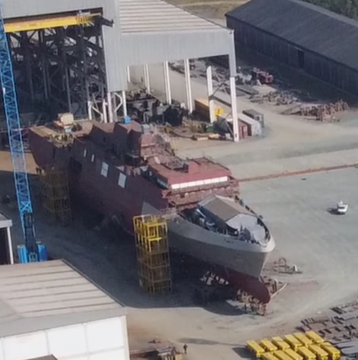
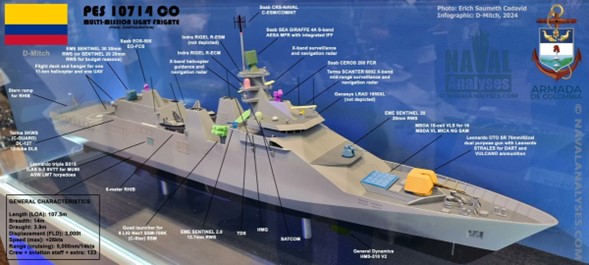
Colombia, for its part, has decided to adopt the Dutch Sigma 10514 design from Damen Shipyard to build five frigates at the local shipyard Cotecmar starting in 2025, for a total cost of US$2 billion.
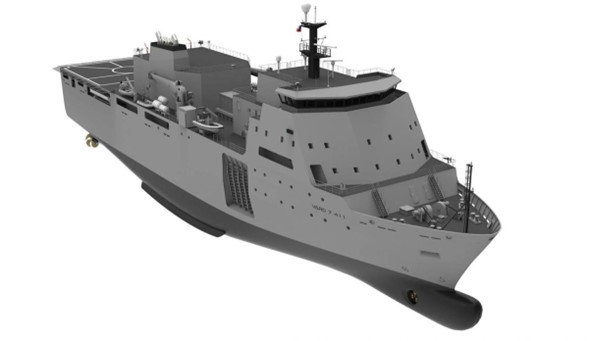
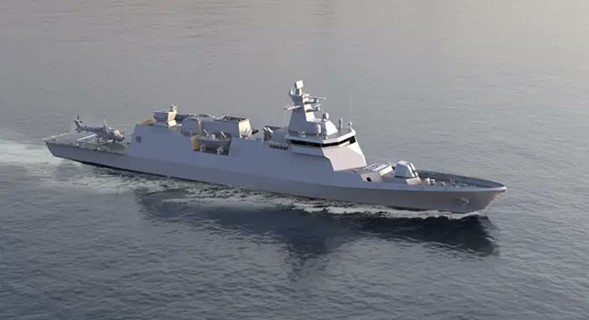
Recently, Peru announced that to begin replacing its surface fleet, it selected Hyundai Heavy Industries of South Korea to build, in partnership with the local shipyard SIMA, a 3,400-ton HDF-3200 model frigate (see render), an ocean patrol vessel, and two barges for a total value of US$463 million. The ultimate goal is to build six frigates and ocean patrol vessels.
For all the above reasons, it can be stated that naval construction is in full swing in South America, overcoming current political circumstances and contributing to countries through innovation, development, and job creation. For Chile, the upcoming challenge will be to build eight frigates in the country. Undoubtedly, the experience and needs exist in a maritime nation, so the questions to be answered are: Partner shipyard and funding? Time is running out.
More related information:
COLUMN | The Strategic Consequences of the Icebreaker Almirante Viel and Naval Construction in Chile. Richard Koyoumdjian in El Mostrador.
COMMENTARY | Icebreaker “Almirante Viel”: A Reflection of National Antarctic Will. Juan Pablo Toro https://www.athenalab.org/comentario-rompehielos-almirante-viel-reflejo-una-aspiracion-nacional/
ARTICLE | More Ice, Please: The Growing Interest in Polar Vessels. Juan Pablo Toro
https://www.athenalab.org/mas-hielo-por-favor-el-creciente-interes-por-buques-polares/.
[1] Janes’s Defense Weekly (07/05/2024). “South America’s Naval Modernization Challenge,” by Tim Fish.