Operation UNITAS LXV: Back to the Essence
This article was translated automatically and may contain differences from the original. For reference, read the original.
- por Juan Pablo Toro
- Análisis
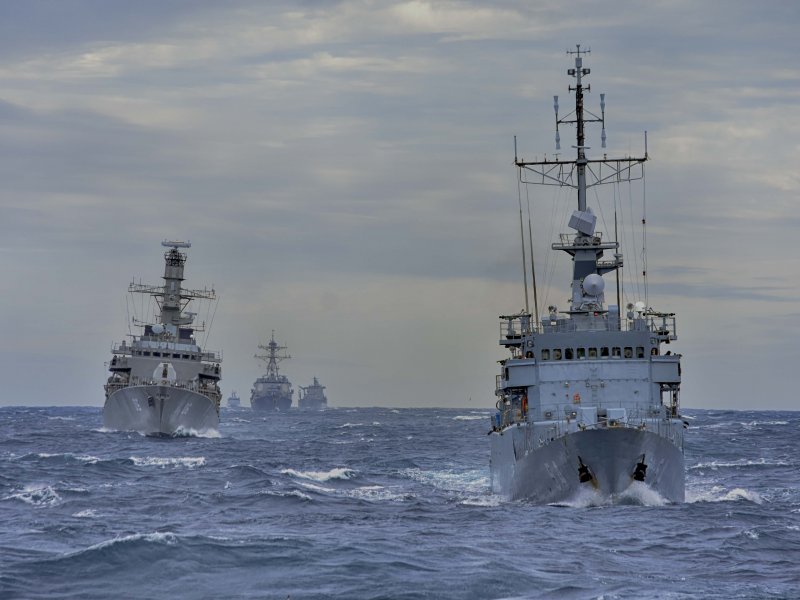
Off the coast of Chile, a fleet of 19 ships will gather next month as part of Operation Unitas, the largest naval exercise in the Americas, created 65 years ago to enhance hemispheric defense against the incursion of Soviet submarines. A reality that may now seem somewhat distant, but not entirely, as while history does not repeat itself, it certainly rhymes.
In mid-June, a Russian nuclear-powered submarine and other vessels from that country docked in Cuba. Although the Russian Navy is a shadow of its Soviet predecessor, which was a global force capable of causing significant headaches for Western navies, we now see the authoritarian regimes of Moscow and Havana aligned as closely as in 1962, with intentions to disrupt the continent.
Despite claims that these are routine visits for the sake of naval diplomacy, it is quite unusual for a second flotilla from Moscow to cross the Atlantic to appear in the Caribbean just six weeks later. Ultimately, these are warships from a country that invades other nations — as seen in Ukraine — and supports disruptive partners — from North Korea to Venezuela.
Framed by the Inter-American Treaty of Reciprocal Assistance (TIAR) and previous experiences of combined operations between the U.S. Navy and Latin American navies during World War II (1939-1945) and the Korean War (1950-1953), the original spirit of Operation Unitas seems to have regained new vigor, as the presence of dangerous extra-continental forces becomes a recurring reality once again.
In 2023, two Iranian Navy ships, which were circumnavigating, crossed the Strait of Magellan and visited Brazil. At the end of the tour, a Persian admiral announced that the next step would be to build a base in Antarctica.
For those who urge not to exaggerate the point, it is worth noting that this year, ships from the navies of Italy and France — the latter being a resident country in South America and the Caribbean — also patrolled the American coasts; however, when dealing with the navies of Moscow and Tehran, it is important to emphasize that we are facing countries that do not respect freedom of navigation, an absolute value that, when challenged in one place, affects the entire system.
Through their direct or indirect actions (Tehran’s support for Houthi rebels and attempts to blockade the Ukrainian coast), these nations have created serious disruptions along important trade routes in the Red Sea and the Black Sea. Therefore, their presence should not be considered innocuous or sterile. Cuba and Venezuela seem to understand this better.
When Unitas was created, the initial focus was on practicing submarine search patrols, but with the dissolution of the Soviet Union, the exercise began to expand into the realm of maritime security to include interdiction maneuvers against threats such as piracy, drug trafficking, and illegal fishing, with significant traffic control and recovery of captured vessels. Humanitarian aid delivery also began to play an important role.
If we accept the thesis of British historian Niall Ferguson, that we are in a 2.0 Cold War, where the strategic rival for the United States and its partners is China, followed by Russia and other members of the axis of disorder (Iran, North Korea, Venezuela), it makes sense to reinforce hemispheric defense in the surrounding seas.
For this reason, Operation Unitas is divided into three phases: the Atlantic, Pacific, and Caribbean. And although it may be forgotten, the TIAR, as a geographical framework, includes in the security area the “American Antarctica,” territory between the meridians of 24° and 90° west; another area where strategic competition is manifesting with increasing strength.
In these times of high uncertainty, the stability of large, medium, and small maritime theaters is more important than ever for the international system; particularly when it relies on an economy that circulates above and below saltwater (cargo, data, energy, and biological resources).
This is something that the United States has understood by promoting that the vast majority of countries in the region host and organize the exercise, unlike in the past when the U.S. Navy sometimes opted to participate with each country separately.
In the case of Chile, its prosperity depends on a secure environment in the Indo-Pacific — the primary destination for its exports — as any conflict there will have a maritime character, no matter how distant, which in turn demands the development of naval warfare skills on the surface, in the air, and underwater. Hence, there is also an unavoidable need to have frigates capable of operating independently — ideally built on national soil — but also integrated into international task forces, such as the one that will patrol the country’s coasts. The mere act of interoperating also has another positive indirect effect, helping to smooth over historical tensions between the invited navies (Argentine and British ships will be seen sailing together, something that has not happened in decades).
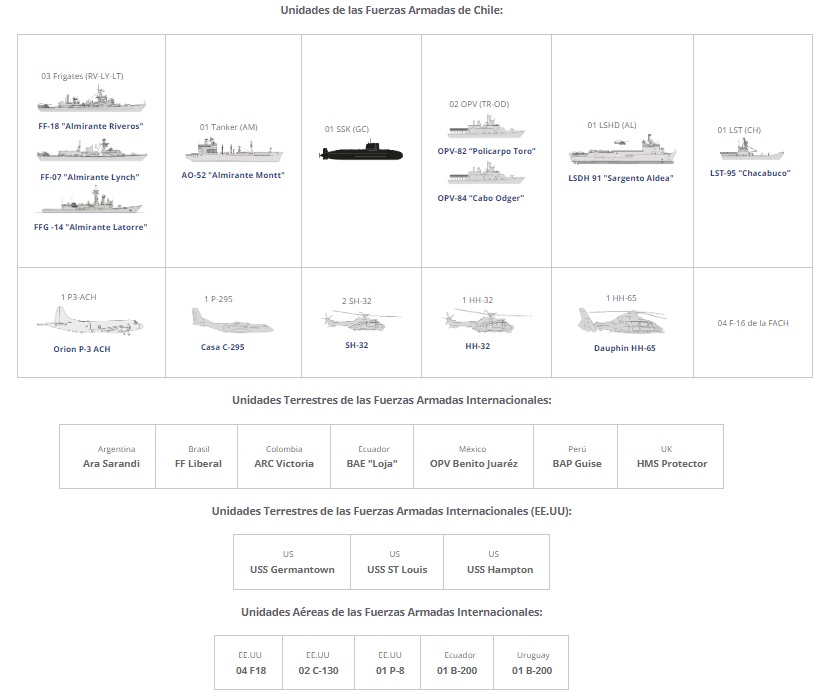
Therefore, if the essence of Operation Unitas seems to have regained broad strategic significance, the imminent presence of ships, aircraft, and sailors from Chile, Argentina, Brazil, Colombia, Ecuador, the United States, Mexico, Peru, and the United Kingdom can only translate into better and more security for our main interface with today’s complicated world. This, and more, is what naval exercises like this are about.