The Growing Defense Relationship Between Chile and China
This article was translated automatically and may contain differences from the original. For reference, read the original.
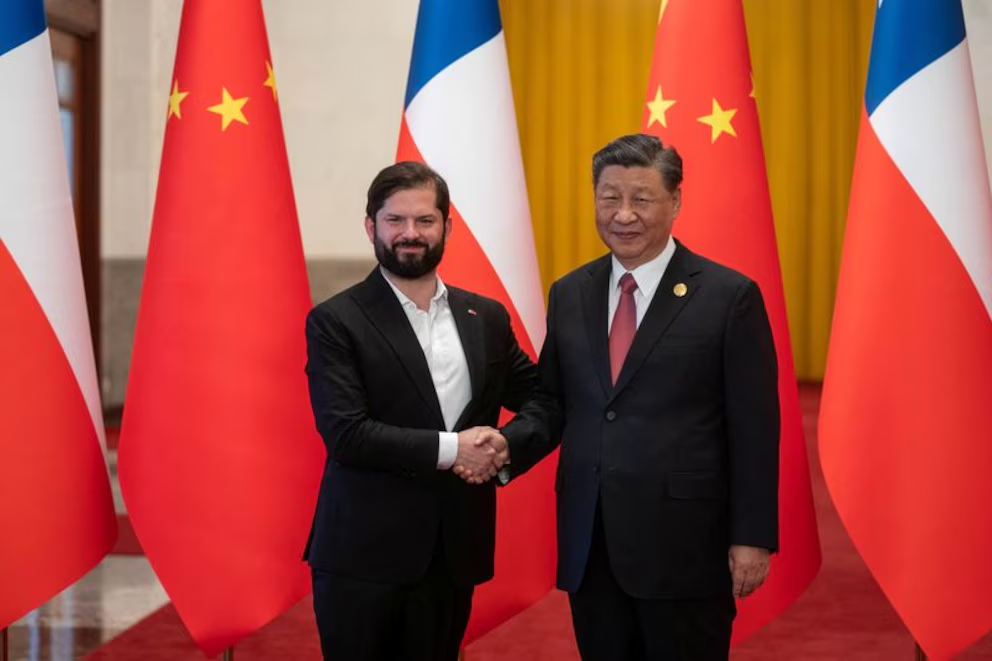
El presidente chino Xi Jinping y el presidente chileno Gabriel Boric se dan la mano durante una ceremonia de bienvenida en Pekín, el 17 de octubre de 2023 (Palacio Presidencial/Marcelo Segura/Handout vía Reuters)
The Boric government will need to act cautiously to ensure that the benefits outweigh the risks and are consistent with democratic values and human rights.
From September 9 to 14, 2024, Chile’s Minister of Defense, Maya Fernández Allende, granddaughter of Chile’s first socialist president, Salvador Allende, traveled to the People’s Republic of China (PRC) to attend the 11th Xiangshan Annual Defense Forum in Beijing. The meeting, the most significant event of the People’s Liberation Army’s (PLA) global defense “diplomacy” for the year, was attended by over 500 representatives from more than 90 countries, including 30 defense ministers. During her stay, presumably following numerous positive meetings and the generous hospitality of the PLA, along with a meeting with the PLA’s Minister of Defense, Dong Jun, Minister Fernández publicly expressed her interest in reviving a closer defense cooperation between Chile and the PLA. Her statement included the intention to reactivate a previously established Chile-PRC Joint Working Commission.
Her explicit desire to revitalize the Chile-China defense relationship generated significant controversy in Chile, including criticism from former Defense Minister Jorge Burgos, as well as from respected Chilean strategists such as Manfred Wilhelmy. Critics expressed concern that Minister Fernández was committing to introduce significant changes in Chile’s foreign policy that could undermine the country’s relationship with important partners like the United States, in addition to exposing Chile to espionage risks by expanding PLA access to Chilean military institutions and personnel. Members of the Chilean Senate Defense Commission called on the minister to testify before the Commission to explain the strategic logic underlying Chile’s significant shift in posture implied by her statement in China, and whether it represents a policy change approved by President Boric and the Chilean Ministry of Foreign Affairs or coordinated with them.
In response to such concerns, Minister of Defense Fernández emphasized that she had not signed any new formal commitments during her stay in the PRC, but had only committed to increasing cooperation already contemplated in the Chile-PRC Defense Cooperation Agreement that former Chilean Defense Minister Andrés Allamand signed with his Chinese counterparts in June 2011. That agreement, like adherence to the Chinese Belt and Road Initiative and other ambiguous memoranda of understanding that regional governments have signed, illustrates how the PRC uses a network of seemingly non-binding contracts and statements to entangle its partners in relationships that can be exploited later when opportunities arise with more willing or needy governments.
To date, Chile’s defense relationship with the PRC has resembled that of other Western democratic governments that have reasonably strong institutions and wish to benefit from interactions with the defense establishments of a range of regimes in their country’s sphere of interest, without jeopardizing basic relationships with countries aligned with their values that significantly contribute to institutional capabilities.
Both the PRC and Chile have military attaches in each other’s countries. Chile has sent officers to the PLA National Defense University since 1997, and the Chilean Army’s language school hosted two Mandarin instructors from the PLA for several years starting in 2005. Chinese vessels have long operated from southern Chilean ports to resupply PRC government scientific facilities in Antarctica. Following the signing of a defense cooperation agreement between Chile and the PRC in 2011, Chile hosted visits from the PLA Navy frigates Lanzhou and Liuzhou in 2013 and conducted combat exercises with them. Those Chinese warships, accompanied by a fuel support vessel, subsequently transited the Strait of Magellan. In December 2018, the Chinese hospital ship “Peace Arc” visited Chile as part of a broader trip to the region.
The PLA and Chilean military have also periodically interacted in naval exercises in the Pacific Ocean such as RIMPAC, as well as in forums like the Western Pacific Naval Symposium. Chinese defense companies regularly participate in major Chilean military fairs such as EXPONAVAL and FIDAE.
In the space domain, the Chinese government has operated an astronomical observatory on Cerro Calán, near Santiago, while the China Satellite Launching and Tracking and Control (CLTC) organization, affiliated with the PLA, operates two C-band radars relevant for military purposes at the Santiago Satellite Station facilities in the northern part of the country.

Maya Fernández Allende, Minister of Defense of Chile (REUTERS/Rodrigo Garrido)
The agenda of Minister of Defense Fernández’s trip to the PRC, which included her arrival three days before the forum began to visit other PRC government facilities, suggests the likely initial direction of cooperation initiatives between Chile and the PRC. Her visit to the National Defense University of China suggests a possible increase in Chilean security personnel attending courses there, and possibly reciprocal visits to Chilean military institutions, with the minister mentioning such cooperation at the ANEPE National Defense University in Chile in public comments. Similarly, her visit to China Electronics Technology Group Corporation (CETC) suggests potential Chilean purchases of defense electronic systems from the PRC, while her visit to the Institute of Chemical Sciences of the PLA Academy of Military Sciences suggests interest in cooperation on military materials and other research. Her meeting with the Director of the China National Space Administration suggests an interest in expanding space cooperation between the PRC and Chile, possibly including the development and launch of satellites, data exchange, and potentially moving away from the previously mentioned CLTC contract to operate at the Santiago Satellite Station when its lease expires. The Chilean shipbuilding sector was also mentioned during the trip as an area of potential cooperation with the PRC.
Individuals in Chile familiar with Fernández’s trip, consulted for this work, differed in their assessment of the intentions behind Minister Fernández’s commitments to the PRC. Some attributed them to the minister’s relative inexperience in defense matters and her efforts to strengthen her position within the Chilean left after being seen as cooperating too closely with the U.S. Others pointed out that, despite her words, to date, Chile has relied on U.S. systems and support, not the PRC, as the backbone of its defense modernization. Nevertheless, the combination of her expressed intentions and the existing agreement suggests that some expansion of cooperation with the PRC is likely to occur.
If Chile proceeds with this expansion of cooperation, it will need to act cautiously to ensure that the benefits gained outweigh the risks and are consistent with the values of civil and democratic control and human rights prioritized by the Boric government. Among these are the risks of espionage by PLA personnel having access to Chilean institutions, and the reciprocal risk of the People’s Republic of China influencing future Chilean leaders who are courted during extended periods during educational visits and other destinations in China. It also includes the issue of the values imparted to Chilean security personnel by PRC institutions, whose own security forces have actively repressed protesters in Hong Kong, Xinjiang, and elsewhere, militarized islands, and challenged the territory of their neighbors in the South and East China Seas, supported Russian aggression against Ukraine through arms sales, commodity purchases, and other means, as well as China’s history of aggression against its neighbors India (2020) and Vietnam (1979). Chile must also consider the risks of an increasing commitment to the PRC, just as it is becoming involved in increasingly significant confrontations with Chile’s closest allies, the United States and the European Union in the South China Sea, including the possibility of a PRC invasion or blockade of Taiwan.
The United States maintains a strong and enduring trust relationship with Chile. The Boric government is likely to understand that sending a significant number of personnel to the PRC for courses and visits, granting PLA personnel access to Chilean institutions, and incorporating Chinese equipment into Chilean security, space, and other governmental architectures would complicate the U.S. ability to share information and work closely with its Chilean counterparts, no matter how much it desires to do so.
The decisions that the democratic and principled Boric government in Chile makes in the coming months regarding its military relationship with the PRC will be important for how the country defines itself and its position toward democratic and non-democratic regimes in the increasingly dangerous world order.
*The author is a research professor at the Strategic Studies Institute of the U.S. Army War College and a senior fellow at AthenaLab. The opinions expressed here are strictly his own.
Article originally published in Infobae and republished with the author’s permission.
October 7, 2024.
¿Quieres publicar con nosotros? Revisa nuestras normas para colaboradores externos.
Ver normas de publicación