BRICS Summit: My World, Your World, and Everyone Else's
This article was translated automatically and may contain differences from the original. For reference, read the original.
- by Juan Pablo Toro
- Analysis

Los líderes de los BRICS reunidos en Kazan en octubre (AFP).
Exactly ten years ago, Henry Kissinger warned with both vision and concern that the world was facing its last opportunity to rebuild an international system with norms more or less accepted by all, similar to the one that operated after World War II. Changes in the balance of power and differing views on what is legitimate and what is not conspired against this.
If statesmen failed in this task, the price to pay would not necessarily be a great war—though it could not be ruled out—but rather the emergence of well-defined spheres of influence with their own internal structures and particular forms of governance.
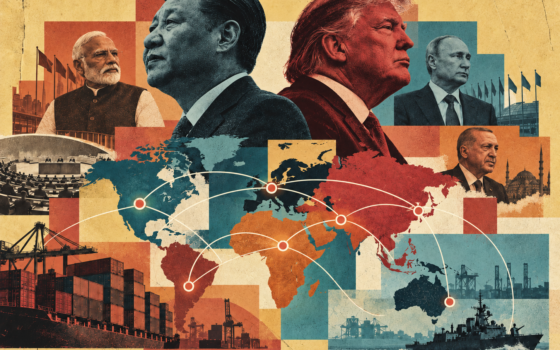
A demonstration of this failure was seen this week at the BRICS summit in Kazan, which includes Brazil, Russia, India, China, and South Africa, along with Saudi Arabia, Egypt, Ethiopia, Iran, and the United Arab Emirates.
The final declaration highlights the emergence of “new centers of power,” allowing for the advent of a “fairer, more democratic, and balanced” world, a world where, for example, unilateral sanctions lacking United Nations approval are rejected, yet the illegal and unprovoked invasion of a country does not merit condemnation (it is not the same to call for avoiding escalation). Of course, who would dare to criticize the host, Vladimir Putin, just as he was receiving a significant diplomatic lifeline after his international isolation?
Beyond the rhetoric, what is confirmed is the clear existence of different worlds that will coexist on the same planet, meaning that fragmentation will only intensify. Below is an analysis:
A JUST WORLD. It is not easy to infer what a “just world” means for BRICS+, beyond assuming that in this scenario, the West, led by the United States, does not have a predominant role in shaping global affairs. Those who truly seem to be the driving force of the group are China and Russia, revisionist powers taking actions to undermine the current international rules that do not align with their national interests.
Aside from the invasion of Ukraine, we can add the harassment of Taiwan and the occupation of disputed islands in the South China Sea by Beijing, as well as direct and indirect attacks—through affiliated militias—by Iran against Israel. Here, we confront what Kissinger said about the clash of visions regarding what is legitimate, from which perceptions of justice derive.
A DEMOCRATIC WORLD. It sounds counterintuitive to have so many authoritarian regimes, with the exception of Brazil, speaking of a “democratic world.” In reality, concepts like representative or inclusive would be more precise if the aim is to highlight the idea of broader global governance. One might believe that Moscow and Beijing want to be peers with other nations when making far-reaching decisions, even if they pretend to be seen as such. One is a major global economic power, and the other is a regional military power with global aspirations.
Again, if the South American country is omitted, the current BRICS+ is more of an Asian-African club. Although Lula da Silva was absent from this summit due to a “domestic accident,” it is worth remembering that in the previous one, he tried to bring Argentina in through the back door, but the arrival of Javier Milei closed that possibility.
It would also be interesting to know, although the opacity of these regimes does not allow it, how their local populations interpret these calls for a “democratic world,” when that word does not apply at home. A curiosity in this regard is the non-admission of Venezuela into the group, despite Nicolás Maduro’s manifest desires, which have the backing of Putin but not the approval of Lula. As explained by his international advisor Celso Amorim, this is due to the difficult political situation facing that country after the elections.
A MORE BALANCED WORLD. Regarding the “new centers of power” that should configure a “more balanced world,” there are many interpretations, but all agree that the world is tending to become increasingly multipolar in some aspects, especially economically, but a new bipolarity between the United States and China is also evident, where the obvious analogy leads to acknowledging the existence of a “New Cold War.”
However, the central issue here is what is meant by “balanced,” and this brings us back to the Kissingerian dilemma. Essentially, the balance for BRICS+ seems to arise from the recognition of well-defined spheres of influence where there is no Western interference, either military or political.
Another form of balance for these countries appears to be the pursuit of distancing from the dollar’s hegemony as the global reference currency. This is through financial exchange mechanisms that allow evasion of economic sanctions, which are currently the most utilized tool by the United States, Canada, the European Union, and Japan to punish disruptive behaviors without reaching a war scenario.
The renowned economist Nouriel Roubini has warned that the fact that the Treasury Department is increasingly focused on national security aspects threatens the primacy of the dollar, providing arguments to those who wish to disconnect from Western banking structures. Massive purchases of gold to generate reserves and the proliferation of cryptocurrencies are some of its concrete consequences.
In Kazan, the idea of a single BRICS+ currency was once again aired, displaying a bill with the flags of the various countries in the bloc, but also featuring Mexico, which is not part of the group and has an incredibly favorable trade balance with the United States, thanks to a 30-year integration treaty. Now, money is a symbolically generalized means of communication, so the bill in question would be nothing more than a message. The use of a single currency by several countries, as the experience of the euro shows, is a complex task that requires ceding economic sovereignty, creating structures like a common central bank, and providing concrete benefits for its users in their daily lives. This seems distant and, rather, unrealistic.
CONCLUSIONS. With the conclusion of the BRICS+ summit, it can be stated that the potential of this group of countries united by the interest of challenging the West should not be underestimated, but neither should their real capacity to achieve objectives be overestimated. There are evident contradictions between their discourses and actions that should not be overlooked.
In their favor is the interest of more countries to join the bloc and the presence of hesitant and isolationist sectors in the United States and Europe regarding the global role they have played for centuries. However, the “decline of the West” is part of a negative narrative, which was countered by the case of Ukraine, when unity and willingness to help manifested quickly, refuting the Kremlin’s calculations.
The danger of this group is that it may also present a fraction of that monstrosity called the “Global South,” a definition that begins by disregarding geography, as it is considered that it includes countries in the northern hemisphere while excluding some from the south, like Australia; this is a maneuver to gain diplomatic weight through more adhesions, without establishing membership requirements.
The proposal by John Ikenberry seems much more sensible, as he recently outlined the emergence of a Global West, where the United States, Europe, and other partners converge; a Global East, represented by the alliance of China and Russia; and a Global South, an amorphous group with little internal coherence, where countries like India and Brazil do fit. In this scenario, of course, the first two compete to attract the last.
Countries that promote a rules-based international order, have open economies, and are governed democratically, like Chile, have no place in BRICS+ and should not accept its version of the Global South. All of the above leads us to be closer to the Global West, or better yet, to adopt the vision of a Free and Open Indo-Pacific, which precisely consists of these pillars.