Trump: Peace Through Strength Has a Second Chance
This article was translated automatically and may contain differences from the original. For reference, read the original.
- by Juan Pablo Toro
- Analysis

En su noche de victoria, Trump prometió terminar con las guerras.
Due to the central role that the United States plays in global security, Trump's return to power will undoubtedly impact the upcoming developments in the current theaters of conflict in Europe, the Middle East, and Asia.
In his victory speech, the elected President of the United States, Donald Trump, assured an expectant world that he would not “start wars, but stop them,” a message from the Republican that closely resembles what Democrats had a few years ago.
“We had no wars. For four years, we had no wars, except that we defeated ISIS,” Trump added while votes were still being counted in some key states.
It is true. The world that he will encounter upon arriving at the White House in January 2025 is witnessing large-scale war between Russia and Ukraine, which began with the invasion in February 2022; missile exchanges between Israel and Iran as a consequence of the events triggered by the terrorist attack by Hamas in October 2023; and an emboldened Kim Jong-Un, who is not only launching test rockets but also supplying weapons, ammunition, and troops to Moscow.
Due to the central role that the United States plays in global security, as the main source of aid for Ukraine, an unconditional ally of Israel, and a provider of ground forces for the protection of Japan and South Korea, Trump’s return to power will undoubtedly impact the upcoming developments in these theaters of conflict.
EUROPE, START SPENDING. The continuation of the military effort to support Ukraine may suffer a decline, not only because the future president has stated that he will end the war even before taking office, but also because Republicans in Congress have already been questioning the provision of over $64 billion in military aid to Kyiv in light of the limited progress on the battlefield. The conflict today seems destined to prolong, as the parties continue to set unacceptable conditions for negotiation.
During his first administration, Trump warned his European partners in the North Atlantic Treaty Organization that they needed to invest more in defense, as they had committed to allocating more than 2% of their GDP. However, it took a war for some to understand the message; although others still do not.
The European Union has been forced to include defense within its portfolio of obligations, taking steps to recover the industrial capacity of the sector. If Washington begins to withdraw, it will be the ultimate test of the desired European strategic autonomy. However, it is more likely that some governments will increase their military purchases from U.S. companies, knowing it is a good card to play before the Republican.
During the campaign, Trump stated that if the Ukrainians had reached an agreement with Russia, even “giving up a little,” it would have been better than what is happening today and “everyone would be alive.” He has also recalled that he has a good relationship with President Vladimir Putin, which he will appeal to negotiate an exit. Meanwhile, Volodymyr Zelensky hurried to congratulate him and expressed hope that bipartisan support for Ukraine would continue, something that, in light of Tuesday’s results, seems more difficult to articulate.
MIDDLE EAST, ISRAEL CELEBRATES. One of the first to congratulate Trump was Israeli Prime Minister Benjamin Netanyahu, who gained a much more determined ally in facing his arch-enemy Iran. It was the Republican who ordered the execution of a high commander of the Iranian Revolutionary Guard in 2020 and discarded the nuclear limitation agreement with Tehran in exchange for the lifting of economic sanctions.
In other words, the ayatollahs must be watching how their chances of continuing to directly harass Israel or through militias like Hamas and Hezbollah are further reduced. In fact, the administration of Democrat Joe Biden spent the last few weeks convincing Netanyahu not to attack Iranian nuclear and oil facilities. Ultimately, Washington’s pressure had an effect, but we do not know if it was reluctantly. Just in case, Tehran’s air defenses were destroyed to clear the way for new incursions.
In campaign statements, Trump argued that his friend “Bibi” Netanyahu is doing a “good job” and that it is good for him to “do what he wants to do.” So far, Israel and Iran seem to be in a strategic dialogue through a delicate calculation of each attack; of course, in Washington, there was no one as determined as there will be starting in January. The Republican may now give a free hand to his partner, who has already removed the Minister of Defense, another brake that no longer exists.
EAST ASIA. One thing is the trade war with China, which is expected to intensify with new tariff increases on products from that country, and another is a potential escalation of military tension with the United States. If Biden’s bet was to “manage the competition” with his strategic rival to keep it within limits and restore communication channels, Trump may be tempted to “win it.”
The target of his attacks has been and continues to be China’s “unfair” competition in many aspects of the economy. However, that is precisely what has partly allowed the Asian country to develop into a systemic rival of the United States. The problem is that his “America first” may clash with Xi Jinping’s “China first.” The separate strings may cross in the South China Sea.
Moreover, the elected president will be in office until 2027, a significant date for two reasons. First, it marks the end of Xi’s third term, something unprecedented since Deng Xiaoping’s departure, and second, it closes the so-called “Davidson window,” the year when China would have the capacity to invade Taiwan, according to a senior U.S. military official before Congress. Although the Republican downplayed his defense of Taipei during the campaign, explaining that he expects more compensation in return, the Taiwanese are already taking care of purchasing weapons from Washington and establishing semiconductor manufacturing plants in the United States itself. Furthermore, among Trump’s cohort are several congressmen favorable to the island.
Although they had a fairly positive relationship when they were in power, the late Prime Minister Shinzo Abe understood very well that the day would come when Japan would need to defend itself on its own in a very hostile environment. Thus, he created a new security architecture and laid the groundwork to double the defense budget, which will be the third largest in the world by 2028. Therefore, Tokyo will continue to be a partner of Washington, but in a position of greater strength. Moreover, Abe’s vision of a Free and Open Indo-Pacific was adopted by the previous Trump administration, marking a significant diplomatic success for the Asian leader.
It is true that during the Republican’s first term, Kim Jong-Un’s missile tests fell to a minimum, partly because Trump agreed to meet with the “little rocket man” twice, granting him the diplomatic and personal recognition he sought. This occurred after his North Korean counterpart was warned in strong terms that the one who would end up as ashes in a sea of fire was not Washington, but Pyongyang. A warning that was supported at the time by military maneuvers with ranges that coincided with the supposed locations of the younger Kim. Will they meet again?
LATIN AMERICA. The next president stated during the campaign that he was inclined to apply the “death penalty to drug dealers,” something that is currently the responsibility of various states. However, this frontal approach suggests that the war against drug trafficking could gain new momentum in the region alongside the United States, with new demands, but perhaps with new contributions.
In the past, Washington designed security assistance plans for Colombia and Mexico, with varying results, but in exchange for aid and cooperation, it demanded a radical fight against criminal organizations, the same ones that today plague Latin America. One of the first to congratulate Trump was Nayib Bukele of El Salvador, of course.
Migration, a central theme of the campaign, has now become a security issue for the United States, and all indications suggest that countries expelling migrants will face a severe task of curbing flows that are not always under their control.
The most concerned must be Nicolás Maduro, who faced total pressure under Trump, including an offer of a reward for his head, although that did not remove him from power.
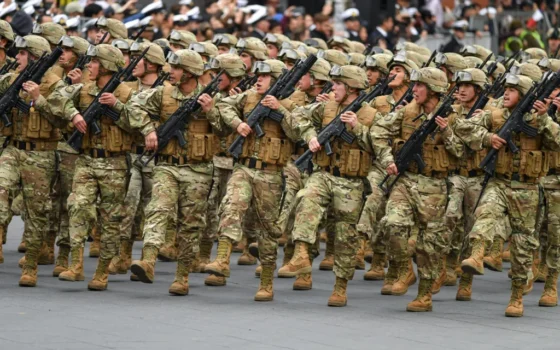
CONCLUSION. Everything seems to indicate that Trump, as in many things, wants to imitate President Ronald Reagan (1981-1989) through a formula of “peace through strength,”peace through strength, where powerful armed forces deter potential aggressors or disincentivize reckless behaviors that could lead to military reprisals.
However, there are plausible doubts about whether he will be able to achieve this, starting with the names of those who would be responsible for implementing such a formula, which requires as much planning as fine calculation, as it is a realpolitik by essence. In his first four-year term, Trump had three different Secretaries of Defense and four National Security Advisors, a record in terms of the short tenure of these key officials. The worst part is that several of those who held those positions, many of them veteran hawks and respected retired military personnel, left speaking ill of their boss, describing him as someone who does not understand global affairs, an anti-leader who divides the nation, a person unfit for the position, or a danger to institutions.
And while it is true that there were no open wars during his administration—although it was Biden and not him who chaotically ended the Afghanistan experience—it is the dysfunctional internal politics of the United States that Trump also helped to fuel, which may have incentivized some dictators and terrorists to strike out, leaving the world in its current state. Overall, bipartisan consensus, necessary for engaging in conflicts, is almost nonexistent. On the other hand, the same Republican president downplayed some of his country’s security commitments, such as those guaranteeing the defense of Europeans, South Koreans, and Japanese.
Now, if we observe the current world, it seems to favor those strongmen who are not afraid to display or use their muscles in the event of conflict. And there, Trump, with his mix of frankness and toughness, can indeed speak the same language as a Putin, Xi, Kim, Recep Tayyip Erdogan, and others who do not place much importance on the international rules written decades ago. To the point that they may not do things they would do if Biden or Kamala Harris were in power. But that remains to be seen.

Juan Pablo Toro, Executive Director of AthenaLab
11/06/2024
Photos: France Presse