Can Trump's candidates for Secretary of State and Defense restore relations with Latin America?
This article was translated automatically and may contain differences from the original. For reference, read the original.
- by Carlos Solar
- Guest Contributions

Donald Trump y Marco Rubio (AFP)
Setting aside politics, Marco Rubio and Pete Hegseth should work more on policies in the Western Hemisphere and transform a relationship of neglect into one of mutual appreciation.
Too little and too late. President Joe Biden’s trip to meet with regional and global leaders in Peru and Brazil at the APEC and G20 summits marked the end of his relationship with Latin America, leaving many with a bitter taste. Local and foreign media and commentators suggested that the United States had failed to achieve significant victories in the past four years in a region that has suffered humanitarian and political crises from Haiti to Venezuela, and that it has been unable to halt China’s economic advances or the spread of Russian disinformation regarding the invasion of Ukraine. More intensely, Biden has felt the pressure on national security due to concerns over migration and rampant insecurity at the southern border.
The Western Hemisphere has remained challenging for U.S. foreign policy, despite a history of fruitful regional free trade and military diplomacy that has characterized decades of nearly unopposed U.S. hegemony in the Americas since the Cold War. The White House’s fight against international terrorism and its focus on global power competition have diverted attention and monetary resources from Latin America and the Caribbean, where new anti-Western voices have filled the vacuum of influence.
Relations between the United States and Latin America have become complicated, and Washington can only count on a few stable partners in the region, such as Chile, Argentina, Uruguay, and Ecuador. But even in these countries, the White House has struggled to align its economic and national security interests without losing ground to China, especially in the latter. Some others have severed their ties with Washington since the early 2000s, which later proved irreparable (for example, Bolivia, Nicaragua, and Venezuela), while a handful of countries remain indecisive, particularly Brazil, which Biden recently visited and whose president Lula da Silva has ‘courted’ Xi Jinping regarding global institutional reform… and Peru.
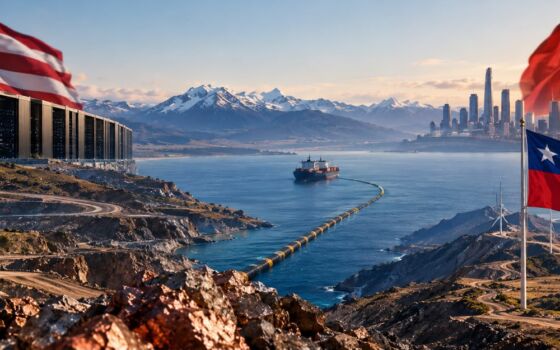
The inauguration of the Chancay port in Peru by Xi Jinping made global headlines as he appeared front and center in a timely photo opportunity alongside Peruvian President Dina Boluarte. Outgoing Joe Biden was placed in a corner of the second row, ‘disappearing’ into the background, in the words of the Wall Street Journal. The U.S. Department of Commerce team responded with renewed interest in other maritime trade areas, such as in Peru’s trade rival and southern neighbor, Chile, where port capacity is reaching its peak but could open up if local authorities clear the way for new businesses to enter the area and the port infrastructure market.
A roadmap for Trump
Could the transition offer a plausible reset in U.S.-Latin American relations? While Biden pushed hard for Southern Command, stationed in Florida, to embark on operational missions that included combating drug trafficking in Peru and expanding bilateral efforts in Southern Cone countries like Argentina, other strategic attempts to counter Russia, Iran, and China in the region have evidently been less effective. Trump could play his cards differently.
During Trump’s previous administration, he and his advisors were skeptical of the Colombian peace process, and time may have given him some justification, as the demobilization of guerrilla and other combatant groups has led to a struggle among new dissident criminal groups controlling territories along the border with Ecuador, a peaceful but corruptible country that has seen an increase in drug, gold, and human trafficking over the past four years.
The president-elect could continue his strong support for the Venezuelan opposition, as demonstrated in 2019 when he praised opposition leader Juan Guaidó in his State of the Union address. With Argentina, Biden achieved a significant victory by approving the sale of F-16 fighter jets to Javier Milei’s administration. Trump will likely become increasingly popular with Milei, who enjoys close ties with the future Director of Government Efficiency, Elon Musk, and is considered a VIP guest at Mar-a-Lago.
Some of Trump’s main challenges will continue to focus on places where his conservative agenda directly clashes with anti-American sentiments and ongoing security threats. Haiti, for example, became a topic of national political debate in the United States, as migration under protected status was widely discussed during the final stage of the campaign. Trump promised to revoke such privileges, but recent calls for a new UN peace mission for the Caribbean country could compel the United States to be more benevolent toward the poorest country in the hemisphere.
Trump has labeled Venezuelan leader Nicolás Maduro a dictator, and the clearest signal regarding how his administration will treat the region was likely given by his nomination of Marco Rubio—a staunch hawk on Cuba, Nicaragua, and Venezuela—as Secretary of State. Maduro, who practically deceived the Biden administration into believing he would honor the results of the presidential elections in July in exchange for lifting oil restrictions, has stated that Trump’s election offers a ‘new beginning.’ Maduro is expected to attempt to negotiate once again with the U.S. government to find a way out of the disastrous situation he faces. Rubio (born in Miami to Cuban immigrant parents), whose senatorial experience on Latin American issues makes him a tough counterpart, should not fall for any of Maduro’s tricks.
Pending Issues
While the southern border will be a significant security issue for Trump, it would be shortsighted not to address the root causes of insecurities flowing north through Central America. Among Rubio’s many challenges, he will have to deal with allies like the recently reelected Nayib Bukele of El Salvador, whose measures on crime—through Republican eyes—have drastically alleviated outgoing migration and the associated crime that would otherwise reach U.S. soil. Bukele’s crackdown on gangs, including the violent MS-13, pleased Trump’s inner circle before and still finds admiration in Washington. Matt Gaetz, Trump’s candidate for Attorney General, who withdrew his nomination, suggested that Bukele’s tough-on-crime policy was a model to emulate. In July, Gaetz visited the El Salvador Terrorism Confinement Center, a maximum-security prison built to hold organized crime leaders.
Rubio, Hegseth, Trujillo, and the Admiral
On November 7, Admiral Alvin Holsey became the new head of U.S. Southern Command in a ceremony marked by firsts, where the previous commander, General Laura Richard—the first woman to lead SOUTHCOM—passed the baton to the first African American commander. A renewed SOUTHCOM could offer the region a new sense of partnership to address shared military and security concerns.
More importantly, Holsey could enjoy the support of his political boss in Washington. Pete Hegseth, Trump’s candidate to lead the Pentagon, served a stint as a National Guard member in Cuba, where he served in Guantanamo Bay as an infantry platoon leader. Another person to watch is Carlos Trujillo, Trump’s ambassador to the Organization of American States from 2017 to 2021. Born in New York to exiled Cuban parents, Trujillo played a key role in securing the Latino vote during the recent presidential campaign. He is rumored to have a new role in dealing with the Western Hemisphere.
The combination of Hegseth’s and Rubio’s experience could become a dominant force in the establishment in Washington when it comes to renewing relations between Latin America and the Caribbean. The mixed diplomatic and military agenda currently led from Washington and Florida could extend far beyond the usual areas of foreign affairs and defense to include broader issues such as irregular migration, climate change, and digital security. Cyberspace was one of the first issues that the Pentagon pushed during Trump’s first administration, with a series of partnerships signed with Chile, Argentina, and Brazil. Setting aside politics, if Hegseth and Rubio are eager to do more public policy work in the Western Hemisphere, the relationship between the United States and Latin America could quickly shift from one of neglect to one of mutual appreciation.
Carlos Solar
Senior Research Fellow, Latin American Security, International Security, Royal United Services Institute (RUSI).
London, November 22, 2024
The views expressed in this commentary are those of the author and do not represent those of RUSI or any other institution.