A potential problem for Chile: the Chinese observatory that worries the U.S. due to its possible dual use
This article was translated automatically and may contain differences from the original. For reference, read the original.
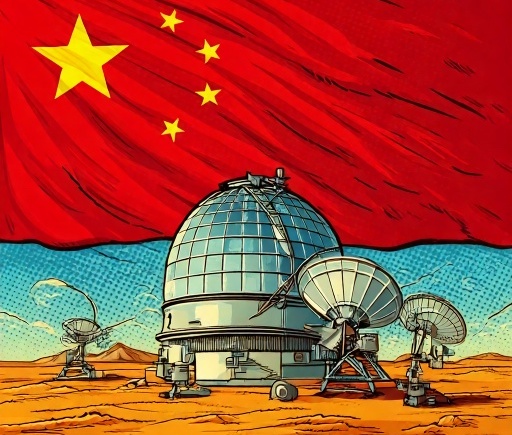
As last year came to a close, an article from Newsweek highlighted the alarm among U.S. authorities regarding an observatory being built by the Asian power in northern Chile, which would be another piece in achieving that goal[1].
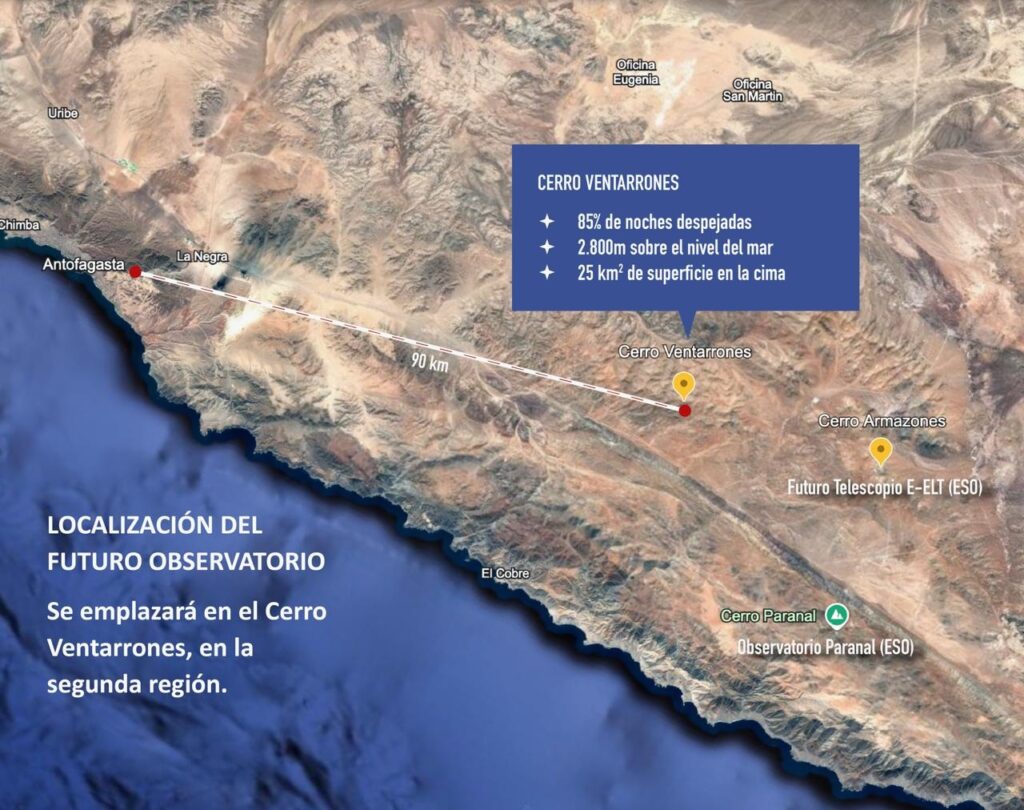
Although it received little attention at the time, a collaboration agreement signed between the Universidad Católica del Norte and the National Astronomical Observatory of China from the Chinese Academy of Sciences in January 2023[2] opened the door for the construction of facilities and telescopes on Cerro Ventarrones, which will allow, among other things, the study of “near-Earth objects,” which are those that orbit at low altitudes (LEO), specifically between 150 and 2,000 kilometers.
While the so-called Transient Source Time Domain Astronomical Observation Project (TOM) could be framed within the numerous astronomical activities conducted from Chile, taking advantage of its dry, clear skies and privileged geographical position, the problem arises from the civic-military integration strategy promoted by the State Council of the People’s Republic of China, which also encompasses the country’s space program.

Source: Universidad Católica del Norte
In other words, the future complex being built with Chinese funding estimated at $80 million could very well have a dual use when it is completed in 2026. According to Newsweek, it is common for Beijing to establish scientific facilities with seemingly benign purposes that also serve multiple strategic objectives. In the case of observatories, they can both track stars and monitor satellites, gather intelligence, and support military space operations. In an era of intense strategic competition with the United States, this has the potential to become a permanent focal point of diplomatic conflict with Washington.
This is not a hypothesis, but a reality already experienced by Chile. As a precedent, one recalls what happened during the first term of President Donald Trump (2017-2021), when then-Secretary of State Mike Pompeo pressured for the fiber optic cable connecting the country to Asia not to be laid by a Chinese company, nor to consider that nation as a connection point[3]. Today, Google is the selected company to build that critical infrastructure, which will have its first terminal in Australia.
Although they may go unnoticed, maneuvers are constantly taking place on the ground among great powers to achieve supremacy in space, whether it involves building facilities, gaining access to existing ones, or blocking future projects. Just after the Swedish Defence Research Agency warned that satellite services provided to China could be used for military intelligence gathering, the Swedish Space Corporation terminated its contracts in 2020[4] with that country to use its antennas and equipment in northern Sweden, Australia, and Chile, including the Santiago Satellite Station. This year, the provision of services to Chinese clients at the Peldehue facilities should conclude.
Competitive Domain
Since its inception, with the launch of the Sputnik satellite by the Soviet Union in 1957, the space race has been an integral part of strategic competition among powers. Being present in that domain is essential for scientific, military, commercial, and even national prestige purposes.
While there were moments during the Cold War (1946-1991) when a more comprehensive approach prevailed, such as when American astronaut Neil Armstrong described his moonwalk as a “small step for man and a giant leap for mankind,” it is true that during that period satellites and ground monitoring stations were key tools for detecting the potential use of nuclear ballistic missiles by rivals, as well as for monitoring the movements of fleets, bombers, and troops.
The United Nations Outer Space Treaty (1967) also dates back to that era, establishing the use of space for peaceful purposes, prohibiting the sovereign appropriation of celestial objects, banning the installation of weapons of mass destruction—including nuclear weapons—and holding states accountable for the objects they send[5]. Its inspiration from the Antarctic Treaty is evident.
In the years following the Cold War, cooperation between the United States and Russia (the successor to the Soviet program) was evident in the assembly of the International Space Station with modules from both countries and the fact that Western astronauts began traveling on Russian rockets. In the first two decades of the 21st century, China, Japan, South Korea, India, Israel, Iran, the United Arab Emirates, and others also accelerated their space programs to position themselves advantageously around the Earth and explore new frontiers.
As space became more multipolar and the private sector emerged as an innovative force thanks to companies like SpaceX, Blue Origin, and Virgin Galactic, specific actions by revisionist powers revived strategic competition in space, making it impossible to share resources and cooperate on projects. The large-scale invasion of Ukraine by Russia on February 24, 2022, for example, was preceded by the hacking of terrestrial satellite infrastructure, which caused an internet service outage over the attacked country[6]. As a result, Americans and Europeans began to terminate all agreements and contracts for service use with their Russian counterparts, creating a significant economic and technical problem for the latter[7].
Since it is one of the five domains of warfare, great powers tend to maximize their space power, which in the emerging field of “astropolitics” is understood as the set of different activities and technologies that a state can deploy in space for purposes of war, development, and prestige[8]. This space power includes satellite constellations, terrestrial infrastructures that act as support (antennas and launch platforms), and also the practical applications that enable these technologies.
Current trends show an increase in national budgets dedicated to space programs, which in 2024 totaled $135 billion, a 10% increase from 2023 and part of a growing trend, according to the specialized firm Novaspace[9]. Of the total, $73 billion corresponded to military purposes (54%) and $62 billion to civilian purposes, reflecting a clear trend since 2022, where defense spending prevails.

Source: Universidad Católica del Norte
In the case of the People’s Republic of China, one of the “big three” in terms of space power, it is estimated that it invested $19.886 billion last year, far below the United States, which invested $79.679 billion. However, in line with President Xi Jinping’s stated goal of turning his country “into a space power”[10], Beijing has been multiplying the number of satellites it places in orbit, enabling space stations and launching uncrewed exploration missions to the Moon and Mars. It has also tested its ability to destroy satellites from the ground with ballistic missiles, generating a significant amount of space debris[11]. While the country’s military strategy promotes the “peaceful” use of this domain, it also promises to defend its assets against threats and security challenges[12].
One specific area where this country seeks to have greater presence pertains to low Earth orbits (LEO), which are primarily used for communications, intelligence, surveillance, reconnaissance (ISR), and crewed space travel. It is estimated that military control provides significant advantages over the terrestrial surface[13], hence its importance.
“China is focused on developing its capacity for space presence in LEO. This includes the construction by 2030 of a national satellite constellation called Guowang, consisting of about 12,992 units, which will support internet services and is considered a ‘new infrastructure’; the launch and operation of 250 military satellites to enhance China’s surveillance and reconnaissance capabilities; and the independent BeiDou system of 35 satellites supporting navigation, missile tracking, launches, and communications, as well as navigation,” states Namrata Goswani, a space security academic at Johns Hopkins University[14].
To monitor and gather information from these satellites, ground stations need to be located at specific coordinates. Regarding low-altitude orbits, these converge over the poles, which is reflected in the density of traffic recorded there, allowing for an analogy with maritime traffic chokepoints, which represent natural straits like Hormuz or artificial canals like Suez. Given the predictable trajectories of the devices deployed in space, vulnerability cones are created where it is more feasible to destroy these devices using kinetic measures (“hard kill”) or to disable/interfere with them through electronic measures (“soft kill”). For example, Beijing lacks the capacity to monitor its rivals’ satellites when they orbit over America and must wait for them to pass over Antarctica to do so.Thus, Bowen’s (2020) explanation makes sense, stating that “countries at extreme latitudes may have greater potential to threaten polar chokepoints in LEO as celestial communication lines converge at their respective poles”[15]. It is Chile’s southern and Antarctic condition that makes it attractive for observing near-Earth objects.While our country has no offensive intentions in space nor military capabilities for the same, as it is also a signatory of the 1967 treaty, this does not seem to prevent third parties from expressing interest in developing astronomical projects whose use, in principle, is promoted for peaceful purposes but may end up being used for military objectives; particularly in intelligence gathering to identify potential targets and rivals’ assets. This becomes especially concerning when the entity establishing itself in Chile does not believe in the separation of civil and military domains but rather promotes their fusion as part of a comprehensive strategy to dominate cutting-edge technologies. In this regard, the clarification comes from the Chinese leader himself, Xi Jinping:“Areas such as oceanology,outer space
, the internet, biology, and new energies share the characteristic of serving both military and civilian purposes, soit is necessary to apply the concepts and requirements of civil-military integration throughout the design and planning, organization, and implementation of achievements, and to resolve prominent issues as soon as possible, in order to quickly create the configuration for
thoroughly developing military-civil integration in emerging sectors with possibilities for multidimensional unification, coordinated promotion, and rapid development”
[16] .Strategic Considerations Regarding an acceleration of military use of space, or an arms race unleashed in that domain, it will depend on the powers with the capabilities to employ it to agree on what will be considered strategic competition or confrontation. However, there is no doubt that in a world where the international order based on rules is already being challenged by actions on land, sea, and air, similar measures will be recorded around the globe. The Outer Space Treaty, for example, is a product of an era when only two state actors had access to conduct activities there. Furthermore, that agreement does not specify what “peaceful use” means and does not contemplate the possibility that individuals through private companies may take the lead in this area; such as SpaceX, by Elon Musk, with reusable rockets. What we do know, as Dodds (2021) states, is that competitive struggles will occur to secure access to Earth orbits, obtain mineral resources, and maintain geopolitical advantage in commanding and controlling communications and conducting global surveillance[17] .Chile’s unique characteristics, such as the pristine skies of the Northern Grande and its geographical position that facilitates deep space observation and LEO, explain why the country currently hosts telescopes from 30 countries in North America, South America, Europe, and Asia. These are unique and among the most advanced facilities of their kind, seeking to better understand the universe and its relationship with Earth. According to projections from the Chilean Society of Astronomy, the country will concentrate nearly 55% of the world’s astronomical capacity by 2030[18]
.
However, this special condition, in a context of strategic competition or the return of geopolitics, must be managed in such a way that it does not inadvertently empower revisionist powers that may act against the interests of Chile or its security partners in the short, medium, or long term.According to Grey Dynamics, a private intelligence company based in London, “the observatory will be the fifth node abroad in China’s global sky surveillance network, designed to ‘scan completely’ the entire sky of the southern and northern hemispheres every half hour, in line with China’s ‘national strategic needs'”[19]
.With the Cerro Ventarrones project, it is once again evident that the absence of a state security architecture in Chile allows private actors, such as a university, to inadvertently incubate a diplomatic problem, as the consequences associated with signing an agreement with an astronomical agency from a country focused on civil-military fusion were not taken into account.The review of such projects should be subject to strategic considerations from a National Security Council, which currently does not exist, or at least to an analysis by the Ministry of Defense before approval. Today, high-ranking Chilean officials are aware of the observatory, already underway, and its potential effects. If we go a step further, the electrical distribution, the future observatory, and a possible third fiber optic cable connecting the country to the Asian power could end up being part of the critical infrastructure that would be in Chinese hands, which warrants a comprehensive perspective.
Ultimately, it is essential that if the complex of the Universidad Católica del Norte and the National Astronomical Observatory of China materializes—the access road has already begun to be constructed—there must be total transparency and guaranteed access for Chilean researchers (according to
, which represents a headache for President Javier Milei’s government.
AthenaLab Team
March 6, 2025 [1]Newsweek (03/18/2024). “China’s Quest for Supremacy Moves into Space,” byDidi Kirsten Tatlow . Available at: https://www.newsweek.com/2025/01/17/china-space-infrastructure-us-latin-america-chile-argentina-1999644.html
[2]
Noticias UCN al día (01/09/2023). NAOC of China and UCN launched a joint astronomical project at Cerro Ventarrones. Available at: https://www.noticias.ucn.cl/noticias/estudiantes/naoc-de-china-y-la-ucn-dieron-el-vamos-a-proyecto-astronomico-conjunto-en-cerro-ventarrones/
[3] Diario Financiero (01/18/2024). “China, Japan, Trump, and France’s Intervention: Those Who Were Left Behind in the Submarine Cable Awarded to Google.” Available at: https://dfmas.df.cl/df-mas/coffee-break/china-japon-trump-y-la-intervencion-de-francia-los-que-quedaron-en-el [4]Reuters (09/21/202). “Exclusive: Swedish Space Company Halts New Business Helping China Operate Satellites.” Available at: https://www.reuters.com/article/world/exclusive-swedish-space-company-halts-new-business-helping-china-operate-satell-idUSKCN26C1ZS/
[5] “Treaty on Principles Governing the Activities of States in the Exploration and Use of Outer Space, including the Moon and Other Celestial Bodies.” Available at: https://www.unoosa.org/oosa/en/ourwork/spacelaw/treaties/outerspacetreaty.html
[6] Wired (03/23/2022). “A Mysterious Satellite Hack Has Victims Far Beyond Ukraine,” by Matt Burgess,
[7] Luzin, P. “Russia’s Position, Cooperation, and Decline in Outer Space,” in
Vanguardia Dossier No. 88, July/September 2023, pp. 45 and 46.
[8] Bowen, B. (2020).
War in Space. Strategy, Spacepower, Geopolitics . Edinburgh: Edinburgh University Press, p. 22. [9] Novaspace Report (2024). “Government Space Programs: A Comprehensive Overview of Government Space Strategies, Activities, and Budgets Until 2033.” 24th Edition. Factsheet. 2024. Available at: https://digital-platform.euroconsult-ec.com/wp-content/uploads/2025/01/Extract_Gov-Space-Progs-2024.pdf?t=678689c4c10ca
[10] The State Council of the People’s Republic of China (January 2022). “China’s Space Program: A 2021 Perspective.” Available at: https://www.cnsa.gov.cn/english/n6465684/n6760328/n6760333/c6813193/content.html [11]U.S. Defense Intelligence Agency (2022). “Challenges to Security in Space. Space Reliance in an Era of Competition and Expansion,” p. 8. Available at: https://www.dia.mil/Portals/110/Documents/News/Military_Power_Publications/Challenges_Security_Space_2022.pdf
[12] Ministry of National Defense of China (2015). China’s Military Strategy. Available at: http://eng.mod.gov.cn/xb/Publications/WhitePapers/4887928.html
[13] Marshall, T. (2021). The Power of Geography. Ten Maps That Reveal the Future of Our World
. London: Eliot & Thompson, 342. [14]
Goswami, N. “China: From the Dark Side of the Moon to the Conquest of Mars,” in Vanguardia Dossier No. 88 July/September 2023, p. 55.
[15] Bowen, op. cit. p. 90.
[16] Xi Jinping (2018). The Governance and Administration of China Vol. II . Beijing: Foreign Language Press, pp. 519 and 520.
[17] Dodds, K. (2021). Border Wars.The Conflict That Will Define Our Future
. London: Penguin Random House, p. 203. [18] Marca Chile (01/30/2024). “Chile and Its Skies, at the Forefront of Studying the Universe.” Available at: https://www.marcachile.cl/chile-y-sus-cielos-a-la-vanguardia-en-el-estudio-del-universo/#:~:text=Actualmente%2C%20Chile%20es%20base%20de,capacidad%20astron%C3%B3mica%20mundial%20a%202030.[19]
Grey Dynamics (01/01/2025). “China’s Chilean Observatory: Science or Subterfuge?” by Justin Markland. Available at: https://greydynamics.com/chinas-chilean-observatory-science-or-subterfuge/ [20] https://www.infobae.com/politica/2019/01/07/argentina-revelo-algunos-de-los-misterios-que-esconde-la-estacion-espacial-de-china-en-neuquen/