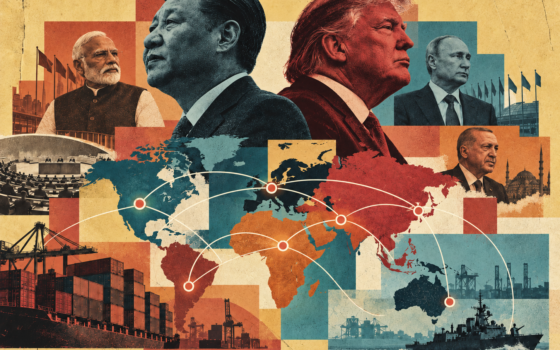
The First 50 Days of U.S. President Donald Trump
This article was translated automatically and may contain differences from the original. For reference, read the original.
- by Karin von Hippel
- Guest Contributions

We are only 50 days in, but if Trump can maintain this pace of change, the next four years are sure to be filled with action.
In theory, a superficial review of Trump’s first 100 days in his first administration, in early 2017, should provide a preview of Trump 2.0. At that time, he boasted of having accomplished more in that short period than any other president throughout their entire term. In fact, that term was marked by turbulence, with constant policy reversals, rapid firings and hirings of high-level staff, driven by a lack of a clear strategy regarding his plan for the country (even if it existed on paper). While the Covid-19 pandemic may have altered the focus, even that did not significantly change his behavior. Remember Trump’s suggestion to inject bleach into the body? The January 6, 2021 insurrection attempt was perhaps the last gasp of that first Trump era.
For those expecting more of the same this time, they were mistaken. Today marks the end of the first 50 days of his second administration, and we are witnessing a frenetic pace of activity: a steroid-fueled Trump working double time, surrounded by like-minded and equally determined acolytes, who are intent on dismantling the “deep state” and profoundly changing the global landscape. They have had four years to plan, and this time they will not be hindered by bureaucracy. With a broader mandate than he had in his first administration and control of all levers of government (not just the White House, but also Congress and the Supreme Court), Trump appears unstoppable. Here, he is backed by an opposition party that is in complete disarray and has yet to unite around a strategy or a new leader.
Around the world, we feel dizzy from the national and international upheaval. In the United States, Trump has authorized Elon Musk and his young acolytes to blow up the bureaucracy, supposedly to recover billions from waste, fraud, and abuse (and to counter the progressive mindset). Within days, they practically dismantled the main U.S. development agency, USAID. They have fired not only diversity, equity, and inclusion officials but also air traffic controllers, doctors serving military veterans, nuclear security officials, and the very inspectors general tasked with preventing waste, fraud, and abuse.
While Musk and company cheer, many outraged Americans are raising their voices. Let us not forget that the two million public servants work across the 50 states, and 30% of them are veterans, who tend to generate much more public compassion than the rest of the public administration. Abroad, the Chinese are also euphoric and are already offering jobs to the laid-off American scientists. On Thursday, March 6, 2025, Musk was somewhat restrained by Trump, likely due to the hostility directed at Republican members of Congress in his public meetings.
Trump’s team has also been expelling undocumented immigrants, as promised, and thousands have been returned, some even in chains. Others have been released due to lack of space in detention centers or because their home countries will not accept them. Many more have gone into hiding. Illegal border crossings from Mexico have been reduced to a minimum: the threats are having a deterrent effect. Of course, there has been resistance, legal cases, and reversals in all these actions, and we can expect much more.
The same enthusiasm has been applied abroad. Trump deserves much of the credit for the ceasefire between Israel and Hamas, which was achieved in mid-January 2025, days before the inauguration, thanks to the joint efforts of senior advisors from the Joe Biden and Trump teams. He also deserves general recognition for changing the conversation about Ukraine, shifting it to more detailed discussions on how to end the war, rather than focusing on what new weapon systems to supply to Ukraine.
However, we are still far from reaching sustainable agreements for both conflicts. His current proposal for Gaza (to displace all Palestinians and take control of the Strip) and for Ukraine (to concede to all of Russia’s demands while cutting off intelligence support to Ukraine that has been vital for protecting innocent civilians from Russian missiles) is unlikely to lead to sustainable peace in either case.
Other announcements have surprised (and perhaps shocked) even his most fervent supporters, notably his imperial aspirations for Greenland, Panama, and Canada. He is confronting the major trading partners of the United States all at once with his favorite word: tariffs. The threats, twists, delays, and actions have caused turbulence in the market, generating concern in the country over rising prices. With Mexico and Canada, Trump is even bypassing the agreement he made in his first administration, the United States-Mexico-Canada Agreement, which was negotiated to replace the North American Free Trade Agreement. China and the EU are ready to respond in kind and have been preparing for this moment for at least a year. On March 7, he even threatened Russia with tariffs, an empty threat given that there is almost no trade with Russia.
Trump has also threatened NATO countries that do not yet invest 2% in defense that he will not uphold Article 5 to protect them if they are attacked. This, combined with his vindictive behavior toward Ukrainian President Volodymyr Zelensky, has prompted the EU, Canada, and the United Kingdom to intensify measures to bolster their joint defenses. The necessary reforms will not happen overnight, but Trump has made these countries take their own defense much more seriously than any other U.S. administration in recent decades.
The first 50 days have undoubtedly been a whirlwind of activity, but have they achieved all the success he boasts of, this time claiming even greater accomplishments than George Washington?
In some areas, he has achieved successes: a much smaller bureaucracy, a slowdown at the southern border, serious commitments from NATO partners to increase defense spending, possible ceasefires, and the return of plastic light bulbs. Of course, any of these achievements could be reversed, although it is unlikely that U.S. courts will overturn all his firing decisions, nor is it clear whether he will respect decisions that go against him.
On the negative side, he has seriously undermined the Transatlantic Alliance, which has kept Europe and North America safe since the end of World War II. Cutting all support to Ukraine will only embolden Russia and possibly put other European countries in Russia’s sights in the near future, once Putin has had time to rearm. If the United States is no longer a reliable ally, other countries, especially Russia and China, will be more than happy to offer their services. Tariffs on friends and foes alike, if fully implemented, will be incredibly disruptive not only to the global economy but specifically to Americans as well, and could drive inflation even higher.
Trump thrives on constant attention and keeping everyone on edge, especially now that he does so both domestically and internationally. Moreover, he is fulfilling his promise to eliminate much of U.S. spending abroad, whether for global disease surveillance systems or for deterrence in Europe (soon, the same could happen in Japan and South Korea). It is unclear whether he fully understands that if the United States withdraws financial aid everywhere, abruptly, it will no longer be able to dictate policies. It is axiomatic that he who pays has a voice, which also means that the opposite applies.
We are only 50 days in, but if Trump can maintain this pace of change, the next four years are sure to be filled with action.
In the best-case scenario: Trump achieves significant successes in foreign policy, which would benefit everyone. All the credit is his if Israelis and Palestinians reach an agreement on lasting peace and a two-state solution, or if Ukrainians and Russians come to a sufficiently good agreement that does not sacrifice Ukraine’s sovereignty or its desire to remain on the democratic Western side.
In the worst-case scenario: his madness lacks method and does not close any of these agreements. If that happens, in the near future, people will simply tire of all the policy changes, empty promises, threats, and bluster, and will change the channel. For Trump, the reality TV star, that would be his worst nightmare.
Dr. Karin von Hippel
Translated by AthenaLab and published with the permission of the Royal United Services Institute
March 12, 2025
by Karin von Hippel
Distinguished Fellow RUSI