The U.S. Begins to Derail the Tren de Aragua
This article was translated automatically and may contain differences from the original. For reference, read the original.
Two months into his presidency, Donald J. Trump’s administration is beginning to realize its policy of a frontal fight against drug cartels and Latin American criminal gangs, such as the Tren de Aragua (TdA), which originated in Venezuela. By designating them as “foreign terrorist organizations,” it opened up possibilities for utilizing a range of tools to combat them. Below is an analysis from AthenaLab.
BACKGROUND. In the United States, groups that engage in a series of activities defined by specific regulations (sabotage, murder, and attacks, among others) and whose effects pose a direct threat to “U.S. citizens or national security (defense, foreign relations, or economic interests)” are designated as “foreign terrorist organizations.”
The legal effects of falling under such a designation include penalizing individuals who are part of the organization and are under U.S. jurisdiction. If they are foreigners, they can be deported or denied entry into the country. Institutions or individuals with financial ties to the group are also penalized. Meanwhile, diplomatically, other nations are encouraged and pressured to combat the designated terrorists.
In this context, the Trump administration invoked the Alien Enemies Act of 1798, which grants the President the authority to detain and deport foreigners, as it is considered a declared war, an invasion, or a “predatory incursion.” This last figure was used to expel 238 alleged TdA members who were in the United States to El Salvador. This measure is not without controversy regarding its legality, but at the same time, it sends an unequivocal message to the criminal gangs that plague the continent.
INSTRUMENTALIZATION. In reaction to the deportation of the alleged members of the Tren de Aragua, dictator Nicolás Maduro claimed that this criminal organization “is history” and now is “cosmic dust.” Although it is known to have originated in the Tocorón prison, which had up to 3,000 members engaged in all kinds of crimes in the region, and that during prison raids to dismantle the gang, its leaders mysteriously disappeared, the Venezuelan regime has even denied its existence, despite all the accumulated evidence to the contrary.
Undoubtedly, one of the greatest fears of the Venezuelan regime is that its direct or indirect relationships with the TdA become transparent; for example, in subcontracting its members to pursue and assassinate opponents in various countries in the region, as the gang has branches where the diaspora has settled. This was evident in the execution of former military officer Ronald Ojeda in Chile last year, where a cell of that organization carried out the homicide in 2024 under orders received from Caracas. According to the Trump administration, the Tren de Aragua “was sent here by the hostile regime of Maduro in Venezuela.” In other words, there seems to be no doubt about its use, in the logic of turning everything possible into a weapon (weaponization), whether it be migration or crime.
For Maduro and several of his associates, the Department of Justice offers $15 million due to their connection with drug trafficking through what is known as the Cartel of the Suns, as the suns replace the stars on the shoulders of the country’s military. This indicates that evidence of the regime’s criminal entanglement would be abundant. This very condition complicates the search for a political solution to the eternal Venezuelan crisis. The country’s leaders likely fear the U.S. Drug Enforcement Administration (DEA) more than the International Criminal Court.
Just as it can be asserted, without fear of being wrong, that the TdA is instrumentalized by the Bolivarian regime, one must ask whether the definitive criminalization of national interest in Venezuela has already occurred. This seems to be the reading from the White House today.
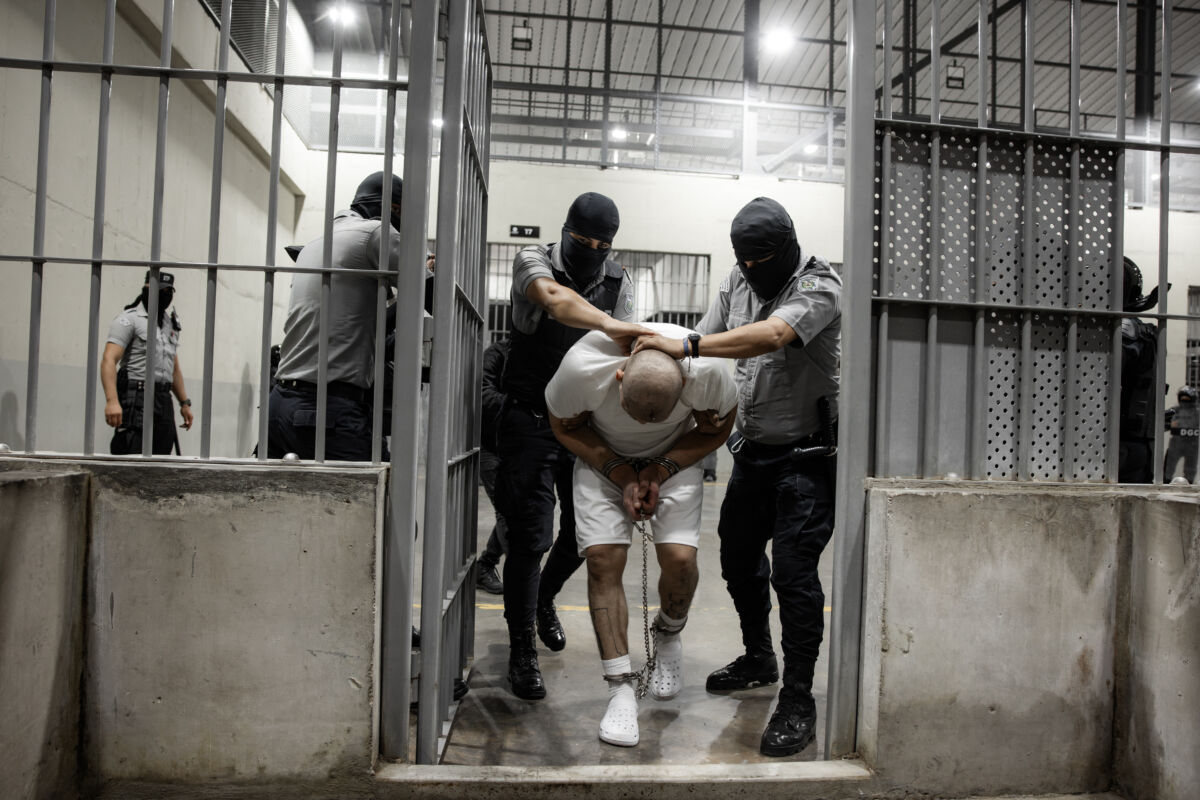
PENAL COLONY. Last February, U.S. Secretary of StateMarco Rubio, visited El Salvador to meet with President Nayib Bukele, who has made mass incarceration one of the pillars of his strategy against gangs or maras. On that occasion, Bukele offered to receive, for a fee, criminals at the Terrorism Confinement Center, amaximum-security prison built in 2022 with a capacity for 40,000 inmates, but where today there are just over 14,000. According to Rubio, it was the “most unprecedented and extraordinary migration agreement in the world.” As a result of that arrangement, TdA members were swiftly transferred from the United States to El Salvador, prompting actions from federal judges and criticism in the Central American country, as they are nationals of a third country arrested in a place where they did not commit crimes.
However, for El Salvador, this represents unequivocal support for Bukele’s hardline policy, and there may even be a fee involved, the amount of which is unknown. Internationally, it seems to be reminiscent of the “penal colonies” implemented in the past by Great Britain in Australia or France in Guyana, to send convicts to overseas territories.
TERRORISM AND ORGANIZED CRIME.
From a theoretical standpoint, terrorism and organized crime are two very distinct phenomena. The former is a method of exercising violence aimed at intimidating a specific audience by attacking a selected target. The latter involves criminal associations whose ultimate goal is to profit through the production of goods or the sale of services. While the “War on Drugs,” launched by Richard Nixon in 1971, tends to be frontal but less intrusive in third countries, focusing primarily on Latin America and the Caribbean, always with a strong police component and, only if necessary, military, the “Global War on Terrorism,” launched by George W. Bush after the 2001 attacks in the United States, has no time, geographic, or legal limits. Wherever the enemies of the nation are, the necessary punishment will be applied, using special forces, drones, contractors, or whatever is necessary.
Both “wars” have connected over time. The hunt for Colombian drug lord Pablo Escobar is an example. Apart from trafficking thousands of tons of cocaine, Escobar was the mastermind behind numerous explosive attacks. Certainly, many tactics for locating and eliminating terrorist leaders were learned from the pursuit of drug trafficking kingpins.
CONCLUSIONS
. For countries suffering from the criminal presence of the Tren de Aragua, such as Chile, its dismantling is good news. However, its possible relocation or reinforcement in other destinations outside the United States must be anticipated. An urgent measure is to share police intelligence with Washington on this matter to avoid surprises.As one of the architects of the pacification of Rosario, which went from being the city with the highest homicide rate in Argentina to not recording such crimes for periods, commented to AthenaLab, given the current power of criminal organizations, one cannot adopt half-hearted solutions when it comes to attacking them. Surprise raids, total isolation of imprisoned members, the use of intrusive technological tools, cutting off supply routes, immobilizing assets, increasing personnel for surveillance tasks, and expedited deportations are all tools that must be employed permanently and simultaneously. The criminal convergence of the 21st century demands it.
Whether Washington can eliminate the Tren de Aragua remains to be seen, but it is clear that its presence in the United States will begin to diminish after observing the severity of the penalties against its members. What is certain is that the group is on a direct path to derailment due to the speed it has gained in expanding throughout the region. Whether one likes it or not, Trump, like those who take office in the White House, commits to protecting the country “against all enemies,” no more, no less.