India-Pakistan Conflict Viewed Through Crisis Theory
This article was translated automatically and may contain differences from the original. For reference, read the original.
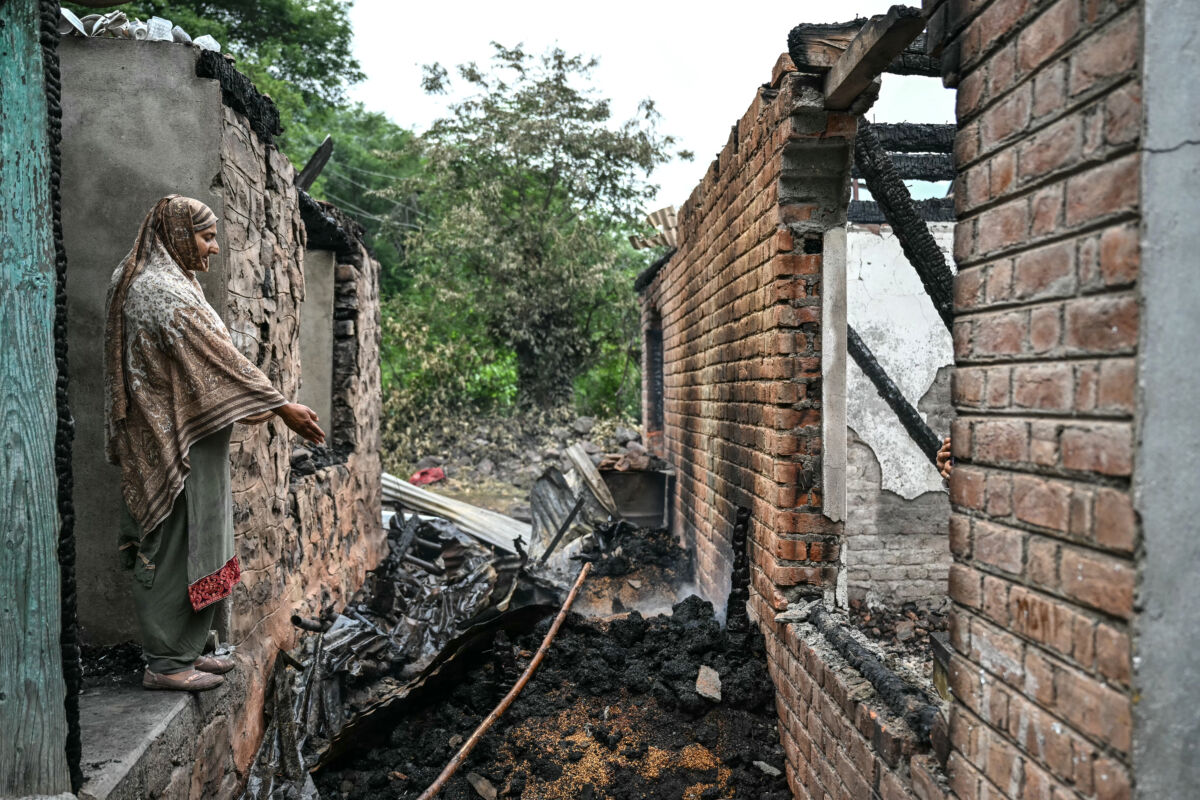
Una mujer se encuentra frente a su casa destruida por el bombardeo de artillería paquistaní en la aldea de Salamabad en Uri, a unos 110 kilómetros de Srinagar.
The exchanges of fire between India and Pakistan appear, so far, to be limited to the Kashmir region, demonstrating a willingness to avoid a point of no return. Both countries seem prepared not to cross the red lines that would lead to a nuclear option.
India’s recent airstrike against alleged terrorist group bases in Pakistan has raised alarms due to the confrontation between two nuclear powers with a long history of rivalry that includes wars.
The recent series of events was triggered by a terrorist attack on April 26 in the Indian-controlled Kashmir region, which resulted in the deaths of 26 tourists in Pahalgam. Prime Minister Narendra Modi’s government accused the perpetrators of belonging to an Islamist group sheltered by Pakistan, which this country denies.
Consequently, on May 6, Indian armed forces launched a retaliatory operation that materialized on Tuesday with an airstrike by combat aircraft, which dropped bombs on insurgent positions but did not cross the line of control dividing Kashmir.
Prime Minister Shehbaz Sharif’s government responded to the attack, which reportedly caused around thirty deaths, with artillery fire, resulting in nearly twenty fatalities on the Indian side. Since then, aerial combat and offensive actions with explosive drones have been reported, with little clarity on the situation.
Below, AthenaLab provides an analysis of the conflict in light of crisis theory.
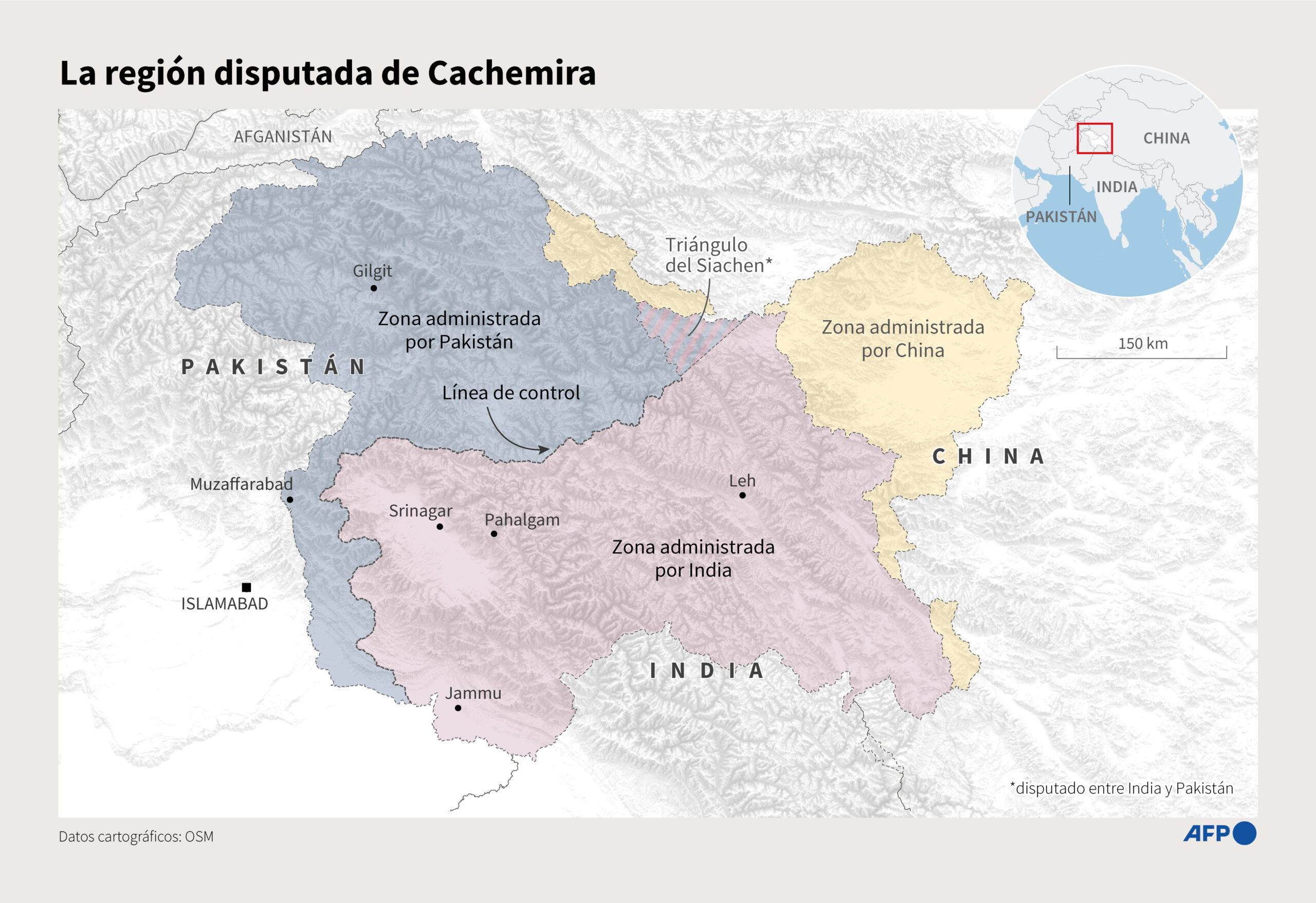
BACKGROUND. The conflict between India and Pakistan has persisted since the end of British rule in the region and the establishment of these two independent nations in 1947. Since then, both states have experienced crises and confrontations, as well as short wars. Among them, the most recent was the Kargil War in 1999.[1]. Instability has been the most prominent feature of this conflict, manifested in frequent cross-border skirmishes and escalations in the use of force; for example, the Balakot airstrikes in 2019.[2].
The main focus of rivalry and conflict is the effect derived from the partition between two states as separate nations; particularly, the situation of the princely state of Jammu and Kashmir.[3]. The issue is that, despite having a Muslim majority in its population, the ruler of Kashmir decided to accede to India, making his region the central topic of bilateral disputes. Consequently, Kashmir holds significant symbolic value for both states. For Pakistan, as it was founded as a Muslim homeland, and for India, which possesses the geographical control of the territory.
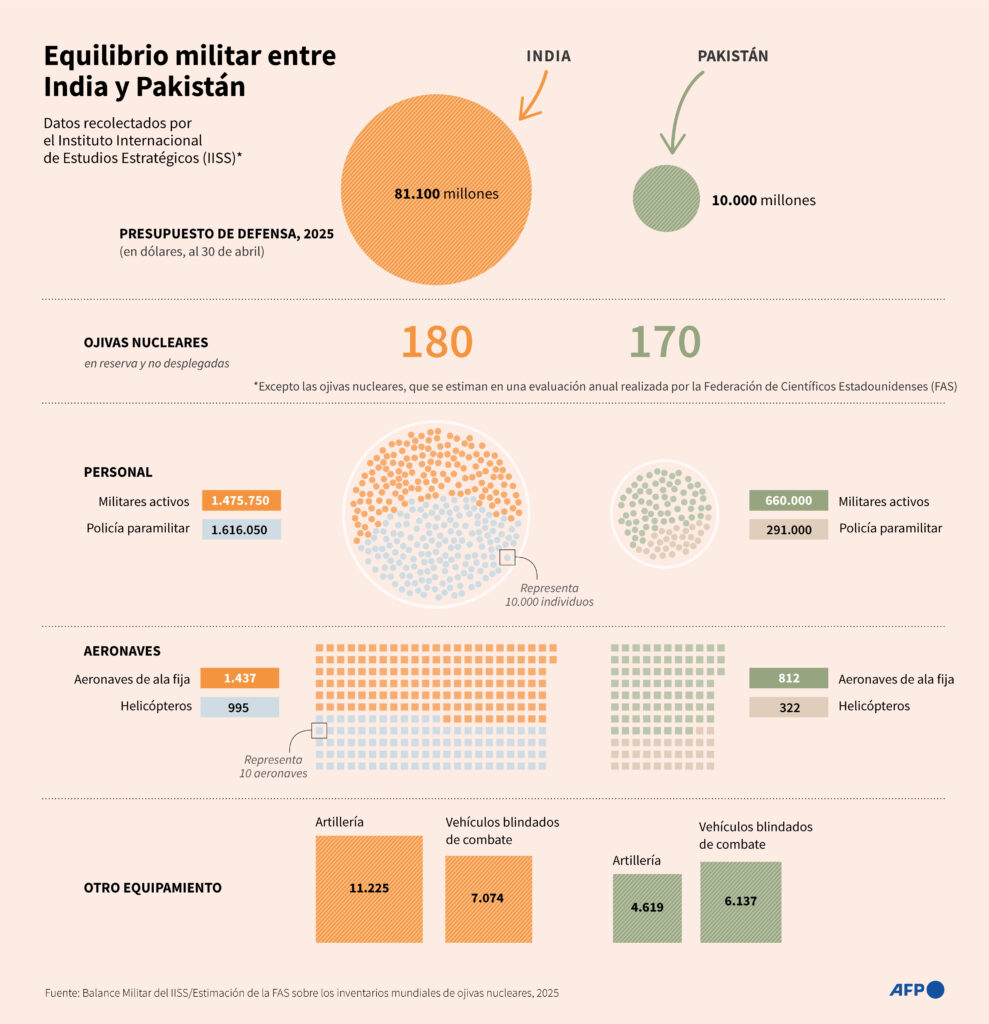
COMPARATIVE. From the perspective of conventional armed forces, the balance tilts markedly in favor of India; moreover, it is the most populous country in the world (1.4 billion) and the fifth-largest economy globally (US$ 13.1 trillion in gross domestic product).[4]. In contrast, Pakistan has 252 million inhabitants and its gross domestic product is US$ 1.3 trillion.[5], one-tenth that of its neighbor.
Where the scenario levels for both is in the field of nuclear forces. Both countries conducted tests with such weapons in 1998; in fact, Pakistan did so shortly after India. Both states primarily use ballistic missiles as their delivery systems, although they also have aircraft, and in the case of New Delhi, potentially submarines.
CRISIS ESCALATION. A relevant aspect to mention is that, in strategic studies, crisis theory is determined by a series of factors worth specifying. First, Snyder and Diesing[6] define it as “a sequence of interactions between the governments of two or more sovereign states in serious conflict, far from actual war, but involving the perception of a dangerously high probability of war.” In this regard, the following central elements should be monitored in any crisis:
- Negotiation
- Use of force
- Escalation
- Deterrence
- Configuration of power / interests / perceptions
- Use of international law
- Communication, diplomacy.
On the other hand, Ole R. Holsti[7] defines crisis as “a situation that arises suddenly, triggering a decision-making process at the highest political level, where the possibility of using force becomes very likely.” Accordingly, there is no doubt that we are in a new crisis where the previously detailed elements are expressed in this dialogue and strategic logic by both parties.
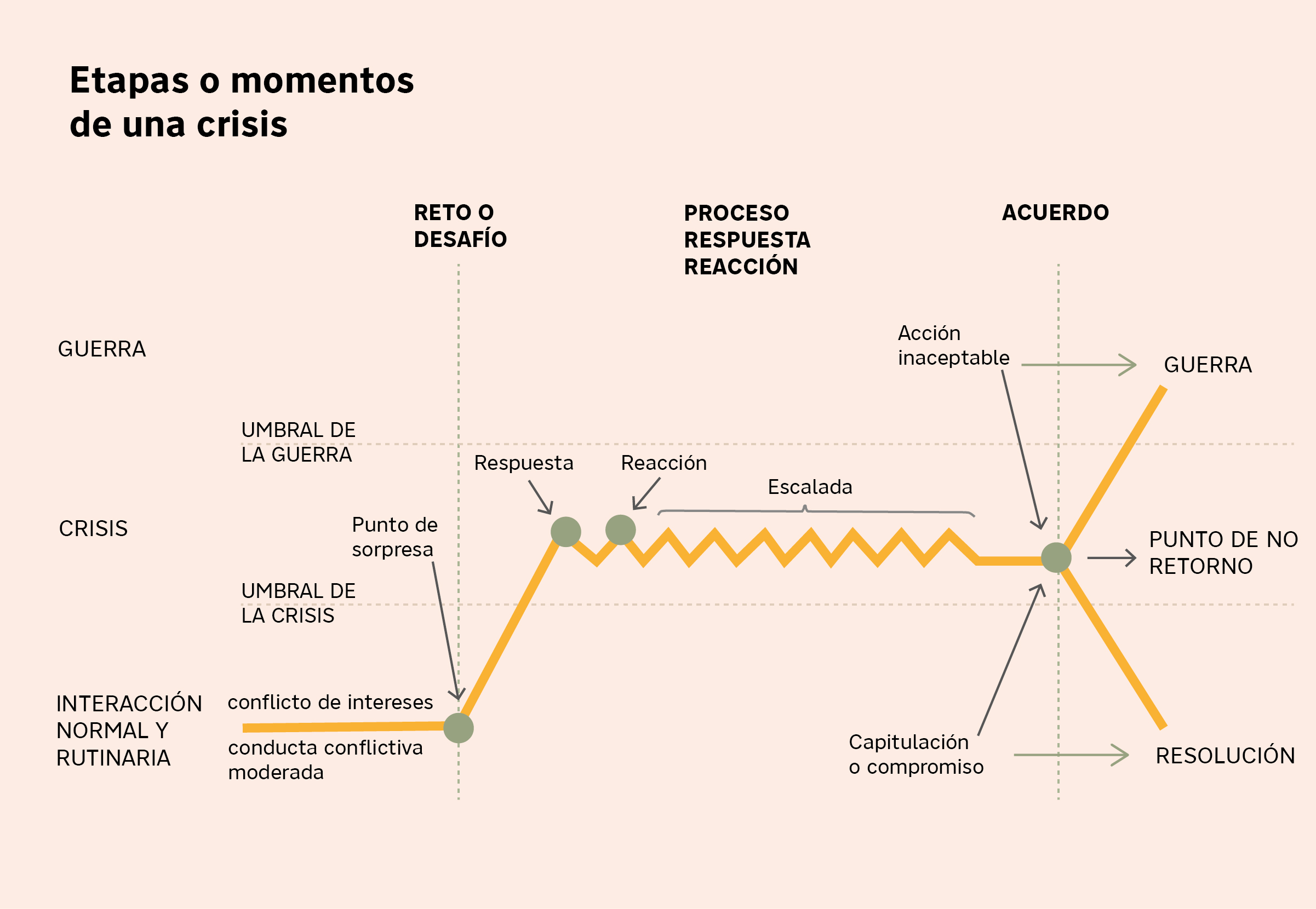
Crises have three phases: the pre-crisis, which is the state of latency, where discomfort and tension are present waiting to be stimulated. The second phase, escalation, manifests in a strategic duel through the actions of one actor and the consequent response of the other, in a reaction that increasingly aggravates that escalation. The key in escalation is not to reach the point of no return unless there is an intention to engage in military confrontation. Therefore, identifying the likely point of return of the crisis in the context of escalation should always be at least identified and anticipated.
In the attached graphic[8] the stages of the crisis are generally outlined, allowing for the identification of the escalation phase of the crisis in the response-reaction process.
Consequently, we could assert that we are facing a crisis between India and Pakistan in the response stage, a reaction that shapes the escalation of the crisis, where the key is not to reach the point of no return, as this would lead to war between these two nuclear-capable powers, where its use will always remain in the realm of the undesirable but possible. In this particular case, its employment is considered unlikely, as the objectives are not vital.
Additionally, both countries have adopted indirect strategies to avoid large-scale conflict, not surpassing this point of no return. On one hand, India prioritizes rapid deployments and limited force to avoid nuclear escalation, while on the other, Pakistan supports and has supported non-state actors and militant groups to exert pressure on India without directly involving its military.
In this dynamic, or escalation, both actors have utilized Thomas Schelling’s “concept of compulsion”[9], which helps explain behavior in conflict situations during periods of formal peace. Compulsion involves the use of limited force, or threats, to coerce an adversary to cease undesirable behavior. For example, the recent Indian bombing was carried out by combat aircraft that did not enter Pakistani airspace, which would have constituted a flagrant violation of Pakistan’s sovereignty.
John Griffiths Spielman (C)
TERRORISM: DOUBLE GAME. India’s bombing of Pakistan is presented as retaliation against terrorist groups operating from that country to attack in Kashmir, something Islamabad denies.
On social media, the Resistance Front (TRF), a relatively new radical group designated as a “terrorist organization” by the Indian government, claimed responsibility for the attack. From New Delhi, it is linked to the well-known jihadist group Lashkar-e-Taiba (LeT)[10].
LeT was responsible, among many other terrorist actions, for the attack on a hotel in Mumbai in 2008, which resulted in the deaths of 166 people, including many foreigners.
This group is pursued in Pakistan, and its leaders are sought; although doubts persist about this, especially because the Inter-Services Intelligence (ISI) has a well-earned reputation for employing proxy forces to strike indirectly at its enemies.
In fact, LeT was created in the mid-1980s, just as the Pakistani intelligence service was acting as an intermediary to deliver U.S. weapons to the mujahideen fighting Soviet troops in Afghanistan, some of whom would later form Al Qaeda.
The ISI also developed a convenient relationship with the Taliban and other Islamist networks based in the Afghan-Pakistani border during the Global War on Terror initiated by the United States after the 2001 attacks in New York and Washington[11].
Indeed, Washington did not inform Islamabad in 2011 of its operation to kill Osama bin Laden, who was hiding in the Pakistani city of Abbottabad, very close to the Military Academy. This action triggered a diplomatic crisis but also demonstrated the lack of trust between the two countries, despite the fact that supplies were being sent from Pakistani soil to U.S. bases in Afghanistan.
That is to say, suspicions of the ISI’s double game are longstanding, as is its ability to navigate the complicated area where countries like China, India, Iran, and others converge, along with all kinds of radical groups with different agendas.
ROLE OF THE U.S. AND CHINA. Immediately following India’s bombing of alleged terrorist bases in Pakistan, the United States and China called for “moderation” and “self-restraint” from the parties; however, how deeply these calls resonate depends greatly on the current state of relations between the belligerents and the two great powers.
While amid its systemic rivalry with China, the United States has sought to approach India, which is reflected, for example, in the formation of the diplomatic coordination group called “Quad” (which includes Australia and Japan); in the adoption of a strategy toward the Indo-Pacific, and in combined naval exercises. Of course, the relationship with India is not linear in many areas.
New Delhi has not condemned the Russian invasion of Ukraine and continues to import oil and weapons from that country, disregarding the validity of Western economic sanctions. Furthermore, this country is part of BRICS+, a forum that includes Brazil, Russia, China, South Africa, and others.
As Foreign Minister S. Jaishankar often explains, coherence cannot be expected in changing times, and India resolves its position on a case-by-case basis, always guided by the national interest of the country[12]. And regarding the relationship with Pakistan, especially the issue of Kashmir, it is treated as an internal problem where other powers have little room to intervene, beyond offering opinions.
While U.S. President Donald Trump claimed to “know the parties very well” and expressed a desire for them to “stop now” their dispute, the reality is that his administration currently has no ambassador in India nor an assistant secretary for Central and South Asian affairs.
In the case of Pakistan, its relationship with Washington has declined following the U.S. withdrawal from Afghanistan in 2021 and is fraught with mutual suspicions that were fueled during two decades of the Global War on Terror in the region. For this reason, Islamabad has sought to improve its relationship with China, which has translated into diplomatic support, military equipment sales (fighters and missiles), and the arrival of billions in investments.
In fact, one of the crown jewels of the Chinese “Belt and Road Initiative” is located on Pakistani soil. It is a road corridor that crosses the entire country, connecting China to the Indian Ocean without having to pass near waters controlled by India. This route, which ends at the megaport of Gwadar, involved an investment of nearly US$ 50 billion by Beijing.
“China regrets India’s recent military action and is concerned about the current developments. India and Pakistan are inseparable neighbors, and they are also neighbors of China,” warned a spokesperson for the Beijing Foreign Ministry.
In the past, India and China have fought wars over border disputes (1962 and 1967, the main ones) and have had frequent skirmishes in the Himalayan heights. The last confrontation in 2020 resulted in the deaths of 20 Indian soldiers and four Chinese military personnel.
After a four-year pause, in December 2024, Beijing and New Delhi agreed to reduce tensions in the disputed area, with information exchanges on patrolling to avoid unexpected encounters. However, this does not imply that both countries will reduce the permanent military deployment of troops and artillery.
In such logic, the rapprochement between China and Pakistan seems to follow a basic strategic rationale. And certainly, Beijing’s call for calm in Islamabad is more likely to be effective than Washington’s, because in the event of armed conflict, Xi Jinping’s regime would face destabilization of one of its most complex borders and could suffer the potential loss of invested assets.
Days before the Indian bombing, U.S. Vice President J. D. Vance, who recently visited India, stated that he expected a response from Modi’s government against the terrorists that would not escalate into a larger conflict and hoped that Pakistan would cooperate in pursuing the perpetrators of the attacks. None of this appears to have been fulfilled.
CONCLUSIONS. Once again, we see that the use of force seems to be the option for regional powers when they wish to assert their interests. In the same week that Israel attacks Houthi rebels and Russia strikes Ukraine, we observe an armed confrontation between India and Pakistan.
All of the above is evidence of the accelerated deterioration of the post-World War II rules-based world order and the entry into a transitional phase characterized by volatility, where countries delineate their spheres of influence and do not hesitate to employ all instruments of national power to achieve their objectives.
The lack of dialogue mechanisms between powers and the diminishing importance of international institutions, such as the United Nations, in preventing conflicts are indicative of this.
The exchanges of fire between India and Pakistan appear, so far, to be limited to the Kashmir region, demonstrating a willingness to avoid a point of no return. Both countries seem prepared not to cross the red lines that would lead to a nuclear option, where attacks would fall against major military bases outside the theater of operations and also offensive actions against vital critical infrastructure, or strikes against the political leadership of the country.
AthenaLab Team
May 8, 2025
[1] See publication: Ashley J. Tellis, Cristine Fair, and Jamison Jo Medby. Limited Conflicts Under the Nuclear Umbrella: Indian and Pakistani Lessons from the Kargil Crisis. RAND Corporation, Santa Monica, California, 2001. Available at: https://www.rand.org/content/dam/rand/pubs/monograph_reports/MR1450/RAND_MR1450.pdf
[2] Deependra Singh Hooda, “Three Years after Balakot: Reckoning with Two Claims of Victory”. Stimson Institute, available at: https://www.stimson.org/2022/three-years-after-balakot-reckoning-with-two-claims-of-victory/
[3] India and Pakistan have faced each other in the following armed conflicts since 1947: 1947, 1965, 1971, and 1999. Additionally, over the past 25 years, there have been recurrent armed exchanges in 2001, 2008, 2016, and 2019.
[4] https://www.cia.gov/the-world-factbook/countries/india/factsheets/
[5] https://www.cia.gov/the-world-factbook/countries/pakistan/
[6] See: Glenn H. Snyder and Paul Diesing. Conflict Among Nations: Bargaining, Decision Making, and System Structure in International Crises. Princeton University Press. 1977.
[7] See: Ole R. Holsti. Crisis Escalation War. McGill-Queen’s University Press, Montreal and London. 1972.
[8] Illustrative graphic, prepared by J. Griffiths, with concepts from Crisis Theory and used in Security and Strategy classes.
[9] Thomas C. Schelling. Arms and Influence. Yale University Press. 2020.
[10] https://www.dni.gov/nctc/groups/lt.html
[11] Rashid, A. (2009). Descent into Chaos: U.S. and the Failure of Nation-Building in Pakistan, Afghanistan, and Central Asia. Atalaya.
[12] Jaishankar, S. (2020). The India Way: Strategies for an Uncertain World. HarperCollins India.