Chile and the BRICS: Diverging Paths
This article was translated automatically and may contain differences from the original. For reference, read the original.
- by Juan Pablo Toro
- Analysis

AFP
From the vault of bad ideas in foreign policy, one that is circulating is Chile's accession to the BRICS. Nothing could be more contradictory for the country than to approach a diplomatic forum that is anti-Western and has few common principles.
From the vault of bad ideas in foreign policy, one that is circulating is Chile’s accession to the BRICS, a diplomatic forum originally composed of Brazil, Russia, India, China, and South Africa, later expanded to include five more countries. The mere fact that the suggestion comes from the Communist Party and from academics who typically promote only the benefits of approaching Beijing should be enough to raise suspicions about the “spontaneity” of the proposal.
However, as the debate will only intensify as the leaders’ summit in Brazil approaches in July, to which President Gabriel Boric has been invited as an observer, it is better to assess this group in its proper dimension. Especially since within it can be identified all kinds of elements that contradict Chile’s foreign policy.
TAKING UP ARMS. The BRICS are often presented as a bloc opposing Western hegemony, but when it comes to asserting themselves in their own regions, nothing seems to stop them; certainly not those uncomfortable rules that speak of respect for borders or non-intervention in internal affairs. Since 2022, Russia has been engaged in an illegal and unprovoked large-scale invasion of Ukraine; India recently launched multiple bombings against Pakistan, claiming that Islamabad sponsors terrorist groups that attack its territory; and China is now openly conducting maneuvers to establish a maritime blockade around Taiwan. Starting in 2024, the group will include Iran, a regime that is behind militias destabilizing the Middle East and has launched direct attacks against Israel.
NOT SO DEMOCRATIC. With the exception of Brazil, India, and South Africa, most of its members are autocracies, some more disruptive to the existing international order than others (Saudi Arabia and Egypt, for example).
During the celebration of the 80th anniversary of Victory Day, when Russians commemorate their triumph over Nazism in World War II, Lula da Silva was the only leader of a major democracy to attend Moscow to shake hands with President Vladimir Putin, whose travels are increasingly limited by the arrest warrant from the International Criminal Court for war crimes in Ukraine. The Brazilian president’s visit, where he was seen alongside the leaders of Belarus, Myanmar, and Venezuela, sparked controversy in his country and especially in Europe, as he is the same person who built his political career protesting against a military dictatorship.
THE MEASURE OF SUCCESS. It is often highlighted that the BRICS today represent 40% of the global economy and that with their upcoming “partner states”—a new category—the figure would rise to 51%, as there are interested parties looking to join. This, of course, is in opposition to the G-7, a group of the leading industrialized nations that contribute 30% of global GDP.
However, when numbers are set aside, which are merely a sum, and the consistency of the forum is evaluated, the G-7 (30% of the global economy) shows greater capacity to articulate coordinated responses, such as in response to the invasion of Ukraine—economic sanctions—or to COVID-19—vaccine packages as humanitarian aid.
The recent BRICS foreign ministers’ summit in Brazil, for example, ended without a final declaration. Meanwhile, the idea of a common currency to reduce dependence on the US dollar has been circulating since the subprime crisis of 2009 without materializing, as it is a task of greater complexity that involves, among other things, ceding economic sovereignty, something very few countries in the group would be willing to do. Therefore, the idea of direct transactions between local currencies has gained more traction. SUBPRIME ACCESS TO THE WESTERN PACIFIC.
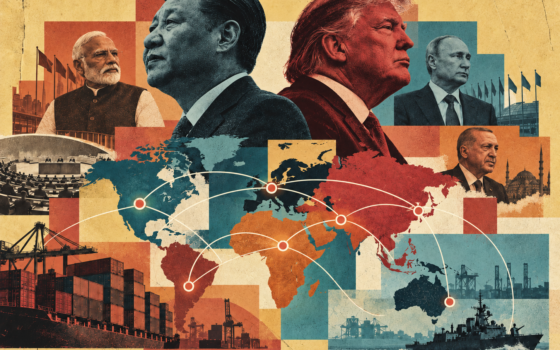
When observing the map, a reality that becomes evident is that the BRICS do not have a direct outlet to the vast Pacific nor a clear representative on its shores. China is encircled by a chain of islands predominantly belonging to Japan, the Philippines, and Taiwan, so adding countries from this area would help it become more representative and present in the world’s main ocean. Hence, the interest of some in incorporating Mexico, for example, although this could further jeopardize its beneficial relationship with the United States, which is expressed in a significant trade surplus. GLOBAL SOUTH?

Despite the fact that most of the BRICS+ territory lies north of the equator, this group insists on presenting itself as the custodian of the so-called “Global South,” that amalgamation of countries of varying sizes and divergent interests that coincide in being one thing: underdeveloped. As the late Joseph Nye Jr. argued, [1], a euphemism for not talking about poor nations, in many cases. Another guru of international relations, John Ikenberry,[2], has stated that the reality is that the Global East (represented by China and Russia) competes against the Global West (the United States, Europe, and others) to attract countries from the Global South as the relationship between the former becomes more competitive. The BRICS would provide the necessary interface for the Global East to achieve its purpose, all wrapped in anti-imperialist rhetoric that obscures the fact that other powers seek new leadership roles.CONCLUSION
. President Boric’s attendance at the BRICS leaders’ summit in Rio de Janeiro on July 6 and 7 presents a suitable opportunity to gather firsthand information from the debate in this particular forum, but it is desirable that the Ministry of Foreign Affairs maintains its firm position of not advancing towards membership and instead focuses on the Organization for Economic Cooperation and Development (OECD).In justifying his measures regarding Israel, the president asserted that “principles are non-negotiable in foreign policy.” Following that argument, Chile’s principle of supporting the peaceful resolution of disputes faces the reality of the recent belligerent actions of three of its founding members. The promotion and defense of democracy also do not align well with the majority of the regimes in this association, which are mostly Asian-African. And if some particular agendas of the current government are pursued, the feminist foreign policy does not resonate in the BRICS as it does in Europe, where there are indeed women in leadership positions.
Chile has much more in common with the maritime democracies of the G-7, both in principles and interests. With most members of the emerging bloc, only interests—trade in goods and others—are shared, and with some, like Russia, neither. Following the path of the BRICS would be to take a fork in the road. It is merely a loose economic and political association, nothing resembling a broad and structured free trade agreement.
However, as the vault of bad foreign policy ideas exists and is deeper than we sometimes believe, it is always better to be forewarned. Undoubtedly, host Lula and some of his partners could exert some pressure or attempt to entice Chilean authorities in their last eight months in power. A scenario similar to that recorded in 2023, when the Brazilian president practically notified his then Argentine counterpart, Alberto Fernández, of his upcoming accession to the bloc amid an electoral process. At that time, it was a new government, that of Javier Milei, that had to slam the door shut.
[1]
Ikenberry, J. (08/01/2024), “Three Worlds: the West, East and South and the competition to shape global order”, International Affairs, Volume 100, Issue 1, January 2024, Pages 121–138. Inhttps://doi.org/10.1093/ia/iiad284.