The U.S. Deployment in the Caribbean Highlights the Importance of Naval Power in Latin America
This article was translated automatically and may contain differences from the original. For reference, read the original.
- by Carlos Solar
- Guest Contributions
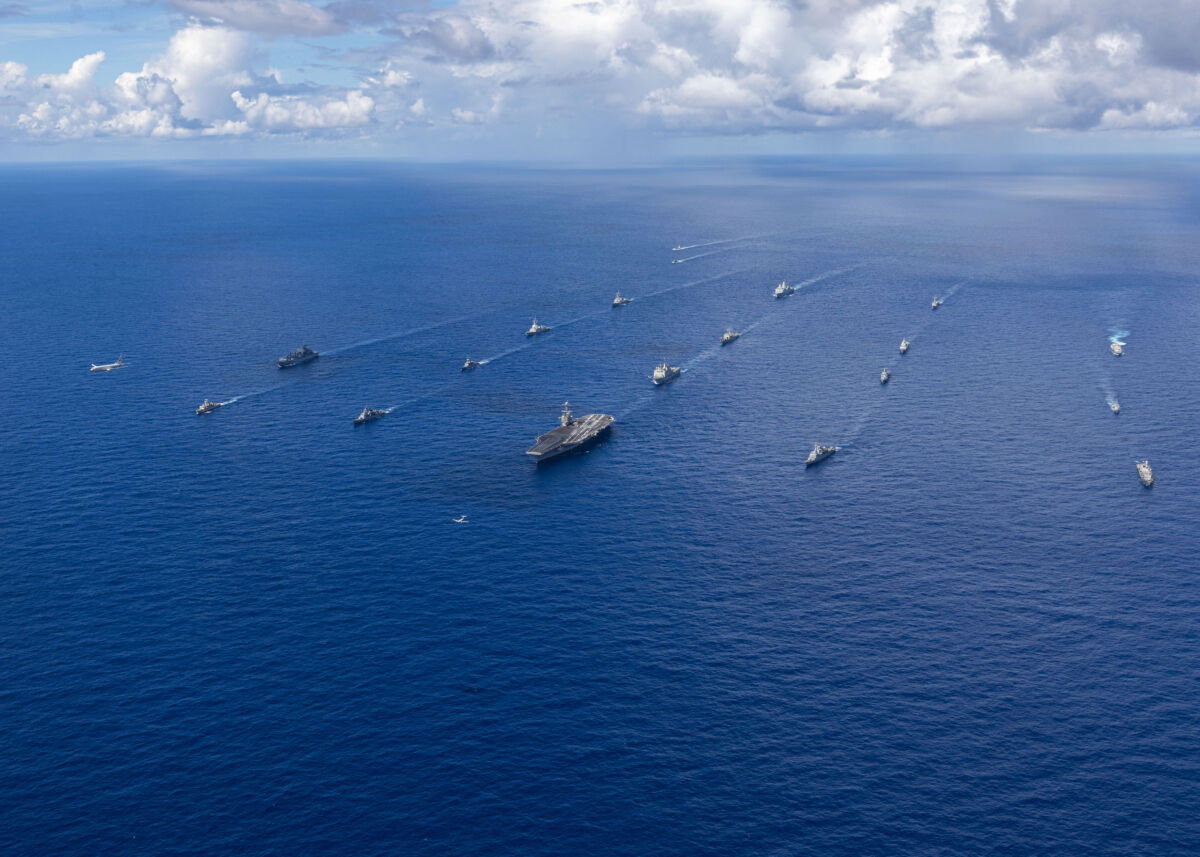
Brazil, Argentina, Colombia, Chile, and Peru are preparing their fleets to protect resources and expand their influence in case rivalries reach their maritime domains.
When it was reported earlier this year that the UK government was in talks with its Brazilian counterparts to sell them the “HMS Albion” and the “HMS Bulwark,” two assault ships that had not sailed since 2023 and 2017, respectively, and which were to be scrapped as part of widespread defense cuts, the signs pointed to an increased exchange of weapon systems between the two countries. Brazil has a recent history of purchasing and refurbishing British ships such as the “PMA Atlântico,” formerly the Royal Navy platform “HMS Ocean,” which also led to a
four-year contract with Babcock International Group to provide maintenance and systems support. It was not surprising, then, that aboard the “HMS Mersey,” during the recent DSEI conference, Brazilian representatives signed the purchase of the “HMS Bulwark.” The ship will be used for the transport of cargo and personnel, essential during humanitarian emergencies, as well as primarily for the protection of the
Blue Amazon , Brazil’s exclusive economic zone (EEZ), rich in natural resources and minerals. “This closer relationship strengthens diplomatic ties between both countries,” declared Admiral Edgar, Director General of Material of the Navy. Brazil’s naval acquisition strategy combines the purchase of second-hand ships with the local program of the Tamandaré class, a series of frigates being built locally with the German shipyard Thyssenkrupp. The plan strategically incorporates national companies such as Embraer and foreign ones, such as the multinational MBDA and the Italian Leonardo, to boost the development of its national defense industry. The first Tamandaré class frigate is expected to enter service by the end of 2025, with other ships following suit until 2029.
Cooperation with the U.S.
However, Brazil maintains a
two-way defense diplomacy with both Western and Eastern countries. In recent years, ties with China have strengthened, ranging from the inclusion of People’s Liberation Army marines in combined military exercises in 2024 to the promotion of defense attachés that Brazil sends to its embassy in Beijing to the rank of general. While the relationship between the UK and Brazil may remain healthy despite the Chinese factor, relations between the United States and Brazil are not at their best. The bilateral defense relationship between the two countries dates back nearly two centuries, and in modern times, according to data from the Department of Defense, almost all exercises sponsored by U.S. Southern Command in the region involve Brazil.
In July, Washington canceled its participation in the Americas Space Conference in Brasília, and shortly thereafter Brazil
canceled Operation Formosa, the exercise that hosted Chinese troops last year, citing budget constraints. Diplomacy is failing to balance the relationship between Donald Trump and Lula da Silva, two presidents with differing worldviews who see the future of the global order in opposing directions. However, the United States is by far a central actor in shaping the naval trajectory of Latin America, even as new actors forge alliances with old friends.
Naval cooperation has historically focused on interoperability through exercises such as
UNITAS , the world’s longest-running multinational maritime exercise, which periodically brings the U.S. Navy together with Latin American partners. Military Buildup in the Caribbean
The United States has supported initiatives to raise awareness of maritime dominance, providing radars and command and control systems to strengthen the capacity of friendly navies against illegal fishing, drug trafficking, and other transnational threats. These measures reflect a dual U.S. strategy: to maintain technological superiority in high-level warfare while simultaneously strengthening alliances that ensure collective control over key maritime routes in the Pacific and Atlantic.
The current deployment of U.S. Southern Command in Caribbean waters, near Central and South America, constitutes an
unprecedented naval concentration. With the aim of containing the flow of drug trafficking, primarily from Venezuela, the military deployment in the Caribbean adds urgency to the naval modernization of Latin America, reinforcing the idea that maritime power is both a tool of deterrence and a means of geopolitical signaling. Washington’s patrols for freedom of navigation near Venezuelan waters, combined with the militarization of Caracas’s exclusive economic zone and tensions with Guyana, highlight how the dispute over
maritime spaces can escalate into conflict points involving global powers. This crisis serves as a reminder that naval acquisitions are not only aimed at replacing obsolete platforms but also at improving preparedness for scenarios where regional disputes intersect with the strategic agendas of extra-hemispheric actors. Latin American states are investing in more capable and versatile fleets to safeguard their sovereignty, protect their resources, and avoid being caught off guard by the possibility of rivalries between great powers extending into their maritime domains. Washington is aware of this and is working to consolidate military relations whenever possible. Recently, the State Department authorized the
sale of twelve F-16 aircraft to the Peruvian Air Force for a value of $3.42 billion. This recent decision underscores Washington’s determination to maintain its influence in the region’s defense procurement markets. Lima had been considering new warplanes to replace its outdated fleet, traveling to Sweden to view the JAS-39 Gripen. These decisions come after the recent authorization by the United States for Argentina to purchase F-16s from Denmark, which could turn these two countries, along with Chile, into a triangular zone with skies dominated by F-16s. Peru is making significant defense purchases that are straining its limited budgets. Last year, Peru awarded HD Hyundai Heavy Industries the contract to work with the Peruvian state company SIMA in the construction of a frigate, an ocean patrol vessel, and two landing craft by 2029, a major triumph for the South Koreans, surpassing bids from Spanish, Italian, and Dutch shipyards. Meanwhile, SIMA has built a good reputation as a builder, with promising new projects such as the “BAP Río Huarmey” and the “BAP Río Nepeña,”
initiated earlier this year as part of a series of new units designed to enhance Peru’s maritime dominance.
Replacement European FrigatesColombia, the country closest to the tension hotspot that Venezuela has become, signed an agreement in late 2024 between Damen
and the Colombian shipyard COTECMAR to build a frigate based on the SIGMA 10514 series at its shipyard, which Damen previously built for Indonesia and Mexico.
Saab also joined to provide its combat management systems, sensors, and radars for the new frigate, which is expected to be delivered by 2030. Additionally, new actors, such as the Turkish defense complex, have ventured into seeking a share of the current wave of naval modernization. HAVELSAN signed an agreement with the Chilean Navy for the modernization of its M-class frigates with ADVENT command and control capabilities, becoming the ninth country in the world to join this combat ecosystem.
Chile is on track to replace at least eight frigates with an average of over 30 years of service. The Navy launched its National Naval Construction Plan considering frigates, auxiliary vessels, and logistical units. The first of its kind and part of the program is the polar icebreaker “Almirante Viel,” key to the country’s Antarctic projection. Chile observes strong competition
to decide who will become the main partner in the construction of its frigates. Although the design of Babcock’s Arrowhead 140 frigate is a strong contender, news about the chosen supplier will not arrive until 2026. Earlier this year, unconfirmed reports circulated about a possible sale to Chile of the “HMS Argyll,” as an addition to its fleet, which currently has three Type 23 frigates that belonged to the Royal Navy. Argentina, on the other hand, is attempting to make a limited purchase of frigates considering possible offers for two Iver Huitfeldt-class frigates from Denmark, as a continuation of its recent partnership to acquire F-16 aircraft. In July, its Ministry of Defense confirmed that the Navy was in negotiations with the Royal Danish Navy to replace the recently decommissioned “ARA Hércules” and “ARA Heroína.” The Iver Huitfeldt class could provide the Argentine Navy with renewed air defense, surface warfare, and anti-submarine capabilities with a vessel that has demonstrated experience in NATO operations. However, these frigates have recently ceased operations, and Denmark halted the necessary repairs, forcing their replacement by the Danish fleet. Another option
for Buenos Aires will be the recently decommissioned Italian Maestrale class, with anti-submarine warfare capabilities. What This All Means The acquisition decisions expose the intricate web of strategic alliances and competition among defense suppliers. The dependence on European shipyards and the entry of Turkish companies in Chile and the influence of South Korea in Peru demonstrate how Latin America has become a competitive market for global defense industries. These dynamics create long-term dependencies that go beyond technology transfer and encompass training, maintenance, and shared operational concepts. They also illustrate how governments use naval modernization to leverage diplomatic capital and negotiate their place in the changing international order. Ultimately, naval modernization in Latin America is a visible sign of ambition. While Brazil, Chile, Peru, and Argentina present different levels of capability and budgetary strength, all four countries are investing in navies capable of protecting resources, deterring adversaries, and projecting power regionally and internationally. The process will be uneven, constrained by fiscal realities and political changes, but underscores a fundamental truth: the oceans remain essential to the prosperity and security of the continent.
The trajectory of these naval programs will not only shape the defense balances of Latin America but also determine how external powers, namely Europe and increasingly Asia, will interact with the region in the coming decades. For Washington, the task will be to balance its global commitments with a sustained presence in Latin America, ensuring that the modernization of regional navies does not fall into the orbit of rivals like China and Russia, whose influence is slowly expanding through defense diplomacy.
Dr. Carlos Solar (RUSI)
London, September 30, 2025
Reprinted with permission from the Royal United Services Institute
(RUSI).
The opinions expressed in this commentary are those of the author and do not represent those of RUSI or any other institution.
Main photo: US Navy.
by Carlos Solar