National Security, Now!
This article was translated automatically and may contain differences from the original. For reference, read the original.
Chile faces the practical and urgent need for an integrated national security architecture, with civilian leadership and democratic control, centered around a National Security Council. This Council, common in NATO/OECD countries, is vital for coordinating key institutions, assessing risks, and formulating an effective national security strategy; it is irresponsible to continue postponing its implementation.
Five years ago, there were voices arguing that the mere existence or use of the term “national security” was a mistake, as it was completely outdated, being “an empty signifier.” Whether due to a strong ideological bias, an outdated perspective, or confusion regarding what was termed the “national security doctrine” in Latin America during the Cold War, the reality is that in 2025—after two constitutional processes and the evident deterioration of public security—none of the former detractors seem to have insisted on the idea of eliminating the notion of national security. As demonstrated by AthenaLab in 2022, national security is a cross-cutting area of study in most of the world’s leading universities.[1].
Let us start from a shared foundation: the State must guarantee its citizens a life free from threats. This public function responsible for the security of the State requires a superior and permanent structure that articulates the various instruments of national power. The key is to ensure that the ideas and initiatives proposed have an institutional pathway and the necessary framework to generate, implement, and control the results. In other words, an organization that, in an integrated and coordinated manner, addresses the threats, risks, and opportunities facing Chile 24/7.
The intended structure is not limited to a single organization—although the National Security Council bears the weight and articulates the other components—nor is it something very abstract or an infinite set of institutions; rather, it considers an institutional ecosystem, where most of it already exists today but operates in a fragmented manner. In summary, the national security architecture must encompass a variety of institutions, laws, decision-making procedures, values, and democratic controls, as well as their interconnections. These responsibilities, which function in an integrated and coordinated manner, aim to implement strategies to ensure a safer country and citizens.
Thus, the national security structure includes: the Executive Power, particularly the President of the Republic, who ultimately makes decisions; a National Security Council and any other body, person, or entity that, due to the matter at hand, is necessary to provide the precise advice to the head of State; Armed Forces, Law Enforcement and Security Forces, Foreign Service, Intelligence System, necessary to implement strategies and public policies; National Congress, General Comptroller of the Republic, courts of justice, and the press, as central institutions of democratic control; and a set of collaborative bodies, such as academia, think tanks, the defense industry, the private sector, and civil society in general. As can be seen, this is not about militarization, but rather, on the contrary, ensuring the political supremacy of civilian leadership in national security, increasing the efficiency of the national security system, and strengthening the State’s capacity to act in response to societal priorities.
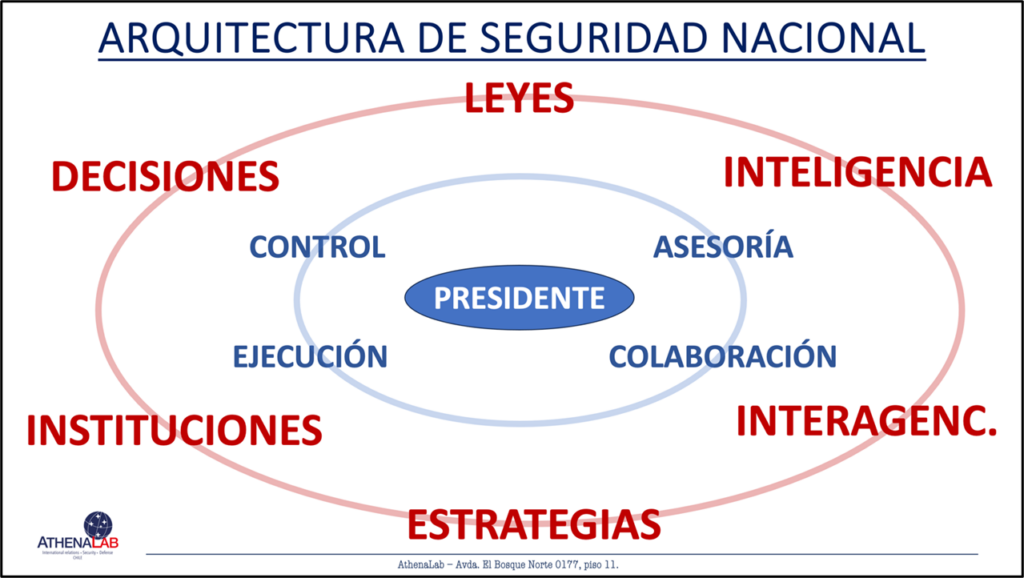
Source: Own elaboration.
The heart of this architecture is a National Security Council. Countries like the United Kingdom and Spain implemented it after suffering catastrophic attacks. However, waiting for a tragedy is a luxury that Chile cannot afford. According to the same study by AthenaLab, 80% of NATO countries and 71% of OECD countries have these structures. The vast majority did not do so out of trauma, but out of common sense and best practices; it provides more and better security for the State and its citizens. Delaying it is simply absurd and irresponsible. It does not seem sensible to continue waiting, as before the eyes of national authorities, critical public transport infrastructure was attacked, burning dozens of Santiago Metro stations; multiple transnational criminal organizations have established themselves in the country; there are organizations employing terrorist tactics to advance their objectives, not to mention that there are areas of national territory where there is no effective sovereignty.
In this council, each strategic function of the State has balanced representation at the highest level (ministers). However, what ensures continuity in the system is the secretariat or team, where the same core functions are represented, now by technical elements and analysts who provide continuity to the work, feeding the analysis and the council’s work, with the national security advisor responsible for leading the daily work of this body.
While security has been a topic of great interest and coverage before recent electoral processes, being a significant part of the discourse and programmatic proposals of the main candidacies, not all diagnoses are correct; many are partial, incomplete, or heavily ideologically influenced. Similarly, it is not enough to have good diagnoses if adequate, timely, and integrated measures are not implemented in time and place, and aligned with objectives.
Not everyone defines national interests in the same way, nor do all national interests hold the same value and importance. Not all phenomena affecting people impact national security, even if they may be related in some way. Not all criminal actions affect national security, but they will if they jeopardize the continuity of the rule of law or affect the country’s interests. Not everything is a national security problem. Ultimately, an adequate strategy cannot be implemented without a structure that provides support and strength.
What can be observed is that: 1) National security is a fundamental element for the continuity of the State; 2) A national security architecture provides tools to enhance the security of the State and its people; 3) A modern and robust intelligence system is intrinsic to national security; and 4) Only a superior authority with adequate elements of democratic control ensures the integration, coordination, and employment of organizations of different types and natures.
Furthermore, it should be anticipated that a national security council should not generate more bureaucracy to continue doing the same, nor should it aim to militarize security or politicize defense and public order institutions. On the contrary, the systematization of a national security architecture, in general, and the implementation of a national security council, in particular, would ensure civilian control over national security. This would facilitate timely assessment of risks and threats, propose alternatives or courses of action for the President of the Republic to make better decisions. Additionally, it would help identify opportunities for the country and, especially, formulate, implement, and control a national security strategy. In summary, its main function could be synthesized in the integration and coordination of the main institutions and organizations that must ensure the security of the State and its citizens.
Chile has waited too long, and national security should not be an ideological debate; it is a practical necessity. The time to act is now.
Marcelo Masalleras, Senior Researcher, AthenaLab
November 26, 2025
[1] John Griffiths and Marcelo Masalleras, “Security and the State of Chile” (AthenaLab: Santiago, 2022), available at https://athenalab.org/wp-content/uploads/2022/06/Seguridad-y-el-Estados-de-Chile.pdf