Pressure on the Andean Axis: Polarization, Fragile Governance, and Risks for Chile
This article is not yet available in English. The original Spanish version is shown instead.
1. Context
The Andean axis is going through a period of heightened political tension. Colombia’s and Peru’s contested presidential elections, together with anti-government protests in Bolivia, point to a problem deeper than the sum of domestic incidents. In all three cases, internal political processes have become marked by a severe polarization that goes beyond the regular contest between alternative projects and leaderships. For broad sectors of society, the political adversary has come to embody a threat to the country’s political future.
For Chile, the evolution of these processes matters for concrete reasons. If severe polarization takes hold across the Andean axis, the likelihood of ungovernability increases, and its effects will extend into the surrounding neighborhood. In this context, Chile appears exposed to the pressure that may build along its northern border, particularly through the convergence of irregular migration flows, illicit economies, and transnational criminal networks operating there, with potential implications for national security.
The risk is not that Chile will mechanically reproduce Andean fragility, but rather that such fragility will increase pressure on its own border, institutional, and territorial capacities. Recent events in Colombia, Peru, and Bolivia should therefore be read not as isolated episodes of neighboring instability, but as signals of pressure on Chile’s immediate strategic environment.
2. Severe Polarization, Fragile Governance, and State Absence
Polarization is part of democratic life. Democracies organize interests and turn differences into institutional competition. That balance rests on formal rules, but also on political habits that make it possible to recognize the legitimacy of the adversary, accept defeat when necessary, and exercise power with self-restraint.
The difficulty emerges when polarization no longer expresses clear disagreements and instead begins to organize politics as an existential divide. This is what several authors refer to as severe polarization1. Differences among citizens tend to align along a single defining axis, and public life begins to reorganize itself in terms of “them” and “us.” At that point, competition takes on a zero-sum logic, and conflict is no longer processed as dissent but experienced as a threat.
In contexts of severe polarization, historical cleavages and the memory of past conflicts provide the underlying terrain on which divisive leaderships operate, reactivating and deepening latent divisions. As a result, every institutional decision comes to be read as a factional maneuver, and every adverse outcome as an act of dispossession.
In Latin America, studies have warned that this divisive dynamic can be intensified by institutional designs such as presidentialism, whose winner-takes-all logic and rigid terms personalize conflict and raise the political cost of defeat2. When these institutional conditions coincide with economic stagnation, uneven state capacity, and social discontent, severe polarization can aggravate problems of governance.
Figure 1. Severe Polarization and Its Risk Scenarios: A Causal Mechanism. Source: Author’s elaboration
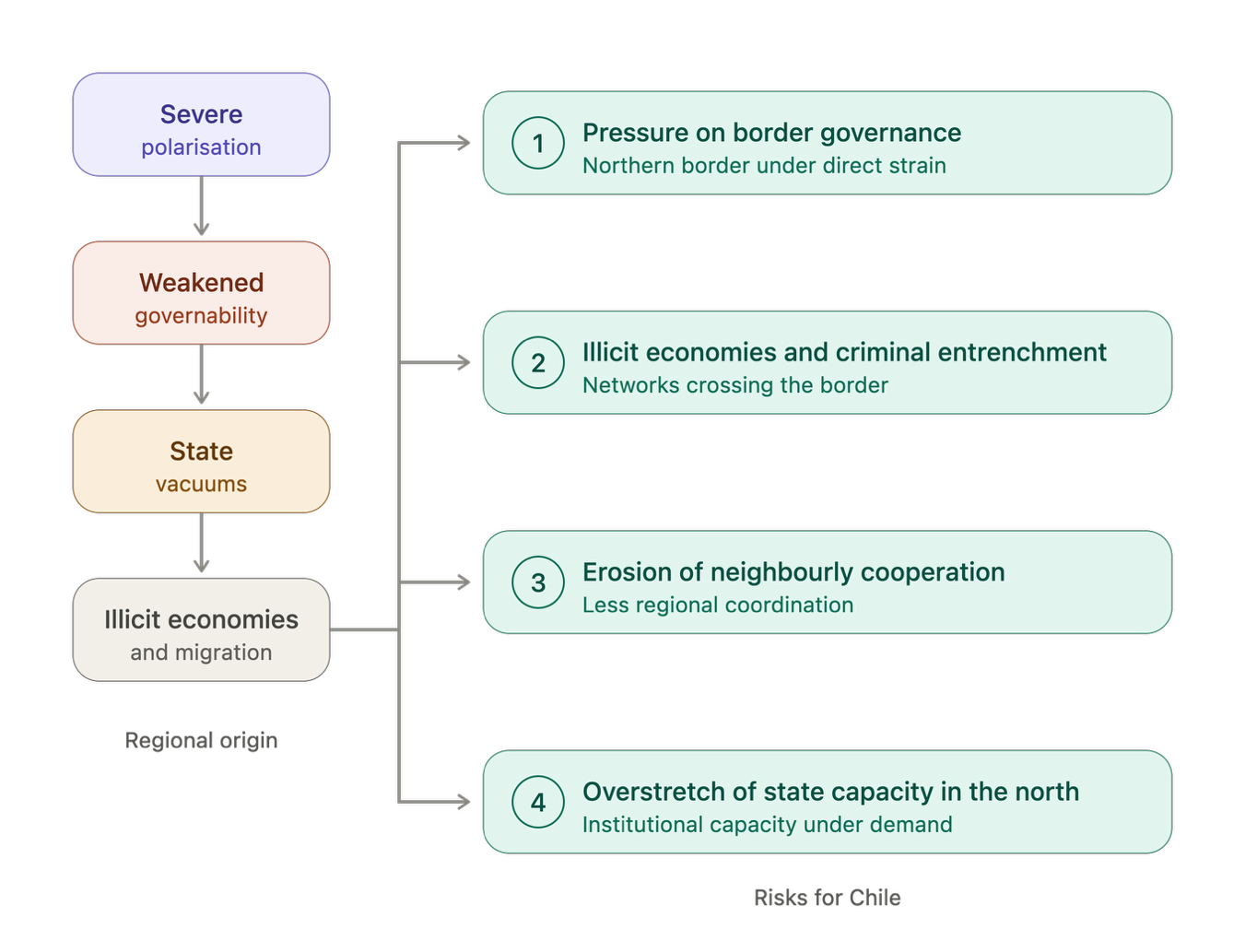
Severe polarization erodes governance when parties and social organizations cease to operate as channels of mediation and begin to act as poles of identity, causing the system to lose its capacity to absorb dissent3. A divided society narrows governments’ room for maneuver by placing constant obstacles before their decisions. Paralysis in the face of urgent social needs inflames discontent, creating conditions for disorder and for challenges to those in power.
When ungovernability persists, it ceases to be limited to the challenges facing the authorities of the day and begins to erode the resources, coordination, and political consensus the state needs to sustain its presence. This erosion does not generate state weakness from scratch; rather, it reduces the political capacity to correct pre-existing gaps, which are more pronounced in peripheral areas, border zones, and circulation corridors.4 In such an environment, illicit economies and criminal networks find more favorable conditions for expansion, while irregular migration flows tend to remain without adequate state management5.
3. Three Expressions of Severe Polarization
3.1. Colombia
The 2026 runoff election pitted Abelardo de La Espriella against Iván Cepeda and ended with a margin of less than 1 percent in favor of the former. The highest turnout in recent history reinforced both the plebiscitary nature of the contest and the perception that more than an ordinary transfer of power was at stake. The defeat of the incumbent camp led outgoing President Gustavo Petro to propose annulling the runoff over alleged U.S. interference, and even to link that rejection to the right to take up arms6. Although Cepeda distanced himself from that position and conceded defeat, the challenge to the winner’s legitimacy had already escalated to the highest levels of power.
This episode points to a longer trajectory. Colombia’s armed conflict left behind a society marked by memories of exclusion, repression, and political violence, while the 2016 peace agreement opened a new divide between those who saw it as an opportunity for democratic reintegration and those who viewed it as an excessive concession to the insurgency7. The social outbursts of 2019 and 2021 deepened that divide. In both cycles, protest displayed limited intermediary articulation and was met with a repressive response, reinforcing the perception that institutions were no longer able to mediate conflict8. Against this backdrop, recent insecurity became one of the decisive organizers of the cleavage in 2026.
An incoming government challenged from above and by a significant segment of society faces a narrower margin for political direction and an opposition incentivized to read every decision as illegitimate. This weakness at the outset carries a territorial cost. An executive with limited political room for maneuver will struggle to sustain the effective arrival of the state in the areas that the 2016 Agreement was meant to integrate.
In the Pacific region of Nariño, Catatumbo, and Bajo Cauca, the ELN, FARC dissident groups, and the Gulf Clan compete for corridors linked to coca production and illegal gold mining. This is not merely criminal activity, but rather the presence of structures that administer populations, regulate economies, and substitute for state functions in the periphery9. In Colombia, therefore, severe polarization erodes governance and reduces the possibility of reversing a fragmented sovereignty that already existed across large peripheral areas, while the political cycle remains trapped in a logic that casts the adversary as a threat.
3.2. Peru
The June 2026 runoff reopened a fracture that the political system has carried for years. Keiko Fujimori won by a margin of 0.3 percent, and Roberto Sánchez responded by denouncing fraud and calling for the annulment of votes cast abroad. The dispute thus ceased to focus on policy platforms and once again became centered on the very legitimacy of the mandate.
Figure 2. Political Polarization in the Andean Axis, 2010–2025 (higher score = greater polarization; 0 ≈ global average). Source: Author’s elaboration based on data from V-Dem (2026)
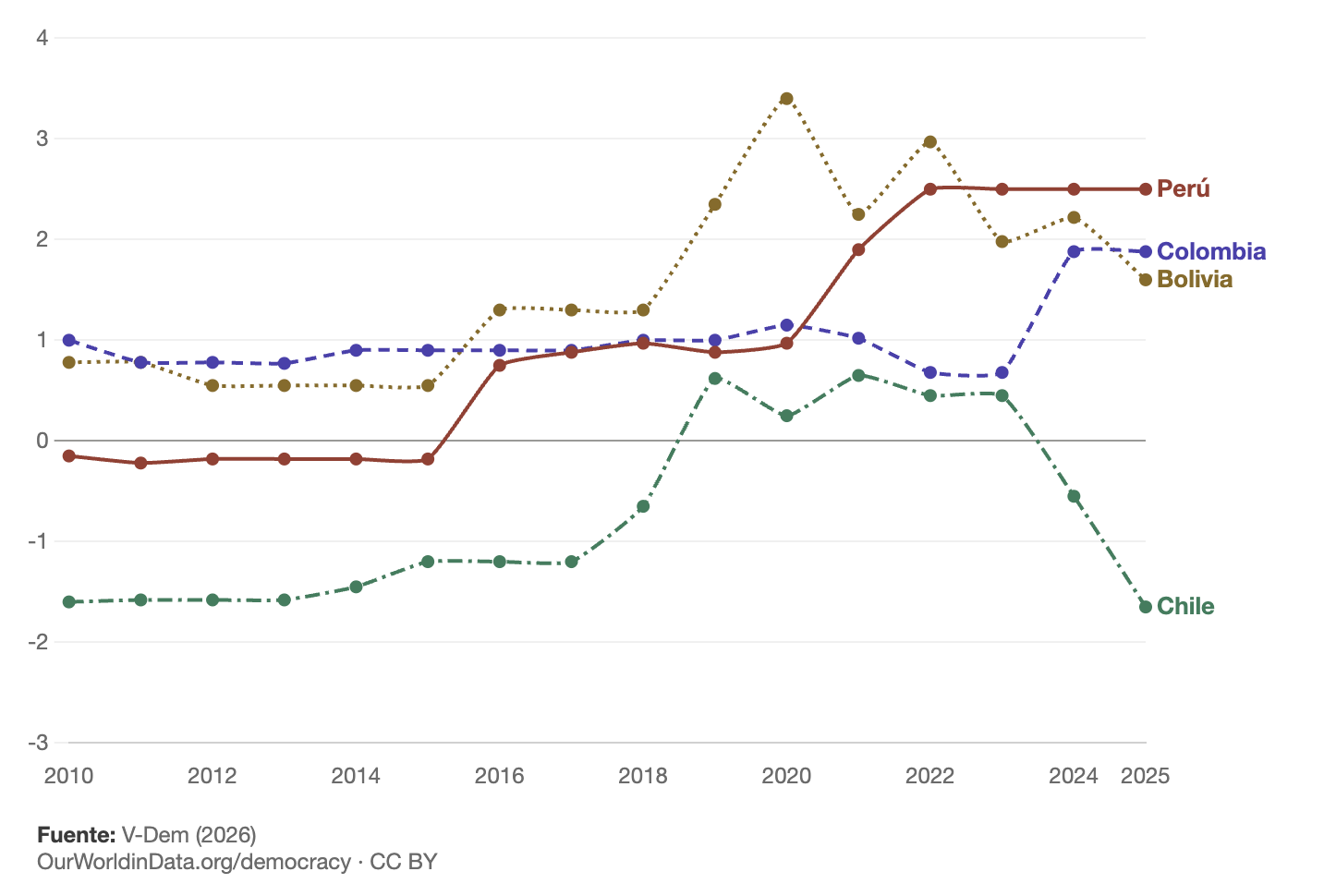
This outcome is better understood against an already eroded backdrop. Since 2016, the recurring confrontation between the executive and the legislature, together with the succession of impeachments, resignations, and presidential replacements, has gradually weakened the balance of powers and drained institutions and political parties of legitimacy10. The absence of solid bridges between society and the state is compounded by the cleavage between Fujimorismo and anti-Fujimorismo, which carries an intense political memory. For one part of the country, it evokes authoritarianism and state repression; for another, the restoration of authority in the face of insurgent violence. When this axis moves to the center of an election, the dispute ceases to feel like an ordinary competition and instead comes to be read as a judgment on the country’s political past and its democratic limits11.
The fall of Castillo and the cycle that opened under Boluarte crystallized this deterioration from above through a survival coalition between the executive and Congress. Yet a state absorbed by this dynamic can hardly sustain a territorial policy in areas where its presence was already limited12.
State weakness is concentrated in the Amazonian and Andean peripheries, in the Valley of the Apurímac, Ene, and Mantaro Rivers, and in the illegal gold-mining economy of Madre de Dios, all of which have their own networks of protection and violence. The Lima–interior cleavage, sharpened by the repression in the south after Castillo’s fall, ultimately stripped the state of legitimacy precisely where it most needs to project it. Thus, in Peru, severe polarization makes governance more precarious and deepens a gap in territorial control that illicit economies occupy with growing autonomy.
3.3. Bolivia
Bolivia’s polarization in 2026 was expressed from the outset as a crisis of authority. A few months after taking office, Rodrigo Paz faced mass protests, shortages, more than a dozen deaths, and the declaration of a state of emergency13. The trigger was the elimination of fuel subsidies, but the conflict quickly ceased to revolve around the cost of living and instead began to test the capacity of the new government to assert authority in a country where street mobilization continues to carry significant political weight.
Behind this conjuncture lies a deeper historical fracture. Bolivian politics has for years been marked by the tension between a national-popular and Indigenous project, strongly articulated by the MAS, and a regionalist and autonomist pole rooted in Santa Cruz and the eastern lowlands. This cleavage combines territory, identity, the model of the state, and the distribution of power. On one side lies the memory of the historical exclusion of Indigenous majorities and the promise of a plurinational state; on the other, the autonomist tradition of Santa Cruz, wary of centralism from La Paz. Added to this is the fall of Evo Morales in 2019, read by some as the result of fraud and by others as a coup, which hardened opposing identities. The decline of the MAS in recent years did not close this fracture; it also divided the popular and Indigenous camp itself, weakening one of the foundations that had long structured political competition14.
Thus, severe polarization is expressed in a state that must govern over overlapping cleavages, with reduced capacity for arbitration and with actors that retain the power to exert pressure outside institutions. The Bolivian specificity, however, lies in the porous control of its borders and extensive corridors, in a country that is both a producer and a transit platform.
The Chapare supplies one of the region’s largest coca economies, whose cocaine reaches Southern Cone markets through organizations—several of Brazilian origin—that thrive in the oversight gaps left open by political struggle. These same corridors structure other illicit flows, such as smuggling and irregular migration. Bolivian severe polarization therefore places governance under constant strain and connects regional illicit corridors with Chile’s northern border.
4. Risks for Chile
These dynamics matter for Chile for concrete strategic reasons. Its northern border makes the country both a destination and a corridor for regional flows with potential national security risks. On that basis, a more polarized neighborhood with more fragile governments may produce four interconnected effects.
The first is pressure on border governance in the northern macro-zone. The combination of Bolivia’s crisis and Peru’s uncertainty increases the likelihood of recurrent tensions in Chacalluta, Colchane, and other crossing points, placing continuous strain on Chile’s capacity to filter and organize human and material flows along an extensive border. The emergence of clandestine bridges after the construction of ditches shows the limits of the promise to “seal” borders, as well as the determined interest of criminal groups in gaining access to Chilean territory15. This risk is both highly probable and highly consequential for the country’s security interests.
The second risk is the potential entrenchment of illicit economies and criminal networks in Chilean territory. The same structures that thrive in the control gaps of neighboring countries may seek a deeper territorial foothold in northern Chile. The qualitative shift occurs when these networks stop using Chile merely as a transit zone and begin to establish themselves within its territory. Arica has offered worrying signs of this possible transition. Gangs such as Los Gallegos —a branch of Tren de Aragua, with a record of operations in Peru— moved from controlling routes to capturing neighborhoods, managing local illicit economies, and imposing their own rules through extortion, human trafficking, and contract killings16.
The third risk is the deterioration of neighborhood cooperation. Chile depends, more than is often acknowledged, on political coordination with its neighbors to control border crossings, share intelligence on criminal networks, and return irregular migrants. Binational committees with Peru and agreements for the return of irregular entrants with Bolivia have produced concrete results so far. The recent Santiago Commitment against organized crime reaffirmed the value of joint action17. Yet this cooperation is sustained between governments and therefore depends on the political stability of the counterpart. A polarized neighborhood, with weak administrations or contested legitimacy, cooperates less precisely when such coordination becomes more necessary.
Figure 3. Causal Mechanism and Risk Scenarios for Chile. Source: Author’s elaboration
The fourth risk closes the chain. Sustained pressure on municipalities, public services, and state legitimacy in Arica, Tarapacá, and Antofagasta may aggravate the sense of territorial abandonment and increase receptivity to harder law-and-order discourses. The north has already shown signs of this shift: both the security protests in Iquique and Arica in 202218 and episodes of neighborhood hostility toward migrant populations reveal a form of discontent that is moving from demands for services toward demands for order. To be sure, Chile retains capacities superior to those of its surroundings, but the risk is not that it will replicate Andean state weakness; rather, it is that it will import its logic of perceived abandonment. The problem thus takes on a political and administrative character, with contained probability but significant political impact.
Taken together, the four risks share a common foundation: severe polarization and fragile governance in the Andean axis are already affecting Chile’s strategic environment, and the northern macro-zone is its first point of contact. The greater danger does not lie in each risk taken separately, but in their silent accumulation. If read too late, or treated as isolated episodes, they may turn neighboring fragility into a domestic vulnerability with consequences for national security.
DIEGO SAZO
Head of Research in International Relations, Athenalab
Notes
- Thomas Carothers y Andrew O’Donohue, eds., Democracies Divided: The Global Challenge of Political Polarization (Washington, D.C.: Brookings Institution Press, 2019). ↩︎
- Juan J. Linz, “The Perils of Presidentialism”, Journal of Democracy 1, no. 1 (1990): 51-69. ↩︎
- Ignacio Sánchez-Cuenca, El desorden político: Democracias sin intermediación (Madrid: Los Libros de la Catarata, 2022). ↩︎
- Guillermo O’Donnell, “On the State, Democratization and Some Conceptual Problems: A Latin American View with Glances at Some Postcommunist Countries”, World Development 21, no. 8 (1993): 1355-1369. ↩︎
- Benjamin Lessing, “Conceptualizing Criminal Governance”, Perspectives on Politics 19, no. 3 (2021): 854-873. ↩︎
- El Colombiano, “‘Podría levantarme en armas legítimamente’: los polémicos trinos de Petro tras las elecciones”, 24 de junio de 2026, https://www.elcolombiano.com/colombia/petro-levantar-armas-fraude-electoral-elecciones-2026-HI38127312 ↩︎
- Andreas E. Feldmann, “Colombia’s Polarizing Peace Efforts”, en Thomas Carothers y Andrew O’Donohue, eds., Democracies Divided: The Global Challenge of Political Polarization (Washington, D.C.: Brookings Institution Press, 2019), 153-176. ↩︎
- Mauricio Archila Neira y Martha Cecilia García Velandia, “State Debt with a Social Agenda, Constructed amid Social Protests in Colombia, 1975-2019”, en Popular Politics and Protest Event Analysis in Latin America, eds. Moisés Arce y Takeshi Wada (Albuquerque: University of New Mexico Press, 2024), 103-137; y Sandra Botero, Laura García-Montoya, Silvia Otero-Bahamón y Sebastián Londoño-Mendez, “Colombia 2022: Del fin de la guerra al gobierno del cambio”, Revista de Ciencia Política 43, nº 2 (2023): 223-254. ↩︎
- Benjamin Lessing, “Conceptualizing Criminal Governance”. ↩︎
- Noelia Chávez y Rodrigo Medel, Perú 2016–2026: una década de inestabilidad política. Crisis políticas, vaciamiento democrático y captura institucional, Boletín CRISPOL nº 2 (Santiago: Núcleo Milenio CRISPOL, junio de 2026). ↩︎
- Carmen Ilizarbe Pizarro, “Perú 2022: Colapso democrático, estallido social y transición autoritaria”, Revista de Ciencia Política 43, nº 2 (2023): 349-375. ↩︎
- Martín Tanaka, “Perú en 2023: de la polarización a la coalición conservadora y populista durante el gobierno de Dina Boluarte”, Revista de Ciencia Política 44, nº 2 (2024): 415-439. ↩︎
- CNN en Español, “El presidente de Bolivia declara el estado de emergencia por la crisis nacional de bloqueos de carreteras”, junio 20, 2026, https://cnnespanol.cnn.com/2026/06/20/latinoamerica/bolivia-estado-de-emergencia-crisis-trax ↩︎
- Ben M. McKay y Gonzalo Colque, “Populism and Its Authoritarian Tendencies: The Politics of Division in Bolivia”, Latin American Perspectives 51, nº 6 (noviembre de 2024): 51-67. ↩︎
- BioBioChile, “Descubren que instalaron un puente clandestino en la zanja de la frontera norte”, junio 15 de 2026, https://www.biobiochile.cl/noticias/nacional/chile/2026/06/15/descubren-que-instalaron-un-puente-clandestino-en-la-zanja-de-la-frontera-norte.shtml ↩︎
- La Tercera, “Los Gallegos: el peligroso tentáculo del Tren de Aragua que remece a Arica”, 23 de septiembre de 2023, https://www.latercera.com/la-tercera-sabado/noticia/los-gallegos-el-peligroso-tentaculo-del-tren-de-aragua-que-remece-a-arica/TCC7WL5YKZAUHF7H4GIH777SHQ/ ↩︎
- Diego Sazo, “Compromiso de Santiago contra el crimen organizado transnacional: oportunidades y limitaciones”, AthenaLab: Análisis, 29 de mayo de 2026, https://www.athenalab.org/publicaciones/analisis-es/2026/05/29/compromiso-de-santiago-contra-el-crimen-organizado-transnacional-oportunidades-y-limitaciones/ ↩︎
- BioBioChile, “Más de 6 mil personas se manifiestan en Iquique por el aumento de la delincuencia y la migración”, 30 de enero de 2022, https://www.biobiochile.cl/noticias/nacional/region-de-tarapaca/2022/01/30/mas-de-6-mil-de-personas-se-manifiestan-en-iquique-por-el-aumento-de-la-delincuencia-y-la-migracion.shtml ↩︎