COLUMN | Security in Chile: The Case of General Director Ricardo Yáñez Reveco
This article was translated automatically and may contain differences from the original. For reference, read the original.
- por Richard Kouyoumdjian
- Columnas
Carabineros de Chile
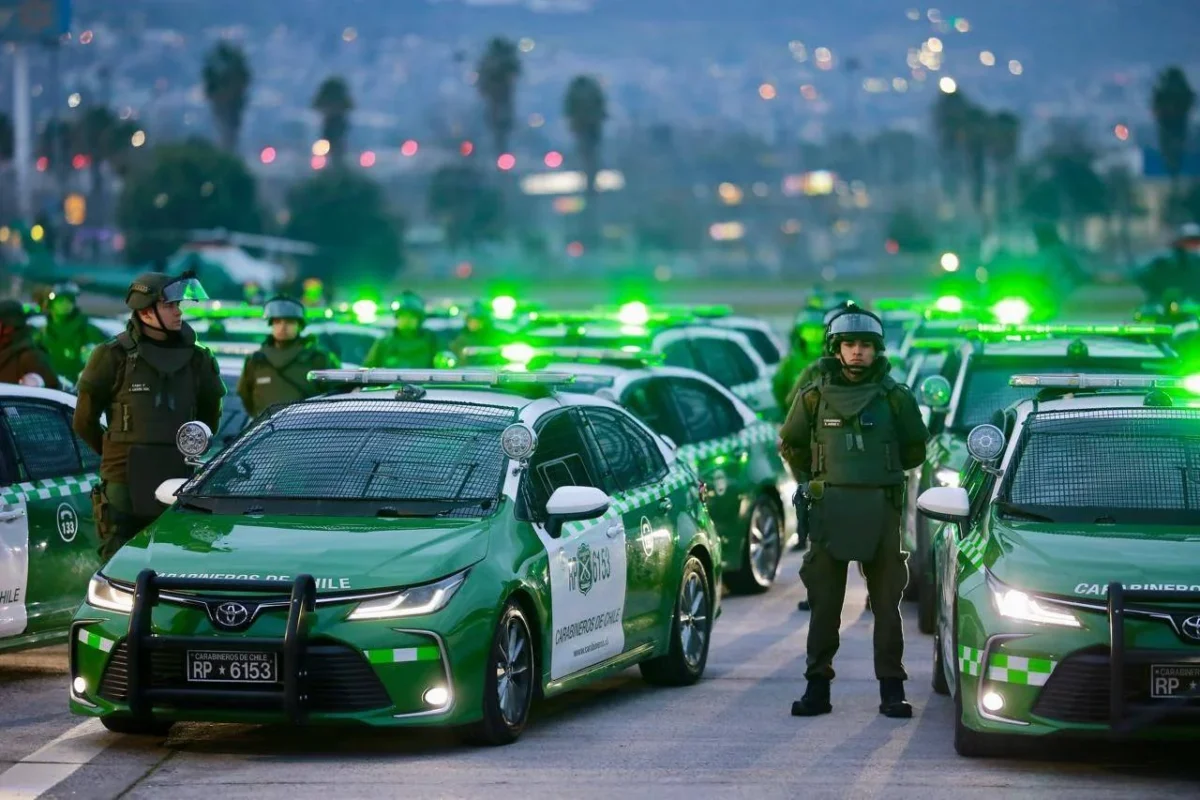
I do not see Carabineros being able to simultaneously address issues of order and security, both due to the number of officers required and the complexity this entails, as well as the need for intelligence, which is evident in areas like the Southern Macrozone.
Having communicated his resignation from the position of General Director of Carabineros on Friday, September 27, due to the formal charges he will face on Tuesday, October 1, and having this resignation quickly accepted by the President of the Republic, including the immediate appointment of his replacement, Inspector General Marcelo Araya, who assumes in the last hours of September, it is appropriate to make a brief assessment of the reasons for his departure, what has occurred during his time in command, and the state of public security in Chile.
First, I find it quite illogical that General Yáñez is to be formally charged for his command responsibility regarding unlawful coercion committed by Carabineros de Chile during the so-called “Social Outburst,” especially considering that they were following orders from the executive branch, and that the National Institute of Human Rights indicated that there was no systematic violation of the rights of the protesting individuals. Furthermore, Carabineros managed the disorder, destruction, and violence with procedures and doctrine that were duly approved. Everything related to this case is nonsensical, and worst of all, it is a nonsensical situation that the entire political class allowed to progress under the supposed rationale of separation of powers, which they claim prevents them from getting involved in the matter, but also with the shortsightedness that, if this proceeds, any authority could eventually be brought to trial by the Public Prosecutor’s Office for their responsibility in events that occurred under their administration.

Along with Yáñez, those who were the general director at that time, as well as his deputy director, will also be charged, all accused of the same thing: unlawful coercion committed by Carabineros. One of the most prestigious institutions in Chile will be put on trial, accused by one of the least prestigious, and judged by one that is not in its best moment. Again, all of this is nonsensical, except perhaps for the government, the Public Prosecutor’s Office, and the judges.
Personally, I would have preferred that General Yáñez did not resign and that the president had been forced to ask for his resignation or outright dismiss him. I do not find the general’s explanations valid, claiming that his goal is to avoid the image of a general director being formally charged while in uniform, but well, those are the general’s circumstances, not mine.
The first thing, to avoid getting lost in analysis, is to be clear about the function of Carabineros. Article 101 of the Chilean Constitution states: “The Forces of Order and Public Security are composed solely of Carabineros and Investigations. They constitute the public force and exist to enforce the law, guarantee public order, and ensure internal public security, in the manner determined by their respective organic laws. They depend on the Ministry responsible for Public Security..”
On the other hand, the constitutional organic law of Carabineros states in its article 1: “Carabineros de Chile is a technical and military police institution that integrates the public force and exists to enforce the law; its purpose is to guarantee and maintain public order and internal public security throughout the territory of the Republic and to fulfill the other functions assigned to it by the Constitution and the law..”
In article 2 bis of the organic law, it is additionally established: “Carabineros de Chile, as part of the State Administration, is at the service of the community, and its actions will be oriented towards the prevention of crimes, the control and restoration of public order, and public security, as well as other functions assigned to it by law..”
Understanding the reasons for the existence of Carabineros is key to determining whether it is fulfilling its roles as a member of the public force, which are: 1) To enforce the law, and 2) To guarantee and maintain public order and internal public security throughout the territory.

If we evaluate the situation today, Monday, September 30, the response, based on the insecurity experienced, the high number of murders and deaths from traffic accidents that occurred during the month, would indicate that they are not fulfilling their constitutional role. This is harsh, but true. That said, we all know that they are not the only ones responsible, and perhaps the least so, but if we refer to what the Constitution states, they are not delivering on their mandate, just as they have not in previous years regarding security at least.
Carabineros is not independent; it reports to the Ministry of the Interior and Public Security, which tells them what to do. On the other hand, their efforts require the cooperation of the Public Prosecutor’s Office and the courts, and it is often the case that bottlenecks are located either due to a lack of processing capacity in places like forensic laboratories or the Legal Medical Service.
I mention this because if the preventive work that Carabineros does in security does not successfully conclude with 100% of crimes investigated, prosecuted, and convicted, the entire cycle is ineffective, and this is largely what is happening today in Chile.
It is correct that Carabineros enjoys a good citizen evaluation, but this is believed to be due both to the effort they put into their work and in comparison to other institutions. This is a matter of perceptions, not metrics or results, since if one were to use that harder dimension, they are not achieving their objective of guaranteeing security.
It is evident that they do much to improve their capabilities and do a better job, but this is insufficient in the face of municipalities, which complain because they see a decrease in the number of Carabineros and, in their unavailability, hire and develop municipal security services, which in many cases, except for the carrying of weapons and some powers, seem very much like municipal police. A similar situation occurs with individuals, who now live in condominiums or gated communities, with surveillance cameras, panic buttons, and many other elements that were not used when Chile was more peaceful.

Along with combating organized crime, the other complex task of Carabineros is the issue of public order, the issue that has Ricardo Yáñez and two other generals on the ropes. Confronting supposed non-criminals is not easy, especially without support from the current government, and where the use of force ends with Carabineros being formally charged and facing justice.
I do not see Carabineros being able to simultaneously address issues of order and security, both due to the number of officers required and the complexity this entails, as well as the need for intelligence, which is evident in areas like the Southern Macrozone.
Ricardo Yáñez had to take command of Carabineros in the midst of a pandemic, an institution that had been questioned by the left for the public order role it had to perform at the end of 2019 and the beginning of 2020. Clearly, an institution more dedicated to community service, to security and not public order, which also saw many of its members fall in the line of duty, quickly brought them back to the hearts of Chileans and earned their affection.
The general is criticized for being more concerned about his legal situation, but he has good reason for it; just look at what is happening to him. Where he perhaps did not satisfy many was in that at the first sign of a problem with one of his officers, he dismissed them, generating a sense of lack of support and that the thread is cut at its weakest point, a situation that does not occur with those who die in the line of duty, whom he has buried with honors and promoted posthumously, impeccably recognizing their dedication to Chile.
In conclusion, Carabineros is not fulfilling its constitutional role of guaranteeing security, which may have other culprits and very good reasons, and that, in the absence of the guarantees provided by the Constitution, municipalities and individuals are covering what they can and how they can.
I am sure that General Yáñez must have dedicated himself wholeheartedly to his work, and that Carabineros today is better than Carabineros before. His successor, who apparently will be a continuity candidate, must understand that Carabineros is bound to its constitutional roles, that a scenario can arise where order and security present themselves together, and that it must be prepared for this. If they do not timely and correctly address the security needs of communities and individuals, they will find themselves merely as a national police force, being replaced in municipalities by those they replaced a hundred years ago for being ineffective and inefficient.