COLUMN | Ukraine: Europe's Powder Keg and Its Nearly 1,000 Days of War
This article was translated automatically and may contain differences from the original. For reference, read the original.
- por Paz Zárate
- Columnas
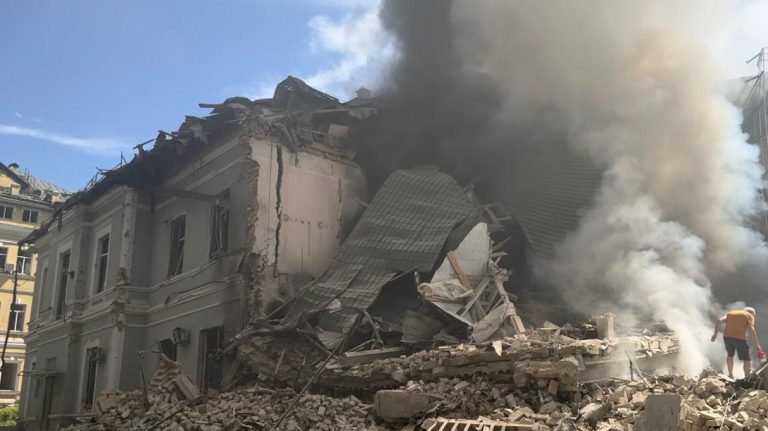
Imagen de la destrucción de un hospital en Ucrania
Ukrainians insist on fighting not only to maintain their territory but for their right to simply exist and be independent. This is why they cannot simply lower the flag, concede, and hand over the Donbas to Putin. However, without assistance, they will not be able to sustain their struggle.
I write these lines from Kyiv, on the 945th day of the war, amid air raid alarms for the third consecutive day across various regions of the country, including the capital, with missiles and drones. I am participating in a visit organized by international institutions and the Ukrainian Foreign Ministry for analysts from the so-called “Global South.” The purpose is to witness firsthand the consequences of the war, which began on a large scale in February 2022, preceded by the annexation of Crimea in 2014.
It is the end of the European summer. The long journey by land from Poland (the only way to reach Ukraine) gradually reveals a country of vast expanse, rich in natural resources, culturally and aesthetically appealing. A country of abundance, symbolized by its wheat fields, yet overshadowed by the cloud of annihilation.
In recent days, Russia launches every week 30 missiles, 400 drones, and 900 highly destructive “gliding” bombs over Ukraine, causing fatalities, injuries, and extensive material damage. Yet, nearly three years into the Russian invasion, if we set aside the diplomatic efforts of the government, the atrocities that continue to occur daily in Ukraine are no longer news, despite the brutal continuation of the war.
A couple of months ago, for instance, Putin bombed the largest children’s hospital in all of Ukraine at 10 a.m. on a Monday. A particularly heinous war crime, where the damage caused is indescribable. But the world is no longer aware.
This week, a prolonged air attack with drones and missiles caused fatalities, injuries, and damage to homes and critical infrastructure in several regions of the country: Odesa, Kharkiv, Kherson, Zaporizhia, Sumy, and Kyiv, the capital. The focus on incapacitating infrastructure across Ukraine is to ensure that much of the country lacks heating and electricity—a form of torture for the Ukrainian people, compounded by the psychological torture of a recent Russian threat regarding the use of nuclear weapons.
Time, however, has begun to normalize the horror even for Ukrainians. They are so exhausted from living among sirens, fires, blackouts, explosions, and gunfire, and so tired of panicked escapes to bomb shelters and forced relocations that ultimately do not keep them safe, that today many decide not to seek shelter when an attack is announced (“if a missile comes, I prefer to die in my home”).
Meanwhile, in rural areas, children aged 10 and older have learned to dig trenches or make homemade Molotov cocktails as part of the collective effort to defend the country against an enemy that could fight indefinitely, simply due to numerical superiority.
It is true that during the first stage of the war, Russia’s crimes in Ukraine were witnessed by the entire world. Bucha and its streets strewn with hundreds of corpses, from infants to the elderly, murdered in cold blood. Mariupol devastated to its foundations, its theater bombed despite being a shelter for children, and its dying mothers-to-be desperately trying to give birth in a besieged maternity ward.
Irpin and its desperate hordes fleeing on foot through the snow and across cut bridges, with only the clothes on their backs and pets in their arms. Borodianka, a bedroom community of the capital, where densely populated buildings were systematically bombed, and then tanks were sent to finish off the survivors.
These names are just a few of the many sites that have already entered the history of crimes against humanity, as part of a deliberate plan of imperial expansion through the extermination of Ukraine: because what Russia seeks is not to “protect the Russian language,” “promote a multipolar world,” “defend values” different from Western ones, nor merely to forcibly seize the territory of another country.
The sites where unimaginable atrocities were committed still show evidence: mass graves containing mass murders, agricultural lands filled with landmines causing multiple amputations, concentration camps where the local population was subjected to torture and all kinds of abuses, the forced deportation and kidnapping of thousands of children.
All of this, apart from the damage to civilian targets such as hospitals, schools, universities, cultural heritage, silos, and critical infrastructure, in order to turn hunger, thirst, and floods into weapons of mass destruction.
Thus, Ukrainians do not insist on fighting merely to maintain their territory but for their right to simply exist and be independent. This is why they cannot simply lower the flag, concede, and hand over the Donbas to Putin. However, without assistance, they will not be able to sustain their struggle.
What is their strategy? And why should this matter to us in Latin America?
We will address these questions in a forthcoming column.