Chile's Foreign Policy: Strategists or Diplomats
This article was translated automatically and may contain differences from the original. For reference, read the original.
El Mostrador, October 8, 2021
Foreign policy is, of course, a specialized and complex public policy, but it must still be both the “object and subject” of citizen scrutiny, especially from citizens in the “regions” who are directly affected by the outcomes of national diplomacy. To assert otherwise, that our foreign policy is managed by a “diplomacy 007” (with a “license to kill”), is merely a simple “expression of desire.” This is, of course, also applicable to “contract” officials, “advisors,” and those “directors” of the Foreign Ministry selected “through competition.” All of them—including professional and political ambassadors—must be subject to citizen scrutiny. A long list of pending and significant issues for the “Chilean people” (in the sense of the Yungay Anthem) supports this.
Despite its limitations and inconveniences, the establishment of Regional Governments marked the beginning of a decentralization process aimed at strengthening citizen participation in state decision-making. It is noteworthy that “regionalization” began to occur in parallel with a constitutional process that is inherently opposed to centralism, suggesting that together, both processes will democratize not only decision-making but also the formulation of priorities for all public policies. In all areas of public policy, prioritization and decision-making will gradually shift from the central government (currently almost omnipotent) to regional and local communities (municipalities).
For years, civil society organizations (for example, the “Decentralized Chile Foundation”) have provided successive governments and generations of parliamentarians with studies and proposals aimed at “illuminating” this decentralization process in order to orderly strengthen citizen participation in issues that directly affect them, such as the sensitive matter of territorial management.
In this last area, the defense of the integrity of regional territories must be included, which has so far been the exclusive privilege of the Foreign Ministry and its foreign policy.
This is a chapter of state management that to date allows for little “accountability,” an unthinkable issue in a progressively decentralized and participatory country. To claim that for citizens in the regions, local issues are “unintelligible” (a “hidden science only for the initiated”), and should remain outside of citizen scrutiny is, today, not only inconceivable but also unacceptable.
In the current context, it is evident that certain “local issues” cannot continue to be the exclusive privilege of little-known and “immovable” public officials, regardless of the impact their performances have on the country’s best interests.
In an increasingly participatory Chile, this is—obviously—unthinkable.
Foreign policy is, of course, a specialized and complex public policy, but it must still be both the “object and subject” of citizen scrutiny, especially from citizens in the “regions” who are directly affected by the outcomes of national diplomacy. To assert otherwise, that our foreign policy is managed by a “diplomacy 007” (with a “license to kill”), is merely a simple “expression of desire.” This is, of course, also applicable to “contract” officials, “advisors,” and those “directors” of the Foreign Ministry selected “through competition.”
All of them—including professional and political ambassadors—must be subject to citizen scrutiny. A long list of pending and significant issues for the “Chilean people” (in the sense of the Yungay Anthem) supports this.
This is the case of the abusive extraction of water resources that Peru conducts, which are shared with Chile but have not been addressed by either the central government or the Foreign Ministry, despite being reported in the press by Aymara communities. It is the same circumstance as in 1975, when the military government offered to cede Bolivia a corridor of thousands of square kilometers in that same region, or the ruling of the International Court of Justice in 2014, which involved the loss of thousands of square kilometers of maritime territory in Arica.
Nor have the Atacameño communities been consulted regarding the piping of the Silala River and the San Pedro de Inacaliri River (for mining purposes), both vital for the grazing and agriculture of our indigenous peoples in the Antofagasta highlands. A humanitarian disaster in the eyes of our “progressive diplomacy,” which is quick to participate in forums, meetings, and international declarations that protect the rights of indigenous peoples. A trip to a “summit” in New York is much more glamorous than a field visit to the Ojos de San Pedro, inland from Calama.
Further south, in the Huasco Valley, only the insistence of some civil society organizations managed to halt the Pascua Lama mining project, the “crown jewel of the mining treaty” signed with Argentina in 1997. A diplomacy serving the profits of multinationals and unaccustomed to dirt roads with gravel and dust included.
The same absence of foreign policy occurs in La Araucanía and the adjacent regions, captured by drug trafficking and cross-border violence from organized groups on both sides of the border, under the same ideological label of “waging an ancestral struggle” on behalf of the Mapuche people (also affected by violence and state passivity). The same violence is being waged in the Argentine provinces of Río Negro, Neuquén, and Chubut, under the same ideological format, but, as the song says, “citizen diplomacy” prefers “not to talk about certain things.”
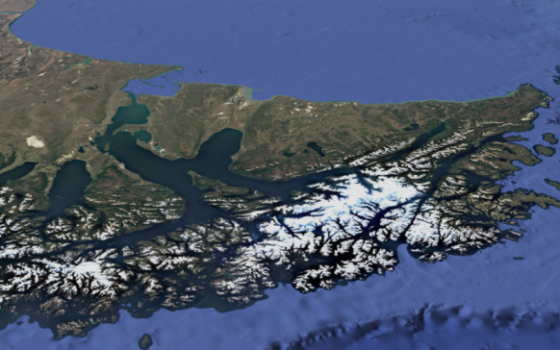
The case of the Southern Patagonian Ice Field constitutes another emblematic example of the failure of an abstract foreign policy, a privilege of a group of “experts” who, at the expense of public funds, have been tasked with “defending” Chile. Along with the unfortunate case of Laguna del Desierto (subject to the jurisdiction of an arbitration tribunal with questionable competencies), the inclusion of the issue of the Southern Ice Field (a matter resolved between 1898 and 1902) among the “pending” issues with Argentina illustrates, in the most dramatic way possible, the incompetence of traditional Chilean diplomacy (incapable of understanding geographical issues distinct from those of a technical-legal nature).
It is this incompetence that ultimately transformed a matter of “on-the-ground demarcation” into a matter of “pending delimitation” that—in the Argentine thesis—includes numerous geographical errors detrimental to the integrity of Chilean Patagonia. Despite the fierce resistance of a few (led by then-senator Antonio Horvath), to use a phrase from Diego Portales, in 1998 and the following years, a certain interested “weight of the night” managed to impose itself over common sense and the most basic patriotism. This is grave. To date, no one has been identified as “responsible” for this act of “treason to the homeland.”
Ultimately, in this matter, “Chile” accepted to discuss a topic already settled, in which certain “new geographical evidence” from Argentina could end up splitting the national territory in two (6 kilometers of ice in the area of Laguna Escondida, Magallanes Region). Such are the detrimental effects of the errors of an unconsulted, abstract foreign policy operating in “007 mode.”
This is also the case for the underwater territorial integrity of Chile beyond Cape Horn, the Diego Ramírez Islands, and both coasts of Chilean Antarctica (Bellinghausen Sea and Weddell Sea).
Until former Foreign Minister Teodoro Ribera ordered affirmative state action regarding the extension of the continental shelf in the Chilean sector of the Southern Ocean (May 2020), based on technical-legal rather than geographical and political reasons (to “not affect bilateral relations”), the diplomacy of successive governments maintained a contemplative attitude towards the Argentine claim that, by reinstating the so-called “bioceanic principle” (defeated by the 1977 Arbitral Award and the Papal Mediation), unilaterally and without consultation, effectively extended the binational limit beyond what was agreed upon in the Treaty of Peace and Friendship of 1984.
Only the update of the legal continental shelf limits of 200 miles (at the request of the Ministry of Defense and ordered by the President of the Republic) has brought some order to this delicate matter.
Before that, our “professional diplomacy” preferred to sidestep the problem so that, “later on,” “someone” would take charge of the issue.
Thus, prioritizing the continental shelf of Rapa Nui (which, while relevant, is not a priority), that same “diplomacy” (which is not that of the Andrés Bello Academy) was able to claim for years that “we are working for you.” The absence of concrete and affirmative action in the Chilean Southern Ocean has managed— as demonstrated by the recent discussion of the issue in the Argentine Senate—to convince our counterpart that, in this specific matter, “Chile consented.”
Although this is not actually the case, with over 10 years of inactivity, the “007 Chilean diplomacy” has managed to grant Argentina an argument that, while “accessory,” will make it even more difficult to resolve an essentially political and geopolitical problem that, in principle, had been overcome with the Treaty of Peace and Friendship of 1984. Unfortunately, this has not been the case. The absence of prospective analysis of our current foreign policy lies at the roots of this problem that, whether we like it or not, will shape our relationship with Argentina for the remainder of the decade.
As in the case of the loss of thousands of square kilometers in Laguna del Desierto and the maritime boundary with Peru (Arica), in this serious matter, “there are no responsible parties.” Even worse: to demonstrate that in this matter “the right thing has been done” (for years we have claimed from Magallanes that this is not the case), the “current government” has “fulfilled” its duty by confirming the positions of those responsible for both failures. Incredible.
The issue of the Magellanic-Antarctic continental shelf is already a concern for citizens. Any political authority is mistaken if they believe that playing the statu quo can bring political dividends. The general elections in November will demonstrate that new parliamentarians and regional councilors (imbued with a distinctly “regional” agenda) will impose a political dynamic that will impact “traditional diplomatic practice.” This will especially be the case for neighborhood diplomacy, which, in the near future, will necessarily have to consult regional and local communities.
It is not unthinkable to suppose that, under a new Constitution and a new political-administrative division, regional governments may participate in international negotiations on matters that directly affect their communities and territories. It is also not unthinkable to assume that in the future, regional communities will have, through plebiscites or referendums, a say and/or veto power regarding international treaties that, once applied, may impact their territories, communities, and natural resources, both living and non-living.
To overlook this new reality is to attempt to cover the sun with a finger. Traditional Chilean diplomacy has an “expiration date.”
Jorge Guzmán
Associated Researcher, AthenaLab