UNASUR: An Ideological Alliance Without Strategy
This article was translated automatically and may contain differences from the original. For reference, read the original.
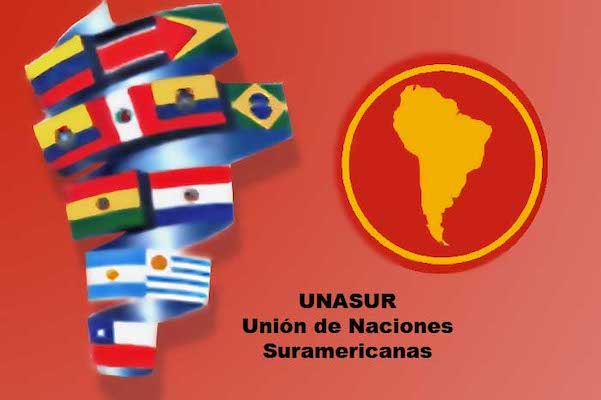
There is no strategic, logical, or common-sense basis for Chile to rejoin UNASUR. We gain nothing and lose a lot. The main countries inviting or enticing us to rejoin have interests in our land, maritime, and Antarctic territories or are competitors of our economy. We must not lose our autonomy and capacity to be free, to make our own decisions.
It should greatly surprise us that voices continue to advocate for Chile’s rejoining UNASUR. We learned nothing from the previous experience where an organization was built on the basis of an ideology and was a resounding failure, a waste of time, a squandering of fiscal resources, and a negative experience. The worst part is that when analyzing the weak arguments in favor of this initiative, we can see that they are disconnected from reality, from the figures, from the data, and from common sense. A reality may not please us, but we cannot ignore it. That attitude can lead us to make catastrophic mistakes.
Let us not be mistaken: UNASUR is a proposal from leftist utopias, aimed at pursuing its own ideological purposes and has nothing to do with the reality or national interests of Chile.
It is true that we are the southernmost country in the world; therefore, everything that bears the name “south” concerns us, but not everything that bears the name “south” benefits us. This is the great contribution of strategic analysis to the decision-making process. The ability to understand our present and the elements that compose it, and to design the best paths to take that present to a desired future that provides the common goods of security, progress, and well-being to our compatriots. Our present clearly indicates where we stand today in our most relevant variables.
Geographically, we are a tricontinental country, with sovereign territory, population, and presence in South America, Polynesia, and Antarctica. Our territory is small compared to that of our neighbors, and we rank 7th in size among South American countries. Our population is also small relative to our neighbors, except in comparison with Bolivia, where we are slightly more populous. Our territory is strategically complex, to the point that we do not have land continuity with the heart of our southern region, only by sea and air. Our economy is small in terms of GDP, but it is strong in terms of per capita income. Its development strategy has allowed us to be one of the countries with the highest number of free trade agreements in the world. This robust and vibrant foreign trade has enabled us to achieve development and growth figures that no South American country, not even those vastly larger in resources, area, and population, has been able to achieve in the last 50 years. Our economic life travels by sea and is primarily linked to Asia and North America. We are vitally dependent on this economic connection with our main trading partners in the Pacific Basin, North America, and the Indian Ocean. Our economic relations with South America do not move the needle and will not do so as long as the majority of South American countries maintain protectionist exchange, monetary, tariff, and customs policies, or compete with us in the export of minerals to the Indo-Pacific, the U.S., and Europe.
Our foreign relations have allowed us to generate a network of free trade agreements that have enabled us to benefit from technology transfer, foreign investment, opening opportunities for our entrepreneurs, and providing our domestic consumers with world-class goods at accessible prices. However, in our regional and especially neighboring environment, our foreign relations have faced and continue to face enormous challenges. Bolivia has elevated its aspiration to access the Pacific sovereignly through Chilean territory to constitutional status. Peru, despite the ruling of the International Court of Justice, has yet to modify its territorial sea declaration in accordance with UNCLOS, of which it is not a signatory, and Argentina, with which we share the longest border, has a long history of tensions and aspirations that clash with Chile’s permanent interests in our seas, internal waters, oceanic passages, continental shelf, and Antarctic sovereignty.
When we conduct a brief strategic analysis of our reality, the figures, facts, data, and common sense dismantle the ideological and utopian narrative. International relations are relations of interests and power. There are no friends or brothers. Ideological naivety comes at a high cost, and we all pay for it as Chileans.
To enter into an alliance, certain simple requirements must be met, such as having common national objectives, narrowing power gaps to achieve goals that we could not reach alone, verifying the status of countries as complementary or competitors with our allies, and, above all, always keeping in mind in the strategic analysis that any alliance involves ceding and losing freedom of action. Just look at the foundations of Great Britain for its BREXIT.
There is no strategic, logical, or common-sense basis for Chile to rejoin UNASUR. We gain nothing and lose a lot. The main countries inviting or enticing us to rejoin have interests in our land, maritime, and Antarctic territories or are competitors of our economy. We must not lose our autonomy and capacity to be free, to make our own decisions. The professionalism of our Foreign Ministry will be put to the test in the upcoming events related to South America, and we will have the opportunity to evaluate whether the defense and achievement of our national interest prevails or if we are seduced by the siren songs of ideologies, samba, and tango.
Richard Kouyoumdjian
Vice President AthenaLab
Source: El Mostrador