Seventy Years Since the Korean Armistice: Judging by the Results
This article was translated automatically and may contain differences from the original. For reference, read the original.
El Mercurio, August 29, 2023
The two Koreas commemorated this week the 70th anniversary of the armistice that suspended hostilities between the sides that faced each other from 1950 to 1953, a war in which the city of Seoul changed hands four times, paying the price with significant destruction. While the North held a lavish military parade showcasing the ballistic missiles with which it threatens its neighbors and other countries, the South chose to solemnly remember the foreign veterans who fought under the United Nations flag.
In addition to highlighting the importance of this friction point in the Indo-Pacific, this anniversary also helps to refocus attention on one of the few natural laboratories the world offers to observe the comparative performance of two political-economic systems divided by the 38th parallel north.
The Koreas are an almost perfect example to see the effects of capitalism and communism on the same people located in the same territory (in fact, the North would have an advantage because it has mineral resources). This is what Acemoglu and Robinson identified, correctly, in their famous “Why Nations Fail,” highlighting the role of inclusive institutions in sustainable development.
While from 1953 Seoul transitioned to liberal democracy and capitalism, becoming a technological marvel and even a pop culture exporter, Pyongyang advanced towards basic heavy industrialization and adopted a national policy called Songun, which places the military at the center of political and economic decisions, and the ideology Juche, which seeks self-sufficiency and independence (read: communism tailored to the Kims).
Over time, the so-called “Miracle on the Han River” has enabled Seoul to seek to project itself as “a global pivot state” from the Indo-Pacific, as stated in the latest strategies of the Yook Suk-yeol government, a former conservative prosecutor who became president in 2022 and has since revived large military exercises with the United States and sought a historic rapprochement with Japan.
This is another point of contrast. The regime of Kim Jong-Un is an international pariah that only interacts with other dictatorships (this week the opening of an embassy in Nicaragua was announced) and has even rejected China’s advice to reform its economy, which survives thanks to trade with Beijing, all kinds of smuggling, bank account hacking, and cryptocurrency movements.
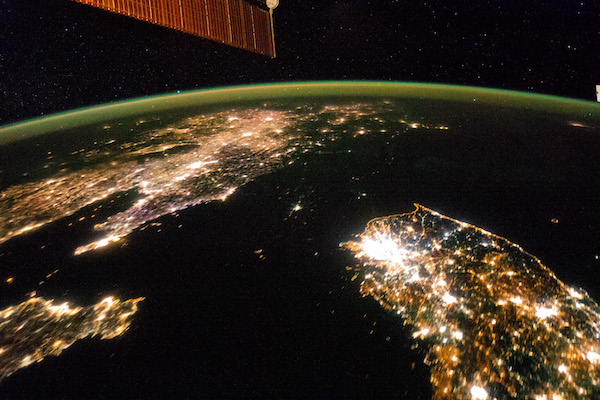
If anyone believes this is an academic debate about political-economic systems, it would be wise to observe a famous satellite image of the Korean peninsula at night, where the North is practically in darkness and the South is illuminated in various points, highlighting the industrial hubs. Perhaps the title of the magnificent novel by South Korean writer Kim Young-ha, “I Have the Right to Destroy Myself,” could summarize the formula adopted by the Kim dynasty. Thus, nothing is clearer than focusing on the results, in light of the confusions of these days. Seventy years is more than a reasonable timeframe for evaluations.
Juan Pablo Toro V.
Executive Director of AthenaLab