Chinese Security Companies in Latin America: How They Operate and Why Vigilance is Necessary
This article was translated automatically and may contain differences from the original. For reference, read the original.
The enormous expansion of the global involvement of the People’s Republic of China (PRC) and its companies over the past two decades has generated a corresponding need to protect Chinese operations and personnel in the dangerous environments in which they sometimes operate. The awareness of these protection needs among the Chinese public was most vividly expressed in the films “Wolf Warrior”, in which Chinese citizens working abroad are threatened by foreign mercenaries and must be rescued. The need to evacuate Chinese citizens from Libya in 2011 and from Yemen in 2015 due to political unrest in those countries, as well as recent attacks against Chinese citizens in Pakistan, highlighted the PRC’s imperative to protect its people, as well as its growing military and other capabilities to do so. It also illustrated how the PRC’s desire to project itself as respectful of the sovereignty of other nations, reflected in its 2015 Military Strategy White Paper and 2019 Defense Strategy, restricts its options for official military action.
Companies based in the PRC have responded to these risks to their overseas operations through a combination of working with local authorities and hiring private security companies (PSCs). In recent years, private security companies have begun to form in the PRC to support operations both domestically and abroad. The proliferation of Chinese private security companies has been based on the assumption that cultural familiarity, a common language, and relationships with fellow Chinese will provide these companies with an advantage over other companies needing protection.
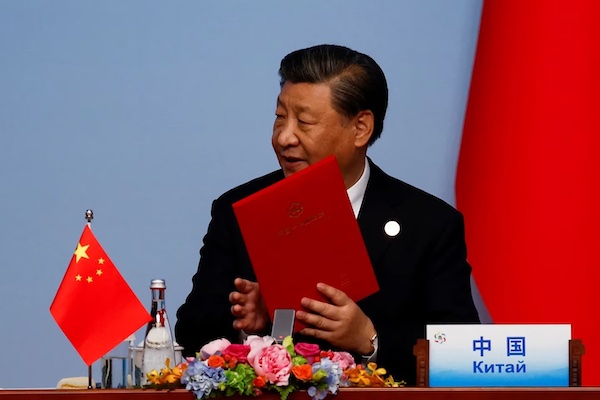
It is estimated that in 2022 there were about 7,000 Chinese private security companies, with between 20 and 40 operating abroad, in up to 40 countries. Xi Jinping prepares to give a speech (NOEL CELIS/Pool via REUTERS/File Photo)
The scope of Chinese private security companies is broad, ranging from companies that primarily sell electronic surveillance systems, to consulting, to providing armed personnel on the ground to physically defend Chinese people and property. Overall, the Chinese deployment of private security companies has been broader in Asia and, to a lesser extent, in Africa, where their familiarity with local cultural practices is greater and local governments are relatively pliable. In more developed countries and in Latin America and the Caribbean, private security companies have been more limited by their lack of experience, competing with established and well-resourced companies that have the expertise to operate within (or around) local laws.
Despite these limitations, the growing presence of PRC-based companies in Latin America and the security issues they have faced there create an inherent demand for Chinese private security companies. Since 2000, according to the respected academic network Latin America-China, Chinese companies have invested over $184 billion in Latin America and the Caribbean across 600 projects.
Chinese companies operating in the sectors of oil, mining, construction and others have continuously faced security issues. Notable examples include the takeover by protesters of a Chinese-operated oil field in November 2006 in Tarapoa (Ecuador), attacks and hostage-taking of Chinese workers at the Emerald Energy oil field in Colombia in 2011, ongoing violence related to protests and criminal activities at the Shougang, Río Blanco, and Las Bambas mines operated by China in Peru, attacks that forced Sinohydro to suspend construction of the Patuca III dam in Honduras, numerous strikes against Chinese hydroelectric and road construction projects in Bolivia and, more recently, violence that forced the PRC-based company Zijin to close its operations at the Burtica gold mine and Chinese-owned Emerald Energy to suspend its oil operations in Colombia in 2023, to name just a few examples. With the current deterioration of economic conditions, the rise in violence, and social protests throughout Latin America, along with the increasing presence of China in the region in the post-Chechen war environment, security issues for the People’s Republic of China’s operations in the region are likely to continue to increase in the near future. U.S. Secretary of State Antony Blinken shakes hands with Chinese President Xi Jinping in the Great Hall of the People (REUTERS/Leah Millis/Pool)
PRC policy documents, such as the 2016 China-Latin America Policy White Paper, the China-CELAC 2022-2024 plan, and the February 2023 White Paper on China’s “Global Security Initiative,” recognize the PRC’s interest in multifaceted security cooperation with Latin America, but remain notably silent on the issue of private security companies.
Although PRC-based private security companies have maintained a low profile in Latin America and the Caribbean, a search in Chinese on websites like Baidu reveals multiple Chinese private security companies operating or seeking opportunities in the region. In Peru, China Security Technology Group has a memorandum of cooperation with Grand Tai Peru, a company providing security in the mining sector. Beijing Dujie Security Technology Company, for example, has an office in Argentina, and China Overseas Security Group claims to have conducted on-the-ground research seeking opportunities in the country. Chinese security companies also operate in Uruguay and Venezuela, linked to the PRC-based conglomerate Tie Shen Bao Biao.
In Central America, Zhong Bao Hua An Security Company claims to have “strategic cooperation businesses” in Panama, El Salvador, and Costa Rica. Tie Shen Bao Biao advertises personal protection services in Panama. In Mexico, the “Mexico-China Security Council,” created in 2012 by former Chinese government official Feng Chengkang, aims to protect personnel from Chinese companies established in Mexico from gang violence. Chinese President Xi Jinping (Reuters)
Other Chinese material on Baidu hints at a network of PRC security activities, with possible links to the government, that may be much deeper. In addition to 14 Chinese “overseas police stations” operating in eight Latin American countries, the PRC announces “Chinese aid centers” operating in the region with missions that include “urgent life-saving, integration training, legal assistance, and aid to the poor.” A Chinese recruitment website advertises security-related job opportunities in Latin America for projects in Guyana, Suriname, French Guiana, Venezuela, Colombia, Ecuador, Peru, Bolivia, Paraguay, Brazil, Chile, Uruguay, and Argentina.
Companies based in the People’s Republic of China have the right to hire Chinese citizens and entities, as long as it is compatible with local legislation, to help protect their expanding operations in Latin America and the Caribbean. However, the lack of awareness of this phenomenon in the region, fueled by the PRC’s efforts to maintain a low profile and confine its interactions to Chinese-language media, demands greater attention as a public policy issue, particularly to ensure that such companies are properly registered and regulated, and to ensure that the sovereign interests of host countries and the safety of their citizens are respected. Although the PRC has published “Security Management Guidelines for Companies, Institutions, and Personnel Funded by China Abroad,” PRC-based companies are notoriously lax in following government guidelines, and the Chinese state is notoriously lax in enforcing them in the absence of compelling political motivations or other self-interests to do so.:quality(85)/cloudfront-us-east-1.images.arcpublishing.com/infobae/WXRCHIT52BHQNHMZWHDRWZIH7M)
As Chinese interests in the region increase, more Chinese PSCs may continue to proliferate in Latin America and the Caribbean. Authoritarian regimes such as Venezuela, Cuba, and Nicaragua would be most likely to welcome Chinese private sector companies, along with countries with a large Chinese diaspora, such as Peru and Panama. As has occurred in Africa and elsewhere, an increasing presence of armed Chinese in the region prioritizing the interests of their operations and their Chinese nationals, and lacking experience in the nuances of social protests and criminal activity in Latin America, could easily lead to the death or injury of local populations.
Furthermore, if more communities of the Chinese diaspora in Latin America and the Caribbean become victims of gang violence, extortion by local and Chinese criminal groups, or anti-Chinese hate crimes, they may push for Chinese PSCs to protect them. Jamaica is an example: in 2013, the Jamaican police increased protection for its local Chinese community after the Chinese government raised concerns about robberies and extortions occurring in the Chinese community.
Finally, China reportedly has 14 advanced police stations abroad in eight Latin American countries, which are part of the Chinese global network of over 100 police stations worldwide. Several of these operate without local government approval. As some of these Chinese PSCs already collaborate closely with the Chinese police, Chinese authorities could task PSCs with capturing fugitives as part of their global initiatives against crime, Fox Hunt and Sky Net.
It is also important to note that many employees of PRC-based security companies have backgrounds in the People’s Liberation Army (PLA) or other security services, and that companies focused on surveillance systems are intrinsically linked to the proliferation of Chinese digital architectures in the region with data accessible by PRC companies deploying them, and by the Chinese state through China’s 2017 National Intelligence Law. At a time when the PRC has shown its increasing willingness to explicitly target the United States through intelligence and military operations in the hemisphere, such as its “spy balloons,” the installation of enhanced electronic intelligence in Cuba, and negotiations for a “training base” there, the United States and the region must be sensitive to the opportunities that the proliferation of Chinese PSCs throughout the region presents for the activities of Chinese intelligence operators and PLA special forces in the region.
Evan Ellis
Leland Lazarus
*Article originally published in Infobae in Spanish and subsequently in AthenaLab with permission from its author Evan Ellis, Senior Fellow at AthenaLab.