Use of Force and States of Exception
This article was translated automatically and may contain differences from the original. For reference, read the original.
La Tercera, August 11, 2023
A preliminary approach to the rules of the use of force (RUF) requires us to initially define what is meant by a Constitutional State of Exception (EEC). This norm is issued by the sovereign; in this case, the President of the Republic. This exceptional measure does not constitute any unusual prerogative or an emergency public security measure. The exception implies the suspension of the legal order due to the natural demands of the state’s self-preservation, with the aim of promptly returning to a state of normalcy.
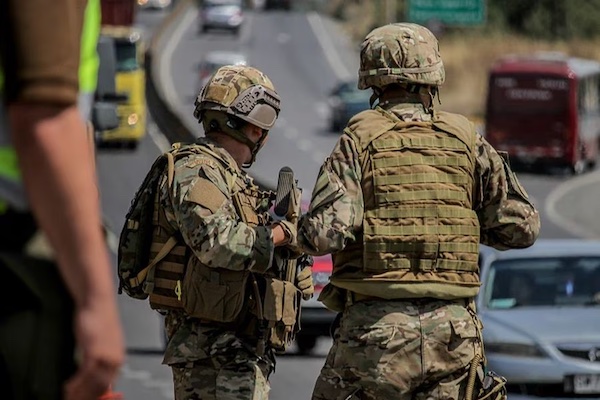
In this exceptional situation, the Armed Forces are called upon to participate extraordinarily in internal security in situations that require “exceptional efforts” to respond to “particular security situations” and thus maintain the Rule of Law. This means that the threshold for the use of force is additionally altered, as is the legal threshold for those mandated by the state to fulfill this exceptional and specific situation, since both authorities and police forces have been overwhelmed in their capacity to impose order. Therefore, they should never undertake such a particular mission without the appropriate exceptional legal backing, nor should it be overlooked that the use of military force—when police force is overwhelmed in a state of normalcy—is executed precisely with its own means and capabilities. It is not about acting as police, since if that were the problem, the evident solution would be to have a greater number of police personnel, and there would be no difference from the situation of normalcy.
The above does not imply that these forces act outside of criteria framed by principles that limit and organize their use to comply with international legal norms, protecting individual rights and preventing abuses of power in safeguarding citizens. However, the baseline for their employment should always be—in accordance with international standards—that they never compromise the legitimate right to self-defense, both of police and military bodies, when aggression threatens the physical integrity or life of a military member, their peers—while fulfilling the mission—and innocent civilians. In other words, their individual right to legitimate defense can never be sacrificed. This is regulated—among other sources, for the use of firearms in police actions—by norms issued by the United Nations General Assembly No. 34/169, dated December 17, 1979, and by agreement of the 8th United Nations Congress on Crime Prevention, signed in September 1990. In International Peace Operations, the UN has always upheld the right to legitimate defense for military forces, even authorizing the lethal use of firearms in response to hostile acts in higher-risk operations.
The implicit danger of neglecting such a situation is that no member will want to fulfill a mission that does not align “responsibilities” with the corresponding “authorities,” resulting in a practical lack of commitment to addressing the primary mission received from the political level.
Additionally, the Armed Forces do not constitute and should not be considered as a broad-spectrum “antibiotic.” Their use must be particularly considered in the context of a diagnosis of the nature of the security problem to be faced. The Rule of Law is primarily defended through the rule of law and well-dosed force.
John Griffiths
Head of Studies at AthenaLab
Source: La Tercera