The Maritime Impact of the Middle Eastern Conflict on Chile
This article was translated automatically and may contain differences from the original. For reference, read the original.
El Líbero, January 17, 2024
For now, Chile will see the situation in the Red Sea reflected in the cost of maritime freight, navigation times, and more complex logistics.
Regardless of how the President of the Republic and the Foreign Ministry handle the situation in Gaza, where they have clearly taken a side, as is evident in the column published in this outlet by José Rodríguez Elizondo , on January 15, which I recommend reading, what is happening in the Middle East has clear impacts for Chile and countries that are open to global trade.
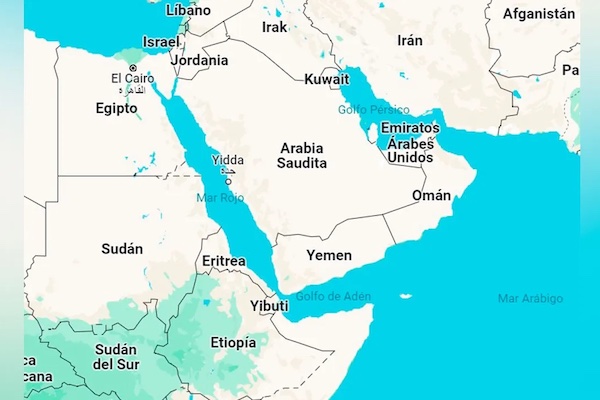
As is publicly known, the Houthis, a terrorist group politically and religiously aligned with Iran, which controls a large part of Yemen, have been attacking with drones and missiles the vessels navigating the Red Sea, which is already impacting freight and insurance costs, or directly causing certain shipping companies to decide not to use the route that first crosses the Suez Canal and then the Red Sea, exiting through the Gulf of Aden.
The aforementioned route was developed by the British and French in the 19th century to avoid having to go around the Cape of Good Hope and the Cape Point located in South Africa. The new route resulted in significant cost savings, but mainly in navigation times, something highly valued in an era when air transport did not exist.
The drones and missiles of the Houthis, or the acts of piracy carried out from Somalia, are disabling the Suez Canal route and eliminating the benefits that have been provided for over 150 years. Just as the Russian invasion of Ukraine impacted grain prices, triggering the economic crisis of 2022, problems in the Red Sea can affect global maritime transport costs, which only recovered in 2023 from the issues experienced during the COVID years.
Given the importance of maritime communication lines for global trade and the impact that the Red Sea problem is having on prices, times, and logistics, the United States and its closest ally, the United Kingdom, have taken the bull by the horns and have deployed naval and air forces in the area to maintain the flow through the Red Sea, eliminating the military capabilities of those seeking to disrupt maritime traffic or engage in acts of piracy.
The Houthis act on behalf of Iran, as do others who are also stirring the pot. Except for Egypt and Saudi Arabia, all other countries located in the Red Sea and the Horn of Africa are failed states, a situation that Iran exploits and uses to its advantage, managing to buy mercenary forces in countries like Somalia, Ethiopia, Sudan, and Yemen, where its allies, the Houthis, are also located.
The question that arises is why the United States and the United Kingdom do not take more severe actions against Iran, and the answer is that they do not want the conflict that started in Gaza to escalate and spiral out of control. For now, it is sufficient to seek to eliminate the capabilities of those acting on behalf of Iran and trying to stop the flow of vessels using the Red Sea and the Suez Canal.
The above might not be so serious if other global issues affecting maritime traffic were not occurring. Therefore, I refer to the drought impacting the Panama Canal, a canal that requires rain to maintain the necessary water levels for its operation. With less water, the tonnage of vessels that can use it is limited, resulting in the obvious impact on costs and times.
The situation in Panama, if it persists, could eventually mean a return to more intensive use of the Strait of Magellan, which would require Chile to be prepared to meet the needs of more intense maritime traffic, such as the services required by vessels to navigate through inland waters and the logistics that may be needed.
For now, the situation in the Red Sea will be reflected in the cost of maritime freight, navigation times, and more complex logistics for Chile, something that affects not only us but all countries open to global trade and dependent on the sea for their exports and imports, which in our case exceed 90%.
The situation described in this column is of such importance that it garnered headlines last week in The Economist and other major international and local media. All highlight the importance of maritime routes for international trade and the need to keep them open and operational. Otherwise, the world comes to a standstill.
Chile particularly depends on the Strait of Malacca, the Panama Canal, and the Strait of Magellan. We are a country open to the world that cares about the system functioning, but we cannot expect only the navies of the United States and the United Kingdom to do the work.
This is why we participate in operations like RIMPAC, an exercise aimed at generating naval forces to keep the Pacific Ocean open and stable, we develop capabilities to operate with NATO and Indo-Pacific navies, and given the current problems, in addition to keeping the Strait of Magellan 100% operational, we should send ships from our fleet to participate in efforts being made in the Middle East, and if necessary, to remote places like the South China Sea, the Strait of Malacca, or the Panama Canal. The primary role of navies is to keep open and operational the maritime communication lines that allow global trade to function.
In conclusion, we should not only be concerned about what the President of the Republic does in terms of Foreign Relations, but more importantly, we must understand that what happens in an interconnected maritime system affects us, and therefore, we must be part of the efforts to ensure it remains operational.
Richard Kouyoumdjian
Vice President of AthenaLab
Source: El Líbero