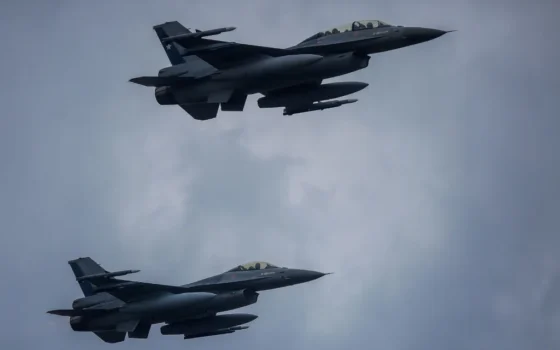
Analysis of Iran's Attack on Israel and Its Consequences
This article was translated automatically and may contain differences from the original. For reference, read the original.
El Líbero, April 17, 2024
The days of the 1967 war, when Israel was able to manage multiple fronts and emerge victorious, are long gone. Today, it must act much more strategically, choose its battles, and make the corresponding decisions.
Night had already fallen in Santiago on Saturday, April 13, 2024, when news arrived that the announced Iranian attack using aerial and space means against Israel was underway. Obviously, such news causes anxiety everywhere, not just in Israel and the Middle Eastern countries. The fear of a widespread conflict in that part of the world and the possibility of it extending beyond has been in the air since dawn on October 7, the day Hamas unleashed its fury on the inhabitants of the state that Jews created in 1948 to ensure their safety from the persecutions they had suffered and the horrors of World War II.
To the relief of many, the attack was materially ineffective, causing only insignificant damage to Israeli physical infrastructure, which immediately alleviated the pressure regarding possible reprisals from Israel or its allies, allowing Benjamin Netanyahu’s government and his war cabinet to assess their options with greater calm and a clear evaluation of what had occurred, keeping in mind the reactions of their constituents and the international community.
The first and most obvious thing to understand in a conflict between Israel and Iran is that the two countries are not neighbors; therefore, to travel from Tehran to Jerusalem, one must pass through Iraq and Syria, or through Iraq, Saudi Arabia, and Jordan, or finally through Iraq and Jordan. This applies to both land and aerial attacks, whether using drones, cruise missiles, or air-to-ground attack aviation. There is also the option of deploying naval assets from the Persian Gulf to the Red Sea to attack from the south with missiles launched from surface ships or submarines, but it is believed that this option is currently unavailable, though it may be in the future as the most modern platforms capable of launching cruise missiles are located in the Caspian Sea.
There is also the possibility of attacking using ballistic missiles, which, due to their trajectory and depending on the distance to be covered, rise high enough to exit the Earth’s atmosphere, making them ideal for striking distant targets without encountering issues with the countries they must pass over or fly above.
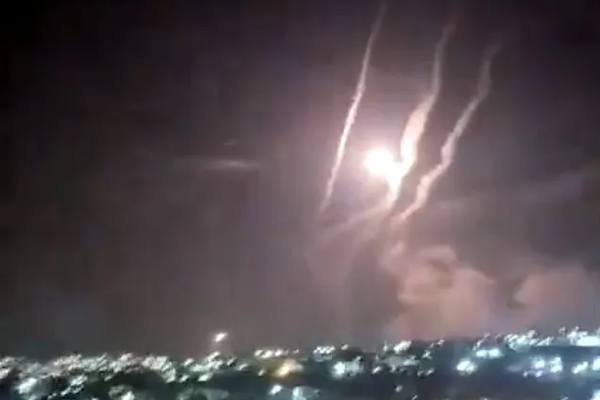
Iran attacked using a combination of means, launching them in such a way that they ideally arrived simultaneously. It is reported that the mix included 170 kamikaze drones (the type that are launched to not return), 120 ballistic missiles, and 30 cruise missiles. Of all of them, only 5 ballistic missiles are said to have impacted Israeli territory or the vicinity of an airbase where Israel’s F-35s operate.
The Israel Defense Forces (IDF) indicate that all drones and cruise missiles were intercepted before entering Israeli airspace, and as mentioned earlier, only 5 of the 120 ballistic missiles launched reached the ground, with several failing to launch or being destroyed in flight. More details on how this was achieved will be forthcoming. What has been reported is not 100% accurate, but it is known to be the result of joint efforts from the United States, the United Kingdom, Jordan, Saudi Arabia, France, and possibly others. It is said that the Russians provided information in a clear example of a multinational effort to thwart an attack, including the Iranians themselves, who executed it in such a way that it was ineffective despite claiming at home that it had been a success.
The most difficult to intercept are ballistic missiles. In that region, only the Americans and Israelis have the technological capability to do so. The British and French could have also assisted, but I do not believe they had available means in the area with such capabilities. In that sense, if Iran were to attempt another similar attack, it would need to increase the mix of ballistic missiles and potentially, if they have them, hypersonic cruise missiles.
Many are surprised by the support from Saudi Arabia and Jordan, but there is nothing unusual about that. To begin with, these are countries over which many of these devices flew and that could have eventually impacted them rather than their intended targets. Iran launched them mostly from its own territory, which, as mentioned in one of the earlier paragraphs, involves flying over several countries that must not have been pleased, or from facilities of the Houthis in Yemen. It is known that Jordanian pilots shot down several, and the Saudis requested permission to join the hunt for the drones and missiles.
The greatest challenge fell on the Israeli air traffic controllers who had to deal with the problem and manage what was happening in the air. It was very easy for errors or miscoordination to occur. Experts indicate that coordination among the air traffic controls of Israel, Jordan, Lebanon, and Syria has existed for some time, but executing it during a massive and simultaneous attack, achieving nearly 99% effectiveness, is another matter.
Some claim that the success was due to the Iron Dome. Those who say that did so before having the data at hand. The Dome handled it easily, much more easily than on October 7 when it was stressed by an attack of approximately 2,200 rockets launched from Gaza at close range. On this occasion, it was rather other Israeli or allied air defense or anti-missile systems that did most of the work, without needing to employ all available Israeli capabilities.
One of the lessons drawn from the event of April 13 is that the technologies of Israel and the countries that assist them are superior compared to those of Iran and Russia. That said, Israel has always had an excess of confidence in its technological capabilities, which can lead to mistakes. This was evident in their overreliance on their protection/separation wall from Gaza and not complementing their defensive capabilities with intelligence from human sources.
The second and very obvious point is that Iran has more enemies than Israel. Not only are there those who do not love them in the West, such as the United States, the United Kingdom, and France, but more importantly, Jordan and Saudi Arabia. The Arab proverb holds true here: the enemy of my enemy is my friend. This only applies to Iran’s interests, as they are Muslims but not Arabs. They are Persians and Shiites, not Sunnis like the Saudis and Jordanians.
The April 1 attack by Israeli F-35s on what was supposed to be a building that allegedly housed Iranian diplomatic facilities in Syria is more than justified. It was a barracks of the Revolutionary Guard that manages the resources used to operate outside of Iran to attack Israel or U.S. assets in the region. By destroying those facilities and killing those inside, they significantly reduce the capabilities of Hezbollah and others that threaten Israel from Lebanon or Syria, or the support they provided to Hamas from that part of the Levant.
Iran is one of several that exploit diplomatic facades to hide resources and facilities that serve other purposes. Therefore, it is difficult to understand, having deceived the system, why they would react with an attack like the one carried out on October 13. Clearly, there is a motivation of Iranian internal politics, but there is also the risk that things could spiral out of control and the conflict could land in the streets of Tehran. I mention this because so far it has been very effective for them to attack Israel through their agents like Hezbollah, who avoid having to confront Israel directly and do not want to see the Persians dominating the region. Perhaps it is time for them to study strategy with Sun Tzu.
It is clear that Iran is Israel’s greatest enemy, but that does not mean they must confront each other directly. It is much more effective for Iran to exert pressure on Israel through the militias loyal to them in Syria, Hezbollah, Houthis, Hamas, and others, than to engage in direct confrontation, which, moreover, is not so obvious and is limited to what can be done through aerial and space means, whether launched from land or sea, or beneath the sea.
On the other hand, Israel is not going to seek confrontation with Iran now; it will do so in its own time and only to eliminate the possibility of Iran becoming a nuclear power, which includes more advanced generation ballistic missiles. For now, it must finish the job it is doing in Gaza properly. It must do so while considering the humanitarian reality in that area. This war does not need more deaths, and I make that very clear. More deaths only serve Hamas’s interests and work against Israel’s national interest. If they do not manage the issue of humanitarian aid well in conjunction with the clearance of southern Gaza, international support will evaporate, and these are not times to be alone on the planet.
Israel must remain attentive to what is happening in Egypt and in the West Bank. In the former case, everything that has occurred recently has not been neutral on its southern border, and along with the political changes happening in the area, it could imply that a front that has been calm for 45 years since the Camp David Accords could become agitated again. On the other hand, the West Bank is on the verge of exploding. Israel does not have the political or military capacity to manage another front like Gaza, which also puts its relationship with Jordan at risk, as Jordan does not want noise or problems and does not want Palestinians or to import conflicts.
The days of the 1967 war, when Israel was able to manage multiple fronts and emerge victorious, are long gone. That was a time when its adversaries were not up to par and could be easily defeated. Today, it must act much more strategically, choose its battles, and make the corresponding decisions. The strategic scenario is more akin to the reality of the Yom Kippur War than to the earlier wars in which it always emerged victorious.
Richard Kouyoumdjian
Vice President, AthenaLab
Source: El Líbero