What does the cruel murder of the three Carabineros in the Southern Macrozone tell us?
This article was translated automatically and may contain differences from the original. For reference, read the original.
El Líbero, May 1, 2024
Eliminating the insurgency requires a joint action from the State of Chile, but with a greater emphasis on military solutions for neutralization or elimination, which are very different from those we have known so far.
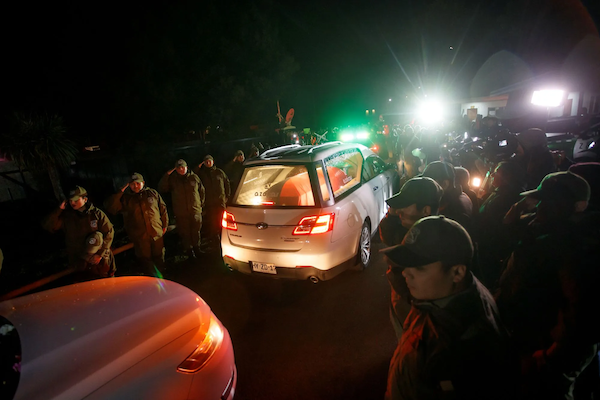
First and foremost, we must pay tribute to the three latest martyrs of Carabineros de Chile. I hope that the sacrifice of the sub-officers Cisterna, Arévalo, and Vidal was not in vain, that something is learned, as Carabineros are not in surplus in Chile, and that we can tell their families that their deaths marked a turning point in the Southern Macrozone, and that the future will be better for those who live in that area, for the people whom Cisterna, Arévalo, and Vidal protected daily as part of their oath to Carabineros de Chile.
I write this column at noon on Tuesday, April 30. It may still be quite early to draw some conclusions and, therefore, to indicate what is right or wrong, but we will take the risk since there is no room for further mistakes and action must be taken soon, as demanded by the people of Chile.
Just last week at Enade, the Minister of the Interior and Public Security presented indicators from the Southern Macrozone. She was pleased as the numbers were better. There were no deaths in 2023. The improved figures were attributed to the state of emergency, the presence of the Armed Forces, the actions of the Public Ministry, but above all, to the fact that Llaitul was imprisoned, which consequently reduced the activity of the Arauco Malleco Coordinator (CAM).
Unfortunately, the minister’s joy, along with that of the Undersecretary of the Interior and the government in general, lasted less than 48 hours. In the early hours of April 27, the murder of the three Carabineros shattered the statistics of deaths per 100,000 that had been published in the media, and it also demonstrated to her that she was mistaken regarding the state of that region of Chile, and that the strategy they were following had failed spectacularly.
It is very possible that the death of the three Carabineros is partly due to the government having relaxed its stance. The figures looked better, so it was no longer necessary for the police to circulate with protection from the marines. Many thought they could return to previous times, and some even spoke of ending the state of emergency.
The main problem with the strategy followed by the government in La Araucanía is that it is based on an incorrect diagnosis. This is not just my assessment, but that of most security and defense experts. This government and the previous one have insisted that the problem is of a criminal nature, and therefore the solutions lie with the police and the Public Ministry.
Both the Piñera 2 government and the current one, until very recently, spoke of rural violence or crime. Tentatively, before April 27, they mentioned some cases of terrorism, but it was something they struggled to acknowledge, as if it were against their nature to recognize that what exists in that area could be a more complex ailment that might require a harsher treatment, rather than simply one aimed at cooling tensions.
In the provinces of Biobío, Arauco, and Malleco, we have the active presence of insurgent groups of Mapuche origin. Subversive activity is also present, but to a lesser extent, in the provinces of Cautín and Valdivia.
Sometimes what insurgents do resembles crime, rural violence, or terrorism, but that does not mean they become criminals, violent actors, or terrorists. One must look at their motivations, as the criminal seeks economic benefits, the terrorist aims to instill fear and gain publicity, and unlike the former, the insurgent seeks territorial control to govern it, to be its sovereign. They will carry out criminal or terrorist actions if necessary for their ends, and will allow theft, drug trafficking, arson, and other harmful practices if it enables them to finance their operations, but worse still, they will extort the inhabitants, charging taxes for leaving them in peace. Terror actions like those of the early hours of Saturday have a purpose.
If we do not understand that we are facing insurgents, we will never eliminate the problem in the Southern Macrozone. Eliminating the insurgency requires a joint action from the State of Chile, but with a greater emphasis on military solutions for neutralization or elimination, which are very different from those we have known so far, accompanied by economic and social actions aimed at improving the conditions of the people living in the affected territories.
For this, a robust and effective intelligence system is required, as we must be able to detect their operational units, the names of their members, the communities that provide them protection and support, and many other things. We must also be capable, on the day we neutralize them, of providing solutions to the problems that allowed the insurgency to arise, meaning that they must be effectively part of the State of Chile and not abandoned territories where the law of the strongest prevails.
The murder of the three Carabineros indeed leaves us with a question due to its violence and cruelty. What we witnessed is more characteristic of organized crime, but that does not preclude the possibility that the insurgency is learning from the bad practices we have seen in other parts of Chile. It would be fatal for organized crime to take on a stronger role in the area, and for them to dominate the territories.
I say this because organized crime is more professional, better equipped, and trained than the Mapuche insurgent movements, which, for our benefit, do not operate in a coordinated manner and lack a leadership that unites and guides them in their struggle.
The necessary military solution, which is accompanied by the actions of the police and the action of the entire State of Chile, is complex but achievable. The Armed Forces have the capabilities to eliminate or neutralize the insurgent movements and the organized crime that operates alongside the subversives. There must be cross-political support, and a prior judicial amnesty for the forces that will have to act. The responsibility for this action lies with the President of the Republic. It is he who must give the order and assume the consequences of acting or not acting. Doing nothing is not an option.
Any deeper action requires a Public Ministry and a judicial system aligned with the action that must be taken. If not, the military and police will not engage in actions where they end up in jail, as could be the case of Marine Corporal Seguel, who is accused of killing Yordan Llempi in November 2021 when the patrol he was part of went to rescue Carabineros who had been ambushed.
What we do know is that more of the same will not work. The government’s strategy announced on Monday, April 29, to deploy more troops and resources will not eliminate the root causes of the problem as it does not address the underlying issues and only seeks to prevent the temperature from rising. The Armed Forces operating in the area do not have the authority to detain or investigate, to seek out insurgents and criminals, which remains the responsibility of the police under the guidance of the Public Ministry.
The solution does not lie in the Rules of Use of Force (RUF), or critical infrastructure, or the Ministry of Security, or the intelligence law. It is enough to indicate that the Armed Forces and the police, when operating in states of exception, or under the figure of critical infrastructure, will be under the regime of military justice and must comply with the orders given to them. The responsibility for the use of the Armed Forces and the police is always a political responsibility. The Armed Forces and the police do not operate independently.
It is time to be effective and to stop playing for a draw. It is time to grant amnesty to the military and police affected by accusations or convictions related to the so-called “social outbreak,” as well as to those who have been unjustly convicted in human rights cases stemming from the military government era. If this government wants to solve the problems of Chileans, it will need more than just pretty words. It will require gestures and actions that protect those who belong to or have belonged to the institutions of National Defense, Carabineros de Chile, and the Investigative Police.
In memory of the SOM of Carabineros de Chile Carlos Cisterna, Sergio Arévalo, and Misael Vidal.
Richard Kouyoumdjian
Vice President AthenaLab
Source: El Líbero