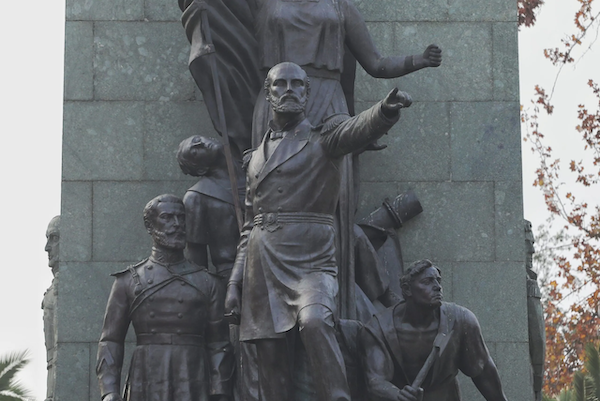
Captain Frigate Don Arturo Prat Chacón
This article was translated automatically and may contain differences from the original. For reference, read the original.
El Líbero, May 15, 2024
Arturo Prat exemplifies military leadership and professionalism. Many of the issues currently occurring in Chile, within its armed forces and police, would not happen if those in command of institutions or leading combat units or police on the ground followed the example of this naval hero.
“In memory of Captain Frigate Arturo Prat and the heroes of the Chilean Navy”
We are in the month of the sea, one week away from May 21, a date when every year we celebrate the day of the naval glories of the Chilean Navy, but above all, we honor the brave and exemplary leadership of Prat, the glorious crew of the Esmeralda, the ingenuity and audacity of Condell, and those who accompanied him in the victory of the skillful Covadonga.
There are many things happening in Chile; the waters are turbulent, and as in other times, we must look back to Prat, who always serves as our inspiration, conveys calm, and with his example shows us the path to follow or how to fix what is not working.
At the age of 10, Prat entered the Naval School, and by 17, he had already seen combat, clearly demonstrating that age is not an impediment to defending Chile or training as a soldier, something also proven by the 77 young heroes of the Concepción.
Prat was not only a distinguished naval officer but also a great lawyer, who defended causes he considered unjust, such as that of his classmate Luis Uribe, who later became his second-in-command on the Esmeralda and went on to become the director general of the Navy.
Prat’s status as a lawyer was not necessarily well regarded by the rest of the naval officers, and there was even a time when it affected the development of his naval career, but he was quite sure of what he was doing, not caring much about public opinion. Ultimately, his merits and abilities were recognized, initially taking on important roles at the beginning of the Pacific War, followed by commands of the Covadonga and the Esmeralda.
For Prat, along with his family, the most important thing was his people, the crews of the ships he served on or commanded. He cared about their well-being and training. He was concerned with being fair, leading by example, and giving clear and precise instructions and orders, all characteristics that were expressed with extreme clarity on May 21, 1879, but which did not appear that day by magic; rather, they were the result of years of training, starting in his parents’ home, then developed at the Naval School, in his naval career, but above all, through his ongoing concern to be a better person and naval officer, chief, and leader, with a strong emphasis on his team, on the crews of the ships.
Arturo Prat exemplifies military leadership and professionalism. Many of the issues currently occurring in Chile, within its armed forces and police, would not happen if those in command of institutions or leading combat units or police on the ground followed the example of this naval hero. I am sure we would have fewer police officers killed, and who knows, perhaps Franco Vargas could be alive, or at least have had a greater chance of survival. It is time to look to Prat or to think about what he would have done when faced with problems or complex situations inherent to the military or police profession.
Prat’s actions also serve as an example for the President of the Republic, his ministers, undersecretaries, members of Congress, judges, and prosecutors. Prat did not get entangled and always understood that it was necessary to concentrate and focus on what is important. At sea, there is no time for entanglements or wasting time on what is not relevant, nor for scoring own goals. The maritime environment is already complex, even more so in combat, where the crew and the ship’s capabilities are what matter.
In present-day Chile, he would tell us to focus on security and the economy. That is what is relevant and what the people demand. There will be time for pension, health, and education reforms, all important issues, but not as critical as the first ones. If we focus on the secondary and not on the primary, we will be defeated and sink to the bottom of the sea.
Prat would not be who he is without the officers and crew he had on the Esmeralda. Many of them had been trained by him, but it was they who allowed him to face a much superior enemy with the confidence and calm that he did. Many of them were also heroes and gave their lives for Chile. The Esmeralda, its commander, and crew knew they were going to sacrifice themselves and did so as indicated by their commander in the immortal rallying cry that says:
“Boys: the contest is unequal, but courage and valor. Until now, no Chilean ship has ever lowered its flag; I hope, therefore, that this will not be the occasion to do so. For my part, I assure you that while I live, such a thing will not happen, and after I am gone, my officers will know how to fulfill their duty” (Version by Vicente Zegers, officer of the Esmeralda).
While the focus on May 21 usually falls on Prat, Carlos Condell—Prat’s classmate and a member of the class of heroes—also deserves recognition. By a decision of the commander-in-chief of the Squadron, Condell left the Abtao and took command of the Covadonga, which was under Prat’s command, and could have been the one to board instead of Prat had he been given the Esmeralda. Condell performed remarkably in command of the Covadonga; his tactical genius and audacity allowed the weak Covadonga to defeat the stronger Peruvian ship, the armored frigate Independencia, in what was a mortal blow to Peru’s naval power, which was definitively ended months later with the capture of the Huáscar at Angamos.
On May 21, 1879, we witnessed what the Chilean Navy is capable of producing. Naval officers who, following the imprint of Cochrane and Blanco, were examples of leadership and professionalism, but also, to be fair, we received a lesson in utmost chivalry from Admiral Miguel Grau, who, despite having fought in combat against Prat’s ship, took care to gather his belongings and send them to Carmela Carvajal along with a letter that says:
“A sacred duty authorizes me to address you, and I deeply feel that this letter, due to the struggles it will commemorate, contributes to increasing the pain that you must justly feel today. In the naval battle of the 21st of this past month that took place in the waters of Iquique, between the Peruvian and Chilean ships, your worthy and valiant husband, Captain Frigate Don Arturo Prat, commander of the ‘Esmeralda,’ as you may already know, was a victim of his reckless bravery in defense and glory of his country’s flag. Sincerely lamenting such an unfortunate event and accompanying you in your mourning, I fulfill the painful and sad duty of sending you the invaluable items that were found in his possession, which are listed in the attached list. They will undoubtedly serve as some consolation in the midst of your misfortune, and for that reason, I have taken the liberty of sending them to you in advance.
Reiterating my condolences, I take this opportunity to offer you my services, considerations, and respects with which I subscribe to you, madam, your very affectionate and assured servant.”
Richard Kouyoumdjian
Vice President AthenaLab
Source: El Líbero