Results in France and the United Kingdom: the Search for the Lost Center
This article was translated automatically and may contain differences from the original. For reference, read the original.
Ex-Ante, July 7, 2024
European liberal democracies are facing challenges that seem familiar to us: inequality, migration, climate crisis, energy transition. If we observe them and see formulas that also sound familiar, we should be concerned about studying the cost these societies have paid: it can be enormous. For a country like Chile, whose engine of development in democracy has been opening up to the world, there are two lessons. Beware of neosovereign populism, whether from the right or the left. And beware of narcissism, which poisons even good political endeavors.
The political fluctuations in Europe deserve careful analysis. The victory of the British Labour Party and the rise of the far right in France—halted in the second round of the legislative elections—warrant a thorough examination if we are to draw any lessons from comparative experience.
The Labour Party has taken a long path: they could have come to power much earlier. It took them 14 years to unseat the Conservatives, despite the fact that the latter did not offer stability, but rather a succession of short-term prime ministers (Cameron, May, Johnson, Truss, Sunak).
On the Tory side, these years were marked by the rise of the extreme right within the party. The cycle began with David Cameron, who frivolously and irresponsibly organized two key referendums: one on Scottish independence, which, if approved, would have fractured the country (Cameron only campaigned for the unity option very late, alerted by polls); and the second, on British membership in the European Union, for which he also did not campaign since it was a non-binding consultation (despite this, Cameron promised to honor the result, not thinking that the option Brexit could win).
An uninformed electorate approved the exit, and a new prime minister, Theresa May, attempted unsuccessfully to negotiate the unexpected disaster. Boris Johnson then convinced the country that it was possible to play it cool in the negotiations, until multiple scandals cost him his position. His successor, Liz Truss, was a total failure: she lasted 45 days in office due to the immediate damage caused by her economic plan.
Ultimately, reality began to impose itself over rhetoric, and the bill began to accumulate. Today, the British have a debt-laden country, where millions skip meals because they cannot afford food, and where both the public and private sectors lack individuals to perform jobs that migrants used to do (doctors, nurses, seasonal workers): for ideological reasons, the last Prime Minister, Rishi Sunak, chose to close the door even to the most essential migration.
For a country whose source of progress has been its openness to the world, radicalized leaders decided to make it distrust the world. The effects of neosovereignism have been poverty, a crisis in public services, disinvestment, and growth that is the lowest since 1826.
How can it be explained that Labour did not take the helm earlier? The answer is: they too became radicalized. For much of this time, their leader was Jeremy Corbyn, an old-school anti-capitalist who was never in favor of integration with the European Union, who promoted the renationalization of public services, and an obligation for large companies to transfer 10% of their capital to employees.
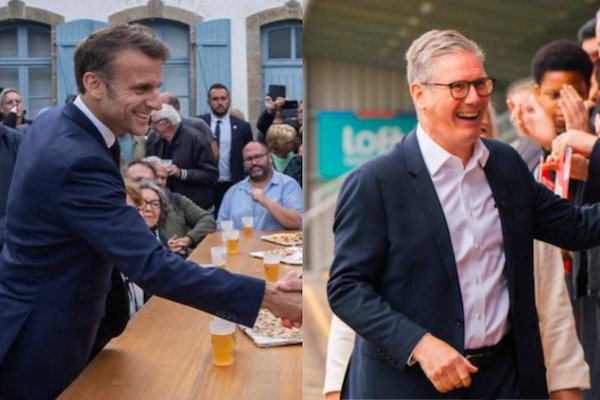
Only in 2020 did Labour seek a path with a majority orientation under the leadership of Keir Starmer, a former prosecutor and human rights lawyer, centrist and pro-European, who, in the face of conservative incompetence, established a little charismatic but credible alternative.
The United Kingdom, then, is coming back from the peak of a populist, anti-globalist, and anti-integration right: it has already experienced its recipe, paying a high price for the experience, and has opted to rebuild the center. How can we understand that its neighbor, France, went in the opposite direction in the European elections?
The Brexit was an unexpected protectionist, anti-system turn that, however, once approved, could have been managed competently. Those countries on the continent that have legitimately chosen not to be EU members maintain a very close relationship with the bloc.
The radicalized Tories, on the other hand, opted for a hard exit, at a very high cost; and this served as a warning to the far right in other countries. This has slowed down and, to some extent, mitigated the radicalization of local electorates, but it has not stopped it (as seen in Italy, where Meloni has moved toward the center, getting much closer to the EU—and in Spain, where Sánchez managed to hold onto his position, while the once calm Popular Party is dominated by the hardliners, as dialogue and civic respect evaporate).
In France, a third of the electorate voted for the far right of Marine Le Pen in the first round of the parliamentary elections. Le Pen, who aspires to win the presidency in 2027, has made an effort to refresh her party with young, stylish, and eloquent individuals; but these changes, in the end, are not credible (until recently, they were about to exit the Euro, the common market—for example, in electricity—and the European Union as such, and now they are not).
The truth is that, behind the marketing, her group remains nationalist, racist, xenophobic, anti-integration, friendly with autocrats and dictators like Putin (Le Pen supported the annexation of Crimea), and distant from traditional center-right, that of Chirac and Sarkozy. Le Pen, yesterday and today, is opposed to essential values of the French Republic such as equality and secularism, and her proximity to power would have effects in the region and globally.
For the mandatory second round, the center and the left promoted tactical voting, thus avoiding the uncomfortable cohabitation between a centrist president and an ultra-right prime minister: Bardella, Le Pen’s protégé, is a 28-year-old without a university degree who promises to challenge presidential authority in foreign policy.
But even after that scenario was avoided, governance will be complex. On the left, from where the likely new prime minister will come, there is a euro-skeptical and anti-capitalist sector. Reaching agreements even on essential matters will be uphill in any case, and the legislature will be deeply divided.
Macron, a former socialist, bears special responsibility in this landscape. Eight years ago, he built, from scratch, a centrist alternative that led him to the presidency in just one year, and to renew his mandate in 2022. But his narcissism, in practice, has led him to nullify any other relevant leadership among his collaborators and to be, in effect, both president and prime minister (the four prime ministers he has had are hardly known outside of France).
His movement has taken on various names, but none stick: in the end, everyone calls it ‘Macronism’: it revolves around him, shares his fate, and the hatred of Macron has become an avalanche. Part of his unpopularity can be explained by the imposition of tough and urgent reforms (such as raising the retirement age), but it is not his agenda but his style that has undermined what he himself built.
Europe is a complex reality, with a supranational institutional framework that makes it even more difficult to extrapolate realities. However, those liberal democracies are facing challenges that seem familiar to us: inequality, migration, climate crisis, energy transition. If we observe them and see formulas that also sound familiar, we should be concerned about studying the cost these societies have paid: it can be enormous.
For a country like Chile, whose engine of development in democracy has been opening up to the world, there are two lessons. Beware of neosovereign populism, whether from the right or the left. And beware of narcissism, which poisons even good political endeavors.
Paz Zárate
Senior Researcher, AthenaLab
Source: Ex-Ante