Public Security According to José Antonio Kast and Martín Arrau
This article was translated automatically and may contain differences from the original. For reference, read the original.
- by Richard Kouyoumdjian
- Opinion

The President explained the state of Chile at the end of May and how things will unfold, a situation that has changed and will not hesitate to use the power of the State to ensure order, security, and respect for the law.
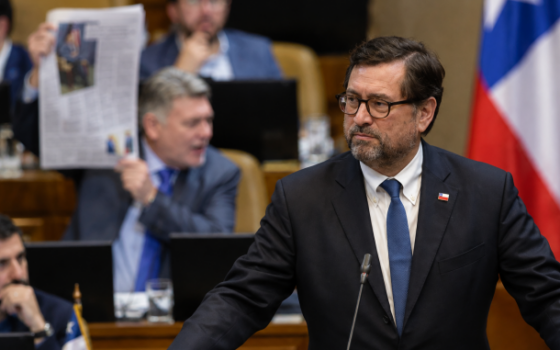
The First Public Account of President Kast was a masterclass in how to communicate necessary information without giving the opposition greater opportunities to complain or attack the government. It was evident that the focus would be on public security and economic emergencies, very much in line with the editorial line of the campaign that brought José Antonio Kast to La Moneda. A somewhat lengthy speech, but it fundamentally addressed and concentrated on the essential issues that most concern Chile.
I would have liked to see discussions on foreign relations, national security, and defense, but Monday was not the time, and their moment will come. The global and regional geopolitical reality demands strategic definitions, as does the concerning budgetary and material reality of the Armed Forces, which are clearly respected by the current administration, but for which they have yet to receive specifics.
The first Public Account has the advantage of being made when there is a better understanding of the reality in which the government was received. It no longer speaks in abstract terms; it speaks with hard data regarding both the poor economic reality and insecurity, as well as the actual capacity of the State to address both issues.
Article 24 of the Constitution of the Republic of Chile establishes that on June 1 of each year, the President of the Republic shall report to the country on the administrative and political state of the Nation before the Full Congress, and that is what the President did. More than just accounting for his first days in office, he explained the state of Chile at the end of May and how things will unfold, a situation that has changed and will not hesitate to use the power of the State to ensure order, security, and respect for the law.. In simple terms, the party is over for criminals and those who do not respect the rule of law that must prevail in national territory and the seas of the homeland. Their fate is prison.
Entering into the matter of security, what was presented in Congress on Monday was not the government’s security policy, which already exists, nor its strategy, which requires clarity regarding the available means, many of which are still not approved or available. It was a detailed outline of plans and actions so that both parliamentarians and the public could understand the direction and intentions of the President and his government in this matter, which is none other than to recover Chile for Chileans.
What is sought at the strategic and political level in terms of security is clear in the text of what the President announced in the public account and which was subsequently presented by Minister Arrau to the Senate the following day. We are talking about interventions and recovery of critical neighborhoods, integration of existing technologies, task forces for seven specific issues, the Southern Macrozone, prisons, police, Gendarmerie, borders with Peru and Bolivia, and much more. I missed a bit the focus on actions directed at criminals that manifest in carjackings, ambushes, assaults, thefts, and similar issues, problems that have us scared and confined. I also believe it was necessary to detail what is intended in terms of municipal and private security, but these must already be incorporated into the plans of the Minister of Public Security, who has quickly grasped the essentials that need to be addressed.
Martín Arrau, early on Tuesday, requested the resignation of the undersecretaries who accompanied Steinert, who will be replaced by Pilar Giannini Bravo in Public Security, who during her recent time at AthenaLab prepared the document “General Considerations for a Public Security Strategy for Chile Against Organized Crime” which was published at the end of January 2026, and Gonzalo Guerrero in Crime Prevention, with extensive academic and governmental experience. Both are individuals with knowledge, character, and conviction, and more importantly, chosen by the minister to accompany him in the management and development of the newest, yet most critical ministry of the government.
The minister additionally needs a team to manage day-to-day operations, as well as the implementation of the detailed plans. The announced task forces will not operate and manage themselves, nor will the future planning of the ministry. It is not the time to slow down; on the contrary, we want more interventions like those in Temucuicui or strikes like the one the Prosecutor’s Office dealt to the funds of the Tren de Aragua.
Coordination with the Public Ministry, the Judiciary, and the use of all State capacities and agencies is mandatory. Communicating effectively, frequently, and timely about progress is essential to change the perception of insecurity and fear. The best of luck to Martín Arrau, Pilar Giannini, and Gonzalo Guerrero. If you succeed, all of Chile will benefit.