DT15 | Chancay Port in Peru and Its Geopolitical Impact on Chile
This article was translated automatically and may contain differences from the original. For reference, read the original.
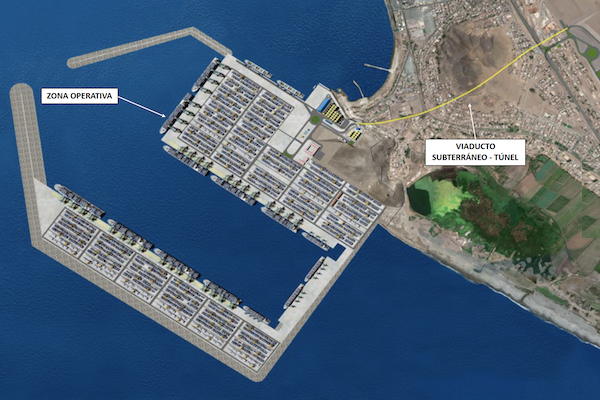
In the last two decades, Chinese investments have rapidly grown in Latin America across various sectors. In this context, the new Peruvian port of Chancay emerges as an important project for Beijing. At the same time, it represents an opportunity to enhance Peru’s strategic positioning, the regional implications of which will impact Chile.
- In 2019, the Chinese state-owned company Cosco Shipping Ports entered the Chancay Port project by acquiring 60% of the shares, while Glencore holds the remaining 40%. Cosco Shipping Ports is part of the Ocean Alliance group, which transports 40% of global cargo and has terminals in mainland China, Southeast Asia, the Middle East, Europe, South America, and the Mediterranean, managing 297 terminals in 37 ports.
- Chancay is not the first port investment by China in Latin America, but it is the first operated by them. It will be located 56 km north of Lima, in the province of Huaral. It aims to be an alternative to alleviate congestion at Callao, handling cargo coming from the east and the central highlands.
- Once completed, Huaral would become the gateway to Peru from Asia and, at the same time, a hub for commercial exchange to redistribute cargo to Ecuador, Chile, and Colombia. Its connection to the multimodal Amazonas axis of the northeastern bioceanic corridor linking Brazil with Peru will undoubtedly have undeniable local, national, and regional geopolitical impacts.
- With an investment of US$3 billion, a port and logistics complex is expected to be built, featuring two specialized terminals on 280 hectares. It will include bulk cargo, general cargo, and vehicle terminals, with four berthing fronts. Additionally, it will have a container terminal with 11 specialized docks for vessel servicing.
- Currently, the Chancay port is under construction for its first phase, which aims to have an initial general cargo dock operational in 2023. By 2024, the remaining sites are expected to be operational, with the challenge of moving one million TEUs (twenty-foot equivalent units) and 6 million tons of bulk cargo. This first phase involves an investment of US$1.3 billion.
- Chancay will provide users with facilities to expedite cargo handling, in addition to having a road interchange, a truck center, an administrative building, service buildings, a container area, a customs zone, facilities for the Maritime Police, and agricultural and livestock services.
- The opening of the Chancay Port project could impact trade flows to and from Chile, which is currently among the top five countries in Latin America and the Caribbean that moved the most cargo in containers (in TEUs) during 2019.
- If there is an expectation to compete with a complex that will receive post-Panamax vessels, it is necessary to realize the large-scale San Antonio port project, which will allow for the reception of larger vessels and, therefore, more cargo. Otherwise, national ports may be limited to the transit to and from Chancay.
- The Chancay port is a clear testament to the challenges Chile must navigate in its international development and positioning. Investments of this magnitude reconfigure the scenarios and the positions occupied by various actors. This seems to be well understood by Peru.