COMMENTARY | Prisons as Incubators of Crime
This article was translated automatically and may contain differences from the original. For reference, read the original.

Last year, in the chapter of the National Prosecutor’s Office’s Drug Trafficking Report, written by the Carabineros, we were warned about more than 500 gangs operating within the prison system, which—behind bars—continue their criminal activities. Today, we are talking about over 800. These gangs consist of both Chileans and foreigners, with the former being more numerous than the latter.
It is not new to discuss prisons as places where criminals learn new techniques and end up returning to society with more knowledge than when they entered. The established idea of the revolving door points somewhat to this. However, perhaps the most concerning aspect relates to the criminal power structures that establish themselves in prisons and can come to control them. In Latin America, there are numerous examples of this. Brazil, Venezuela, and Ecuador remind us daily how transnational organized crime groups have emerged within the prison system, controlling territory not only in their country of origin but also in other states.
A few weeks ago, we saw the emergence of the criminal gang “R7” in an Ecuadorian prison.[1]. They originated from an alliance with a group called “Los Lobos,” but soon managed to seize power and gain territorial control within the prison as their organizational structure solidified. Today, the new Ecuadorian criminal organization is being discussed, and they are blamed for the massacre in the Turi prison and another in a penitentiary facility in Santo Domingo de Tsáchilas.
The Ecuadorians are just the most recent. Between 2009 and 2010, another criminal organization emerged, which is now transnational and operates in Colombia, Peru, Bolivia, and Chile. We are referring to the Tren de Aragua, the Venezuelan megaband that has arrived in our country to change the criminal landscape and compel the state and Chileans to view security through a different lens. Led by Héctor Guerrero, alias “El Niño,” its center of operations is the Tocorón prison in the state of Aragua, Venezuela. Once again, the prison system appears as a cradle of transnational organized crime in Latin America.
Several years earlier, rather decades, in the last third of the 20th century, during the glory days of Colombian drug cartels, two groups emerged in Brazil that have since spread to various countries in the region. In 1979, the well-known Comando Vermelho emerged in the prison system of Rio de Janeiro, which, with over 20,000 members in that city, has extended its criminal business to Bolivia, Colombia, Paraguay, and Peru. Years later, in 1993, the Primeiro Comando da Capital (PCC) emerged in a prison in São Paulo, dedicated to drug trafficking. Today, it operates in 38 countries and has over 30,000 members.
Why should we pay attention to what is happening in those countries? Well, because Chile is not an exception in the Latin American criminal landscape. Transnational organized crime groups were bound to arrive sooner or later, and indeed they have. The Tren de Aragua, Sinaloa Cartel, Jalisco New Generation, Gulf Cartel, and Primeiro Comando Capital are just some of the Latin American organizations that have reached Chile, either directly or indirectly. We already have detained leaders from the first groups, and their methods have firmly established themselves both inside and outside our prisons. The problem: The integration with local gangs, the power they acquire within the criminal social pyramid, and the transfer of knowledge among inmates. Coercion is the means of exercising power, not only among the penal population but also among guards. Extortion and homicides are added to drug trafficking as part of the criminal menu. The challenge: To prevent our prisons from becoming the breeding ground for criminal groups.
THE NATIONAL PRISON LANDSCAPE
As of July 2022, there were a total of 127,036 individuals in the prison system. The closed subsystem records 47,707 inmates, of which 92.4% are men. Since February of this year, there has been an increase in the number of individuals entering the closed subsystem. Among the detained foreigners, Bolivians, Colombians, and Venezuelans are the most observed nationalities.
Figure 1: Summary of the population served by the closed subsystem
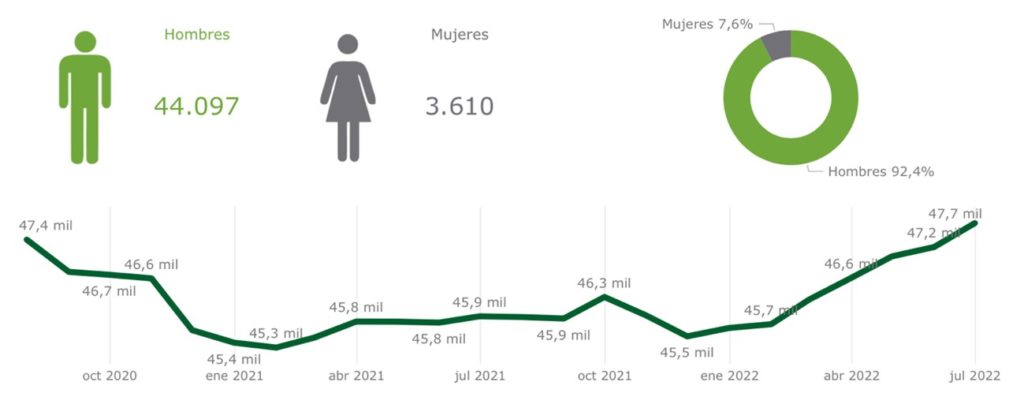
Source: Statistics from the Carabineros of Chile, https://www.gendarmeria.gob.cl/est_general.html
This context, despite being closed, cannot be dissociated from the social environment. The prison is another link in the public security chain and is vulnerable to being permeated by the free environment. An example of this is how crime behaves behind bars. When homicides increased nationally in 2020, the same happened in the prison system, which saw a 75% increase compared to the previous four years.
In the free environment, crime establishes itself where the state does not reach and exerts territorial control over neighborhoods. Inside the prison, it is not very different. The system of domination outside the walls replicates inside, and the prison system transforms into a “criminal business center” where the weakest are subjugated and killed or extorted for power.
This situation is not new; there has been ongoing discussion about what happens in prisons. But what happens when new elements arrive with transnational organized crime? We are no longer talking about the same territorial control or the same way of exercising power. Moreover, in a context where there is no segregation of the penal population, younger criminals will see those who arrive with an international criminal career as an opportunity to stand out in their social environment. Thus, a completely new system of control and domination will be established where common criminals will learn new techniques, and new criminal groups will form within the prison system. Who can say that if timely measures are not taken, national criminal gangs will not emerge that will internationalize and take control of the prisons?
This has already happened in other countries, and there are no exceptional cases unless concrete measures are developed that strengthen institutions and generate prison policies that are in line with the new criminal scenario that has forcefully emerged in Chile over the past year.
The work is not easy, but we can start by building integrated databases with all links in the public security chain, working in police cooperation with other law enforcement agencies, both in the Americas and worldwide. Building criminal profiles and gathering information that allows us to anticipate certain situations is essential. Essentially, we are talking about intelligence, a system of intelligence that provides information to all those involved in public security work.
To that system, we must additionally include the strengthening of institutions, specifically the Carabineros in this case. In a context where the prison is another link in the public security chain, its services cannot be left out of the strategies that are developed.
Another aspect to consider, which can be implemented immediately, relates to the segregation of the prison population and the reintegration of inmates. First-time offenders should not share a prison facility with repeat offenders, and the same applies to the types of crimes. Common criminals should be separated from those committing more socially significant crimes, such as homicides. In this way, the safety of detainees can be safeguarded, and coercion among prisoners can be made more difficult.
Segregation also allows for the integration of the prison with a reintegration system, especially for first-time offenders who have committed common crimes. Ultimately, the goal of all this is to prevent the prison from becoming a breeding ground for organized criminal gangs and to ensure a real reintegration process that reduces recidivism.
Finally, for the above to have real chances of success, the debate must take place with a transversal, state-oriented perspective, free from political trends. Security transcends governments; their responses must be long-term. Understanding the threat is fundamental, but equally important is knowing the capabilities that the state has to combat it. The prison situation is one of many dimensions where we must ask what the weaknesses and strengths are. Strengthening the latter and working to improve the former is essential. In this sense, reinforcing the Carabineros, segregating the prison population, and developing intelligence are measures that can be applied now and would contribute to making a difference in the future.
Pilar Lizana, researcher at AthenaLab
September 14, 2022
[1] https://www.eluniverso.com/noticias/ecuador/los-r7-banda-que-surgio-a-la-sombra-de-otras-organizaciones-criminales-esta-vinculada-por-tercera-vez-en-una-masacre-nota/