ANALYSIS | BRICS + Expansion Package
This article was translated automatically and may contain differences from the original. For reference, read the original.
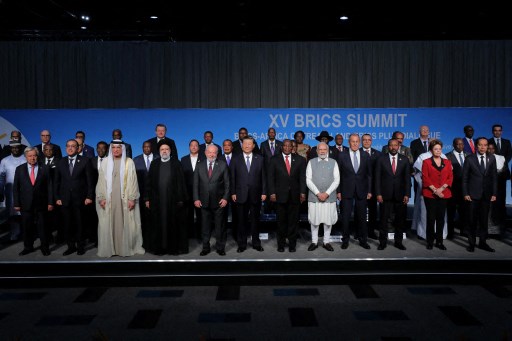
With one of its leaders absent due to fears of an arrest warrant from the International Criminal Court, the bloc of countries comprising Brazil, Russia, India, China, and South Africa (BRICS) announced on Thursday, August 24, a considered “historic” expansion by inviting Argentina, Egypt, Iran, Ethiopia, Saudi Arabia, and the United Arab Emirates to join, effective January 1, 2024.
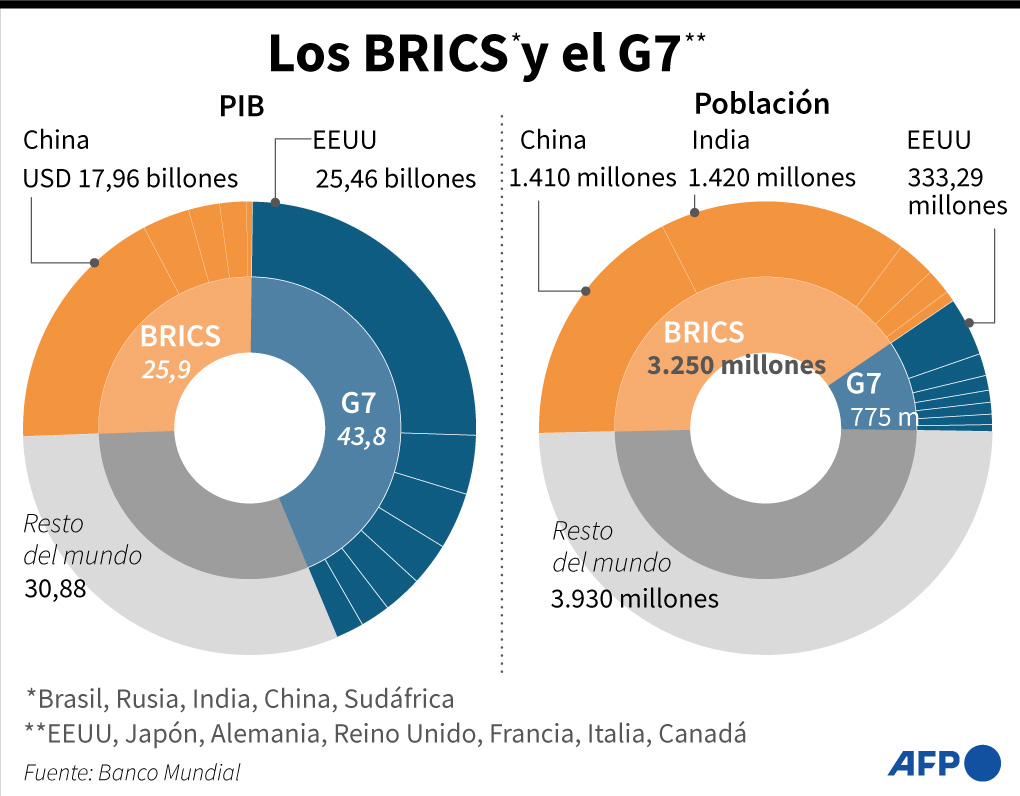
The last time this group, which accounts for 42% of the world’s population and 26% of global GDP, expanded was in 2011, when South Africa, which hosted the last summit in Johannesburg, joined the bloc. Although BRICS has experienced ups and downs, the interest of other nations in joining persists and even gains new momentum.
“BRICS is not a counterpoint to the G7 or G20 or against anyone. We want to organize ourselves as the Global South, something that did not exist before,” stated Brazilian President Lula da Silva on his social media account X. “We are important in the global debate, sitting at the negotiating table, on equal footing with the European Union (EU) and the United States,” he added.
His statements certainly align with the tone of the conference, which has not been very confrontational, aside from a few outbursts from Russian and Chinese officials. Heads of State and Government have emphasized that the bloc seeks to contribute “more diversity” to global governance and not add more competition to an increasingly polarized world. However, analyzing the agendas of the members and the new invitees reveals potential geopolitical implications.
“GLOBAL MAJORITY.” The summit convened by South African President Cyril Ramaphosa took place at a time when Russia is isolated from the West and allied countries due to its illegal and unprovoked invasion of Ukraine. The crimes committed by Vladimir Putin’s forces prevented him from traveling and forced him to participate virtually. Thus, his partners have provided him with a necessary diplomatic respite.
It is worth noting that China has a “limitless friendship” with Russia; India has not condemned its military aggression against Kyiv; Brazil seeks an improbable mediation between the parties, and South Africa remains silent.
In this context, Chinese President Xi Jinping took the opportunity at the summit to criticize “any country that imposes maximum sanctions,” at a time when export bans on advanced technology, asset freezes, and financial disconnections have become the preferred instruments of the United States, the EU, and other countries to punish revisionist powers. Ramaphosa also joined the calls for these tools not to be used as “instruments of geopolitical dispute.”
Putin has already announced that he would like the bloc to continue expanding, which is logical. That “global majority” he spoke of is very convenient for challenging the West and shaping his vision of a “multipolar world,” where his country is a respected power and not judged as irresponsible.
Among the new invitees to the club is Iran, a country that disrupts navigation in the oil shipping route of the Persian Gulf and is subject to diplomatic and economic pressures due to its missile and nuclear energy development program.
Although the bloc has a distinctly economic character, thinking that the economy will be separate from politics and security in a world marked by competition and conflict is a plausible intellectual exercise, but above all useful for countries that need partners and backing when they transgress international norms. Therefore, the expanded BRICS may seek to revive, at least in form, the spirit of the Non-Aligned Movement of the 1970s.
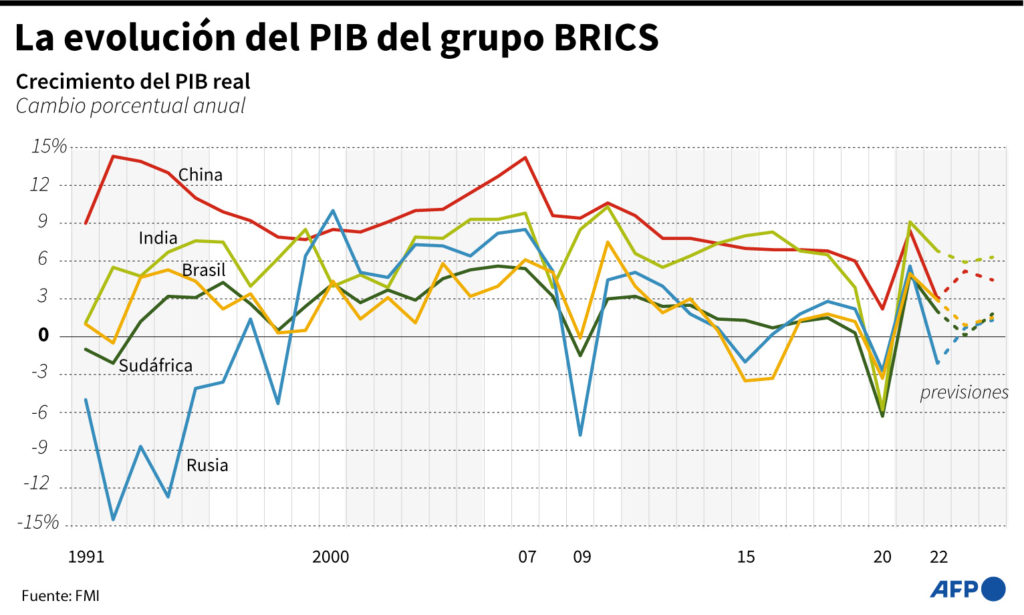
However, reviewing the bloc’s actions in recent years, it is quite clear that for Putin, the big winner of the day with his mere virtual intervention, and Xi, who faces an impending economic crisis, BRICS is a privileged vehicle to challenge the preeminence of the West under the convenient label of “Global South,” a concept fraught with political, geographical, and economic contradictions within it.
BRANDING. The acronym BRIC, which phonetically refers to “brick” in English (brick), was coined by Goldman Sachs economist Jim O’Neill in 2001 to highlight emerging economies that would surpass traditional developed ones over time in terms of their contribution to global GDP. That investment bank even created a “BRIC fund” to develop business in those countries.
The 2008 subprime crisis gave further momentum to emerging economies like Brazil, China, India, and Russia, as they questioned the fact that its epicenter was the financial system of the United States and the contamination it later produced worldwide. The first BRIC summit was held in 2009 in Yekaterinburg, where the group positioned itself as an original alternative to the G8 (at that time, Moscow was part of the industrialized nations. It would later be expelled in 2014 after the annexation of Crimea). The success of this acronym was such that others like CIVEATS (Colombia, Indonesia, Vietnam, Egypt, and South Africa) or PIIGS [1]
(Portugal, Italy, Ireland, Greece, and Spain) were later used to describe groups of countries that are attractive or risky from an economic perspective.Over time, only the BRICS group survives, which created an investment bank in 2015 and discussed in Johannesburg the implementation of a common reference currency for trade among them, although if implemented, it would not replace local currencies. Apparently, another attempt aimed at diminishing the hegemony of the US dollar from the now “BRICSAEIEASEUA?” ABOUT THE EXPANSION.
The more members a club has, the harder it is to reach consensus; just ask the 27 members of the European Union. Now, with BRICS expanded to 11 countries, the governance of the bloc will become more complex, especially since it includes nations that have commercial agreements but also strong antagonisms.
China and India, for example, sporadically confront each other in the Himalayas over border disputes, a conflict that leaves casualties in both armies. While Saudi Arabia and Iran may have resumed relations thanks to Beijing’s successful mediation, they remain indirectly opposed in Yemen and other Middle Eastern conflicts, where they subsidize opposing irregular forces. Moreover, Riyadh is a fundamental partner of the United States in the security framework of that region. The same applies to the United Arab Emirates and, to some extent, the military rulers of Egypt.
ARGENTINA ELECTIONS.
The surprising inclusion in BRICS was celebrated by President Alberto Fernández, as Argentina will now be “a protagonist of a common destiny in a bloc that represents more than 40% of the world’s population.” A manifest aspiration of the Kirchnerists has been fulfilled, although they did not even expect it, which is why they did not send the chancellor.
Now, this country is immersed in an electoral process whose outcome will be known in October. Center-right candidate Patricia Bullrich, who came in second in the primaries, stated that she will oppose the country’s integration into BRICS. She warned that this proposal comes at a time when the war in Ukraine is ongoing and questioned the inclusion of Iran, with which there is trauma due to its indirect involvement in attacks on national soil. Meanwhile, libertarian Javier Milei, who leads the polls, has stated that he will break with China if elected and will withdraw from Mercosur to distance himself from Brazil.
For all the above reasons, it is unclear whether Argentina will be part of this bloc, especially since a future leader could choose to play the G20 card, where it is already a member.
WHAT ABOUT CHILE?
As an open economy to the world with a network of free trade agreements that provide access to 85% of global GDP, BRICS should not arouse much concrete interest for Chile, although it may provoke some diplomatic and academic attention.
The Comprehensive and Progressive Agreement for Trans-Pacific Partnership (CPTPP), the Asia-Pacific Economic Cooperation (APEC) forum, and the Pacific Alliance are much more important structures where the country has contributed as a protagonist in writing the rules of 21st-century trade governance in its priority area of development.Juan Pablo Toro, Executive Director of AthenaLab August 24, 2023
Photo: France Presse
[1]
The “civeats,” or “civets” in Spanish, are small felines from tropical areas, while the word “piigs,” with the addition of an “i,” phonetically refers to “pig.”.