REVIEW | "Chile Taken," a Territorial Perspective on the Retreat of the State in Chile
This article was translated automatically and may contain differences from the original. For reference, read the original.

In “Chile Taken,” Iván Poduje (Santiago, 55 years old) presents an uncompromising diagnosis of the degradation experienced by the country due to four crises that, rather than simply adding up, seem to have multiplied each other: the migration crisis; the social outbreak; the pandemic; the rise in crime. A crisis to the fourth power, if you will, for which it is difficult to find a sense of opportunity, thus avoiding the common place, as it is understood.
Among the many merits of this book is the author’s testimony that arises from field visits, from the occupations in the north to the deteriorated centers of our cities. In the face of academic overdiagnosis, necessary but sometimes indulgent, here appears the brave decision to portray in situ the retreat of the state, which suggests that it does not seem to have anything spontaneous about it.
Thanks to georeferencing tools in the hands of the consulting firm atisba, the intersections between drug micro-trafficking, land occupations, harassment of police stations, and attacks on productive infrastructure are evident. To some extent, it is a very good continuation of “Siete Kabezas: Urban Chronicle of the Social Outbreak” (2020), also published by Uqbar.
Thus, for the first time, we are offered a panorama of the spatial distribution of violence, identifying its expansive and adaptive trends. Just as in nature, there is no possible power vacuum when the state retreats and cedes ground to criminal organizations. The maps presented are eloquent.
Now, the question that runs through the book is how did we get here? And the answer points to “self-segregation.” The elites living in bubbles of tranquility rarely had any notion of what was happening in the peripheries. They simply gradually reinforced their defense mechanisms with alarms, cameras, and guards. However, something similar occurred in the neighborhoods, albeit with fences and barbed wire. The double stratification of megacities, with their enclaves and ghettos, yields the same result: we all end up enclosed.
The problem is that unequal access to security, magnified by intra-urban stratification, is essentially undemocratic and calls into question one of the essential roles of the state, which is to guarantee the integrity of individuals and property. There is no doubt that the resulting insecurity has a profound cascading effect on the daily movements and interactions of people.
When Poduje speaks of a national security crisis, rather than public security, he points out that the institutions responsible for the latter have been overwhelmed, as evidenced by the deployment of military forces in the north and south to assist the police; what a paradox for this government and a lesson for its leaders, who bet on the demolition of the credibility of law enforcement and security forces as one of the paths to power.
Despite everything, it is true that Chile still presents one of the lowest crime rates in Latin America, a region that is extremely violent and accounts for 30% of the world’s homicides with only 8% of the global population. Therefore, it is not very useful to compare ourselves too much with the neighborhood, and it is better to focus on our own evolution over time and on the capacities we still have to correct the course.
In this sense, Poduje is correct when he proposes the development of a national security strategy—alongside a social integration strategy—that should be implemented by a new state security architecture that allows for genuine intelligence gathering, employs new surveillance technologies efficiently, and permanently articulates inter-agency cooperation.
This is an exercise, however, that requires both knowledge of the subject and precise political leadership—a point mentioned by the author—and a social consensus that allows for the prioritization of the crimes to be combated, identification of the costs to be incurred, and avoidance of simplistic hardline solutions, so characteristic of populism. Unfortunately, leadership and consensus are difficult to see these days.
The positive aspect is that thanks to “Chile Taken” by Iván Poduje, those who take on the task of reclaiming the space lost by a disorganized state in the face of organized crime have a unique situational panorama, a useful and indispensable tool that clearly indicates the red areas where efforts should be focused. Success will be measured by its reduction, failure by its expansion… our failure as a country.
Juan Pablo Toro, Executive Director of AthenaLab
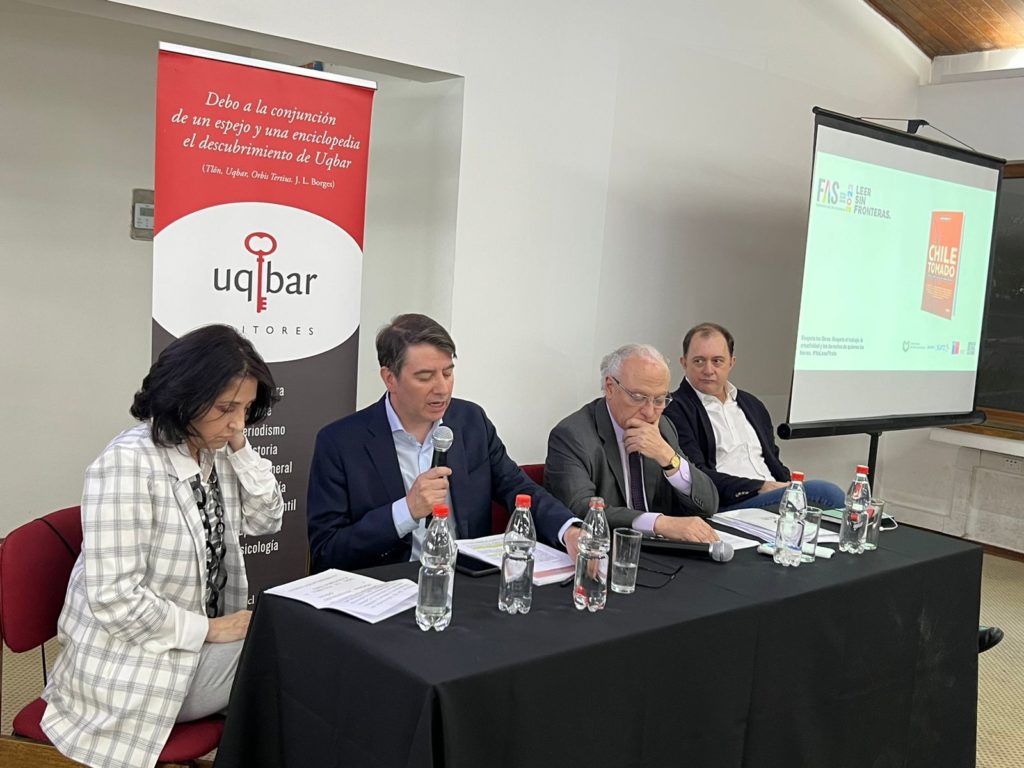
Presentation of the book “Chile Taken,” held on October 13, 2023